

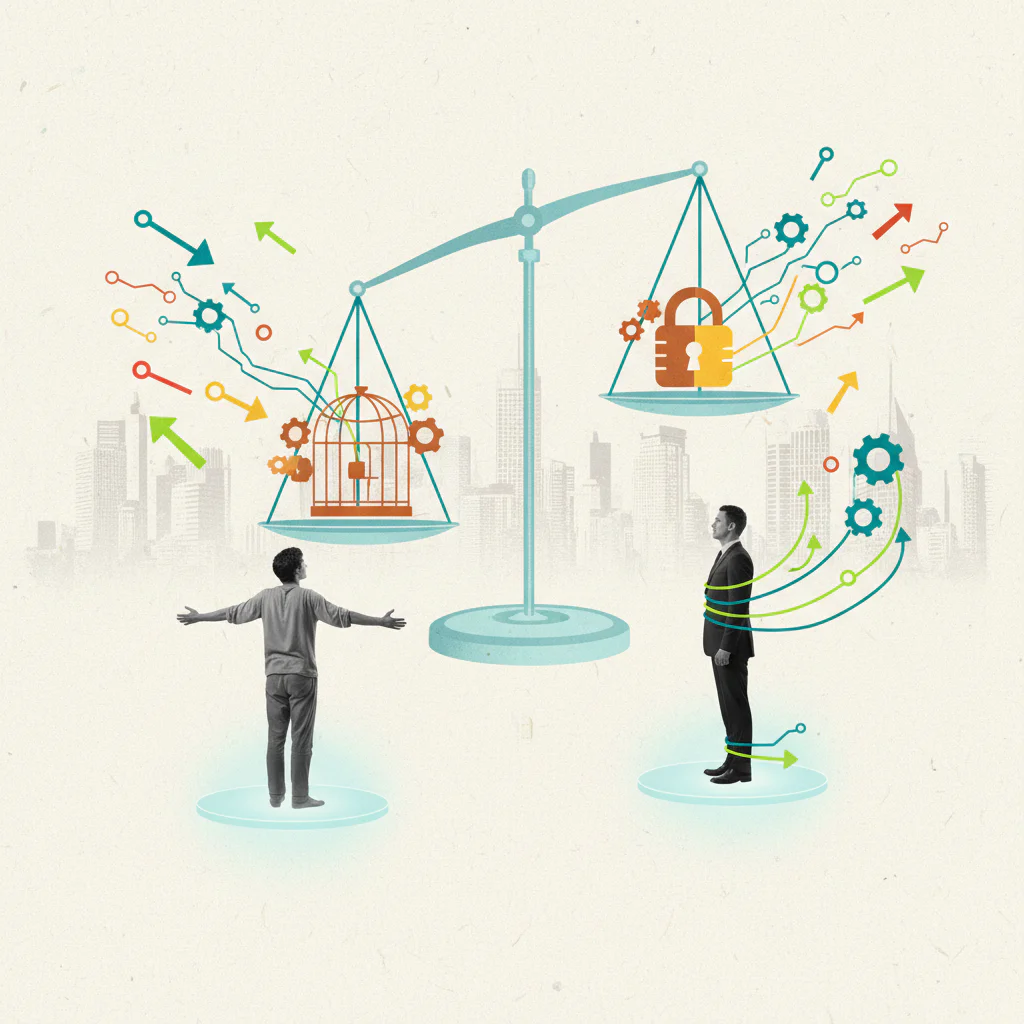
You want freedom to act, but also need clear rules—discover why the tension between autonomy and governance feels impossible to resolve.
Imagine a team that moves a product from concept to customer and somewhere in the middle the work stalls. The reason is not a missing spreadsheet or a broken tool but a quiet disagreement about who owns the next step and how the handoff is signaled. When a designer hands a prototype to engineering and the engineer assumes the design is final, the product lingers in limbo. When an external partner delivers data without a shared definition of completeness, the internal rhythm is thrown off. Those moments feel like a mystery you have lived through but never named. The tension between freedom to decide and the need for a common guardrail is the hidden engine that either propels a company forward or keeps it stuck. In the next section we will follow the path of a single decision and see how clarity can turn friction into flow.
What makes a handoff a moment of flow rather than a bottleneck
The moment a designer passes a prototype to engineering is a crossroads. If the two parties share a single definition of “ready” the work slides forward; if each holds a private checklist the project stalls. Imagine a kitchen where the chef plates a dish before the server knows the order is complete. The food sits, the table waits, frustration builds. The same principle applies to software, data pipelines and any collaborative chain. Clarity in the handoff removes guesswork and lets each role move with confidence.
A simple practice can seal the gap: a shared checklist displayed in a common space, whether a digital board or a physical whiteboard. When the designer marks “prototype approved” and the engineer sees the same signal, the transition becomes a single step rather than a debate. The cost of that alignment is a few minutes of conversation, but the payoff is a rhythm that feels inevitable.
How fairness perception can turn governance from control to collaboration
People do not respond only to rules; they respond to the sense that the rules are fair. When a governance model is seen as a blunt instrument, compliance drops and work slows. Conversely, when team members believe the guardrails reflect a balanced view of risk and reward, they internalize the standards and act proactively. A study from Taylor & Francis shows that fairness perception reshapes contractor behavior, turning oversight into partnership.
To harness that power, leaders must invite the people who will live under the rules into the rule‑making process. A brief workshop where engineers, designers and partners voice their concerns creates a shared narrative of fairness. The resulting policy feels less like a mandate and more like a contract that everyone signed, reducing friction and encouraging ownership of outcomes.
When spreading authority creates hidden silos and how to see them
Distributed governance promises agility by moving decisions closer to the work. In practice, however, each pocket of authority can develop its own language, metrics and incentives, forming invisible silos. A product team may sprint on feature velocity while the compliance group tracks risk exposure, and the two streams never intersect. The result is a company that appears decentralized but actually fragments its own purpose.
The first step to repairing the fracture is to surface the hidden boundaries. A cross functional map that plots who decides what, when and why reveals overlap and gaps. When the map shows that two groups are independently approving the same data set, a simple coordination point can be introduced. By aligning decision horizons, the organization regains a sense of unity while preserving the speed that distributed authority was meant to deliver.
What regulators really expect from autonomous distributed networks
Autonomous distributed networks sound like a rebellion against central control, yet regulators are watching closely. Their primary concern is not the technology itself but the accountability chain: who is responsible when a decision leads to harm? The SSRN paper on regulatory likelihood highlights three pillars – transparency, traceability and enforceable standards. Without these, even the most innovative network will face legal roadblocks.
Builders can meet those expectations by embedding audit logs that record every decision node and by publishing a clear governance charter. When an external partner queries the network, the charter explains how data is sourced, transformed and validated. This openness does not diminish autonomy; it simply provides the safety net that allows the network to operate at scale without triggering regulatory shutdowns.
The hidden handoff gap
When a handoff relies on a private checklist or an email thread, the point at which responsibility transfers is often ambiguous. The lack of a shared signal means each party may wait for confirmation that never arrives, leading to stalled execution and loss of visibility across the workflow. Informal coordination persists because teams default to familiar tools rather than a common system that records state and ownership centrally. A centralized work system provides a single source of truth for task status, ownership, and completion criteria, allowing every participant to see when work is truly ready to move forward. By embedding the definition of “ready” in the system itself, the handoff becomes a recorded event rather than a guess. Workhint serves as one example of such a centralized work system, linking execution data to clear ownership without relying on ad-hoc communication.
At the start we asked whether freedom can coexist with a shared guardrail. The journey shows that the answer is not a balance sheet but a conversation that makes the invisible handoff visible. When a team agrees on what ‘ready’ looks like, autonomy becomes the engine and governance the map. The quiet insight is that the real work of governance is not writing rules but inviting the people who will live by them to shape them. That invitation turns a potential bottleneck into a moment of flow and keeps hidden silos from forming. Carry this forward: ask your next handoff what signal would make it unmistakable, and watch the rhythm of your work settle into a steady pulse. The space between freedom and structure is where true progress lives.
Leave a Reply