

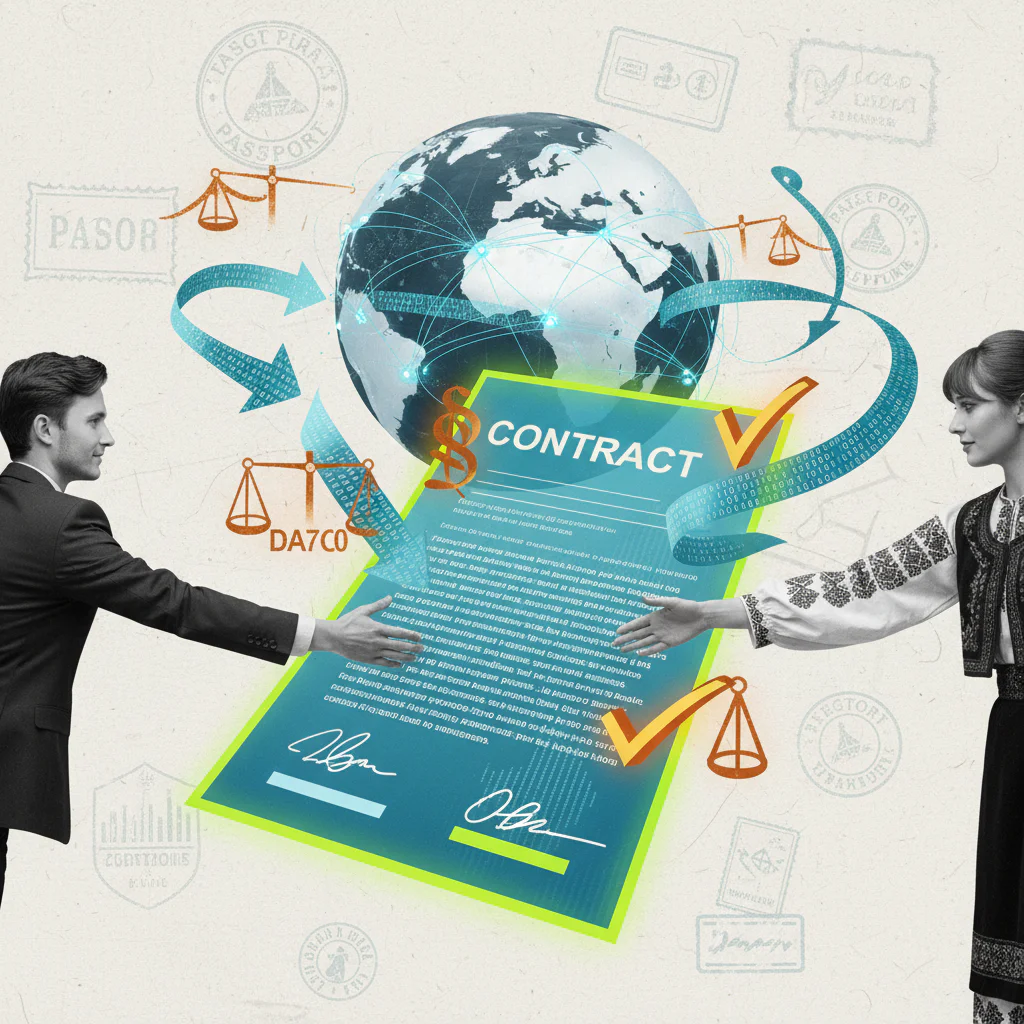
When teams span continents, the paperwork feels endless. Get clear on what a cross‑border contract really means.
Imagine a project that lives in three time zones, each team receiving a brief email that promises a deliverable by tomorrow. The promise arrives, the work is done, but the next group never sees the result because the handoff was a whisper, not a record. No one owns the gap, yet every meeting ends with the same question: who will pull the thread? This is not a failure of talent, it is a symptom of a system that treats work as a series of isolated tasks instead of a flowing conversation. When ownership evaporates at the edge of a contract or a sprint, visibility drops and the rhythm stalls. You have felt the frustration of chasing a missing piece that never appears, of watching a plan dissolve because the map was never shared. In the next section we look at how a simple shift in how we frame responsibility can turn those silent losses into a clear path forward.
Why decentralized dispute resolution matters for global agreements
When a contract stretches across continents the chance of a legal clash grows. Traditional courts sit in one jurisdiction and force parties to travel, translate and wait. A new model uses blockchain based arbitration that triggers automatically when a smart contract detects a breach. The research from the ASCE Library shows how these mechanisms embed settlement rules directly into the code, turning a dispute into a data point that can be resolved without a courtroom. For a product team this means a missed deadline no longer spirals into a costly legal battle; the system flags the slip, applies a pre agreed penalty and moves on. The real power is not in the technology alone but in the shift of mindset: treat conflict as a predictable event that can be programmed, not an unpredictable surprise.
How DAOs create legal wrappers to survive across borders
A decentralized autonomous organization like Aragon DAO faces the question of which law applies when members live in different countries. The answer lies in legal wrappers – entities such as limited liability companies that sit behind the code. By registering a wrapper in a jurisdiction with clear guidance on digital entities, the DAO gains a legal personality that can sign contracts, own assets and be sued. This structure separates the on chain governance from the off chain responsibilities, allowing the organization to operate globally while staying compliant. The Oxford Academic study highlights that such hybrids reduce friction for investors and partners, because they can rely on familiar corporate protections while still benefitting from the speed and transparency of blockchain voting.
What knowledge transfer looks like when decision rights are decentralized
In a franchise network or a multi‑site project the flow of information often stalls at the point where authority changes hands. The Springer Nature research explains that explicit knowledge transfer mechanisms – such as documented handoff templates, shared dashboards and regular sync rituals – keep decision rights clear even as teams disperse. Imagine a designer in Berlin finalising a UI mockup and uploading it to a shared board that automatically notifies the developer in Bangalore with a checklist of acceptance criteria. The developer can see who approved the design, what constraints exist and why certain choices were made. This transparency prevents the “I never got the memo” syndrome and lets each participant act with confidence, knowing the context behind every task.
How to embed smart contract triggers into everyday workflows
A smart contract is only as useful as the process that feeds it data. Start by mapping the critical milestones of a cross border project – proposal, approval, delivery, payment – and ask where a digital record could be generated automatically. Tools like workflow engines can listen for events such as a file upload or a status change in a project management system, then call the blockchain to lock in the new state. The result is a living contract that updates in real time, eliminating the need for manual signatures after each step. Teams that adopt this pattern report faster cycle times and fewer misunderstandings, because the contract itself becomes the single source of truth rather than a static PDF tucked away in an inbox.
Why the handoff often stalls
When work is passed between parties through ad‑hoc emails or separate spreadsheets, the moment of transfer is rarely captured in a shared record. Ownership therefore fades at the edge of each handoff, visibility drops, and subsequent steps wait for an implicit signal that may never arrive. The lack of a single source of truth means that each participant must rely on memory or personal follow‑up, which introduces delay and error. A centralized work system replaces those informal channels with a common layer where assignments, status updates, and approvals are logged in real time. By anchoring responsibility to a persistent object, the system makes gaps observable and ensures that every transition is traceable. Workhint serves as one example of such a centralized work system, providing the structural backbone that keeps work flowing without the need for manual coordination. The result is a steady stream of information that remains visible to all involved, reducing the chance that execution stalls unnoticed.
At the start we asked what it feels like when a promise vanishes between teams. The journey shows that the missing piece is not talent but the invisible thread that binds responsibility. When contracts become living conversations, every handoff is recorded, every pause is visible, and the system itself protects the work. The real shift is to treat ownership as a shared signal rather than a hidden handoff. From that perspective a global agreement stops being a maze and becomes a map you can follow without a compass. Carry that map forward: design your processes so the next person can see not only the what but the why, and the work will find its own rhythm.
Leave a Reply