


Freelancers scale capacity quickly, but only if every project has ownership, context, approval paths, and payment discipline.
Knowing how to manage freelancers across multiple projects is no longer a small team problem. Many companies now rely on external specialists for design, marketing, operations, engineering, research, implementation, and content. That can make execution faster, but it also creates a coordination layer that ordinary project management often misses.
The challenge is not just assigning tasks. It is keeping every freelancer clear on scope, protecting access, routing approvals, avoiding duplicate work, tracking performance, and making sure completed work turns into clean invoices and payments. The U.S. Bureau of Labor Statistics reported 11.9 million independent contractors in July 2023, and alternative work arrangements remain a meaningful part of the labor market. Upwork’s freelancing statistics also show strong participation among knowledge workers.
What’s in this article?
- A practical operating model for managing freelancers across projects.
- A workflow for intake, assignment, approvals, delivery, and payment readiness.
- A simple table for deciding what each project needs before work starts.
- Common failure points that create delays, rework, and invoice disputes.
- Where Workhint fits when freelancer coordination becomes a repeatable business system.
Why freelancer management breaks across multiple projects
Freelancer work breaks down when companies treat every project as a one-off relationship. One team uses email, another uses a spreadsheet, another keeps files in a shared drive, and finance only hears about the work after an invoice arrives. The freelancer may be doing good work, but the company has no consistent operating system around the work.
The bigger the freelancer bench, the more this matters. A missing brief can cause rework. Stale permissions can expose sensitive information. An unclear approval owner can delay launch. A late invoice review can damage the relationship with a reliable contributor. Managing freelancers well means designing the coordination system before the work becomes chaotic.
How to manage freelancers across multiple projects
The best approach is to manage freelancers through a lifecycle, not a loose list of tasks. Each project should move through the same basic stages: request, qualification, brief, assignment, access, kickoff, delivery, approval, payment, and closeout. Details can change by department, but the control points should stay consistent.
Start by separating three layers of information. The first layer is the freelancer profile: skills, location, agreement status, tax documentation, rate, preferred payment method, availability, and past performance. The second layer is the project record: scope, owner, deadline, deliverables, budget, access needs, review path, and payment terms. The third layer is the work activity: tasks, files, messages, milestones, approvals, changes, and invoice status.
When those layers are mixed together in email threads, companies lose visibility. When they are connected, managers can answer practical questions quickly: who is available, who owns the brief, which deliverables are late, which invoices are blocked, and who should be invited back.
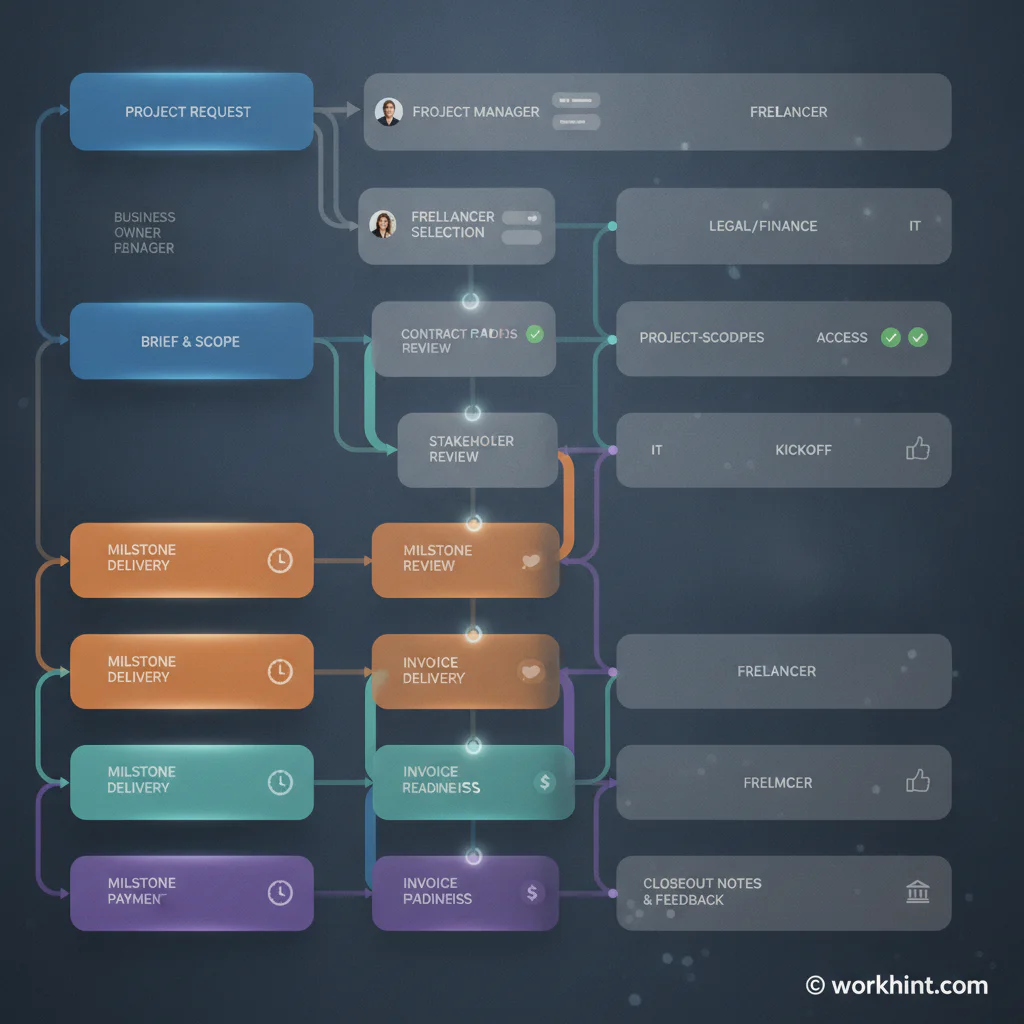
The freelancer management workflow
- Create one intake path. Every freelancer request should capture the business owner, project goal, needed skill, deadline, budget range, confidentiality level, and whether the work is new, recurring, or urgent.
- Confirm worker and contract readiness. Before assigning work, confirm the freelancer has the right agreement, statement of work, tax details, payment profile, and compliance status. For U.S. independent contractors, the IRS explains when businesses may need to report payments to independent contractors. Classification-sensitive questions should be reviewed with qualified counsel, especially because the Department of Labor maintains guidance on independent contractor classification under the FLSA.
- Assign a single internal owner. One person should own scope, decisions, feedback, and acceptance. Freelancers can work with multiple stakeholders, but they should not have to guess who can approve changes.
- Use a project brief, not scattered instructions. The brief should include deliverables, audience, examples, constraints, milestones, file locations, review dates, acceptance criteria, and what is out of scope.
- Grant only project-scoped access. Give freelancers the minimum access needed for the current work. Set review dates for access removal when a project closes or pauses.
- Define the review path before delivery. Decide who gives feedback, who approves final work, and how many review rounds are included. This prevents late-stage stakeholder surprises.
- Track payment readiness during the project. Do not wait for finance to resolve missing purchase orders, approvals, tax details, or milestone acceptance after the invoice arrives.
- Close the loop. At completion, record whether the freelancer delivered on time, met quality expectations, communicated well, followed scope, and should be considered for future work.
Freelancer coordination table
| Control point | What to define | Why it matters |
|---|---|---|
| Intake | Goal, skill need, budget, urgency, owner | Prevents vague requests from becoming unmanaged work |
| Brief | Deliverables, constraints, examples, acceptance criteria | Reduces rework and subjective feedback loops |
| Access | Systems, files, permissions, expiration date | Protects information while keeping the freelancer productive |
| Approvals | Reviewer, final approver, turnaround time | Keeps work from stalling between teams |
| Payment | Rate, milestone, invoice owner, required documentation | Avoids payment delays and freelancer frustration |
Common mistakes when managing freelancers
The first mistake is hiring before the work is defined. Freelancers move faster when the project has a clear outcome, not when they have to discover the operating model. The second mistake is allowing every department to invent its own process. Local flexibility is useful, but core controls should be shared.
The third mistake is separating performance from payment. If milestone approval is not connected to invoice readiness, finance becomes where operational gaps surface. The fourth mistake is keeping access open after the project ends. External work needs closeout: file handoff, credential removal, final approval, and relationship notes.
Where Workhint fits
Workhint fits when freelancer management needs to become a live operating system rather than spreadsheets, forms, and status meetings. A company can use Workhint to structure intake, define roles and permissions, collect documents, route approvals, assign work, track milestones, monitor payment status, and keep reporting connected to the freelancer lifecycle.
The point is not to make freelancers behave like employees. It is to give external contributors enough structure to do good work while giving the business visibility and control. For teams coordinating many freelancers across projects, Workhint can turn the workflow above into a repeatable system with clear ownership from request through closeout.
FAQ
What is the best way to manage freelancers across multiple projects?
The best way is to use a consistent lifecycle: intake, contract readiness, project brief, assignment, access, kickoff, delivery, approval, payment, and closeout. This keeps every project visible without forcing every freelancer into the same rigid task list.
Should freelancers use the company’s project management tools?
Usually yes, but only for the work they need to perform. Give project-scoped access, clear instructions, and an expiration point. Avoid giving broad access just because it is easier at kickoff.
How do you track freelancer performance without micromanaging?
Track outcomes instead of activity. Useful signals include deadline reliability, quality of deliverables, responsiveness, scope discipline, stakeholder feedback, and whether the freelancer is a good fit for future projects.
Who should approve freelancer work?
Each project should have one accountable internal owner, even if several people provide feedback. The owner should confirm acceptance criteria, resolve conflicts, and approve completion for payment.
What documents should be ready before freelancer work starts?
Depending on the relationship and jurisdiction, common documents include an agreement, statement of work, tax form, payment details, confidentiality terms, access approvals, and any required compliance documentation. Compliance-sensitive situations should be reviewed with legal, tax, or HR advisors.
Conclusion
Managing freelancers across multiple projects is an operations problem, not just a staffing problem. Companies need clear intake, scoped access, strong briefs, accountable approvals, performance records, and payment-ready workflows. Once those pieces are connected, freelancers can move quickly without forcing managers, finance, legal, or project owners to reconstruct the work after the fact.
The companies that get the most value from freelancers are the ones with the clearest operating system for external work.
Leave a Reply