


Use this PIP template to turn a hard performance conversation into a clear, documented, and fair improvement process.
A performance improvement plan template helps managers and HR document what needs to improve, what support will be provided, how progress will be measured, and what happens next. The goal is not to create paperwork for its own sake. The goal is to make expectations clear enough that the employee, manager, and company can work from the same facts.
This resource is for business teams that need a practical PIP structure they can adapt with HR or legal review. It is not legal advice, and sensitive employment decisions should be reviewed against company policy, applicable law, and the specific facts involved.
What’s included
- A performance improvement plan template you can adapt.
- A checklist for deciding whether a PIP is the right tool.
- A table of owners, timing, and outputs.
- Example language for expectations, support, check-ins, and outcomes.
- Common mistakes that make PIPs vague, inconsistent, or unfair.
When to use a performance improvement plan
A PIP is usually appropriate when an employee is missing clear job expectations and there is a reasonable opportunity to improve. SHRM describes a PIP as a tool that gives an employee with performance deficiencies an opportunity to succeed while documenting the process. That means the plan should be specific, realistic, time-bound, and tied to work outcomes the employee can influence.
A PIP is usually not the right first step for every issue. Serious misconduct, safety concerns, harassment, fraud, or policy violations may require a different process. A PIP also should not be used as retaliation, a surprise termination form, or a substitute for regular management. The EEOC’s retaliation guidance is a useful reminder that adverse employment actions and documentation decisions need consistency and care when protected activity may be involved.
How to use this resource
Start by collecting objective examples. Do not write “poor attitude” or “not a team player” unless you can translate the concern into observable work behavior. For example, use missed deadlines, incomplete handoffs, recurring quality issues, customer complaints, or failure to follow an agreed process.
Then decide whether the employee has the role clarity, tools, training, manager availability, and workload conditions needed to improve. If the company has not provided basic support, fix that before turning the issue into a formal plan. SHRM’s guidance on effective PIPs emphasizes specific incidents, clear improvement instructions, reasonable goals, and ongoing follow-up.
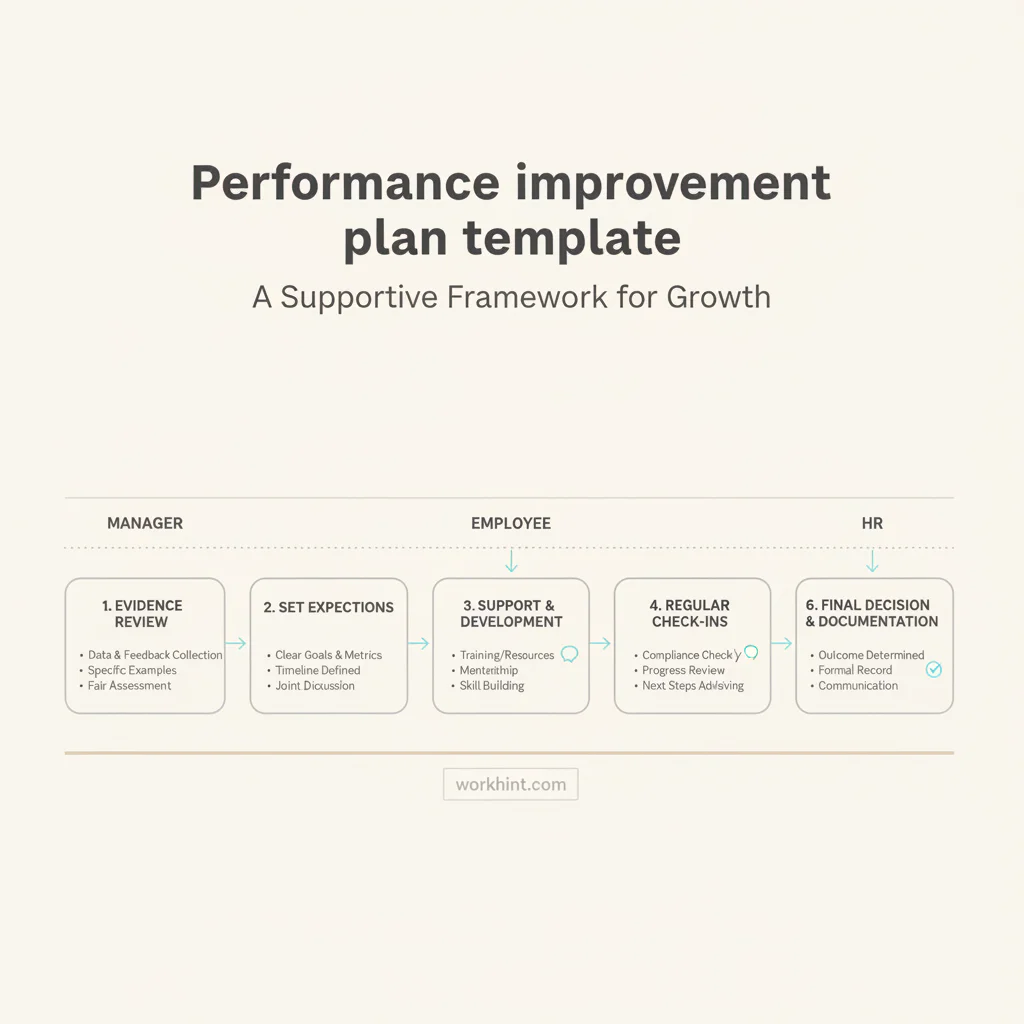
Performance improvement plan template
| Section | What to write | Owner |
|---|---|---|
| Employee and role | Name, job title, manager, department, start date of the plan, and review period. | HR |
| Performance concern | The specific gap between expected performance and actual performance, with dates or examples. | Manager |
| Expected standard | The clear standard the employee must meet, tied to role duties, policies, goals, or service levels. | Manager |
| Improvement actions | The actions the employee must take, written as measurable behaviors or deliverables. | Manager and employee |
| Company support | Training, coaching, examples, documentation, access, workload adjustments, or tools provided. | Manager and HR |
| Check-in cadence | Weekly or biweekly meetings, evidence to review, notes to keep, and who attends. | Manager |
| Timeline and outcomes | Plan length, decision date, possible outcomes, and next steps if expectations are or are not met. | HR |
Example PIP language
Performance concern: Over the last six weeks, three client implementation milestones were delivered after the agreed deadline: May 12, May 26, and June 9. Two of those delays were not escalated until the day the milestone was due, which created rework for the customer success and operations teams.
Expected standard: Implementation milestones must be delivered by the agreed due date or escalated at least two business days before the deadline with a revised plan, owner, and dependency list.
Improvement actions: For the next 45 days, the employee will update the implementation tracker every Monday by 12 p.m., flag at-risk milestones during the weekly project review, and submit client-ready deliverables by the agreed deadline unless a manager-approved change is documented.
Company support: The manager will review the milestone plan each Monday, provide examples of acceptable escalation notes, and remove or reprioritize conflicting work where the employee identifies a valid capacity issue before the deadline.
Check-ins: The manager and employee will meet every Friday for 30 minutes to review completed milestones, blocked work, escalation quality, and next week’s risk items. HR will review notes at the midpoint and before the final decision.
PIP checklist before you send it
- Is the performance issue specific and supported by examples?
- Is the expected standard clear enough that another manager would understand it?
- Are the improvement actions measurable?
- Can the employee reasonably complete the plan within the timeline?
- Does the plan explain what support the company will provide?
- Are check-ins scheduled before the plan starts?
- Has HR reviewed the plan for consistency with policy and past practice?
- Does the plan avoid loaded language, assumptions, or personality judgments?
Common mistakes
The first mistake is writing a PIP that sounds specific but cannot be measured. “Improve communication” is too vague. “Send a written status update by 3 p.m. every Thursday covering status, risks, decisions needed, and next milestone” is usable.
The second mistake is treating the PIP as a termination script. If the decision has already been made, the plan is not really an improvement plan. That creates trust, documentation, and legal risk. The third mistake is leaving HR out until the end. HR should help check consistency, language, timing, accommodation considerations, and whether similar cases have been handled similarly.
The fourth mistake is failing to document support. A fair plan does not only list what the employee must do. It also records what the manager and company will do to make improvement possible.
Where Workhint fits
Workhint helps when a performance improvement plan needs to become a managed workflow instead of a document sitting in a folder. A business can use Workhint to define the PIP intake, assign manager and HR roles, route the draft for review, schedule check-ins, collect evidence, track support commitments, document decisions, and keep the process visible to the right people.
That matters because PIPs often fail operationally, not because the template is missing. The plan gets written, but check-ins are missed, support actions are not tracked, notes live in different places, and the final decision lacks a clean record. Workhint can turn the template into a repeatable workflow with owners, permissions, reminders, documents, approvals, and reporting.
FAQ
How long should a performance improvement plan last?
Many PIPs run for 30, 45, 60, or 90 days, depending on the role and the issue. The timeline should be long enough for meaningful improvement but short enough that the business can review progress clearly.
Who should write a PIP?
The manager should write the performance facts and expectations, HR should review the structure and consistency, and the employee should have a chance to discuss the plan and ask clarifying questions.
Should a PIP include consequences?
Yes, but the language should be clear and professional. It should explain possible outcomes, such as successful completion, extension, role change, further action, or separation, depending on company policy and the facts.
Can a PIP be positive?
It can be constructive, but it is still a formal document. Keep the tone direct, factual, and supportive. Avoid sugarcoating the seriousness of the issue.
Conclusion
A strong performance improvement plan template creates clarity before the conversation gets emotional. It names the issue, defines the standard, sets measurable actions, documents support, schedules check-ins, and gives HR a clean way to review consistency. Use the template as a starting point, adapt it to the role, and manage the plan like a real workflow from the first conversation to the final decision.
Leave a Reply