


A useful contractor talent pool is not a contact list; it is a ready-to-activate operating record.
Contractor talent pool management is the process of organizing known freelancers, contractors, consultants, specialists, and external workers so the business can reuse trusted people without starting from zero. It sits between sourcing and assignment: the company knows the person, but still needs current skills, availability, rates, documents, approval status, risk notes, and performance history.
That matters because external talent is not a simple recruiting backup. The Bureau of Labor Statistics tracks alternative work arrangements such as independent contractors, on-call workers, temporary help agency workers, and contract firm workers in its contingent and alternative arrangements FAQ. The operational question is how to keep external capacity organized without creating a shadow workforce.
Why contractor talent pool management matters
A contractor talent pool helps teams move faster when a project, location, campaign, customer, event, or service line needs outside capacity. Instead of asking every manager who they know, the business can search by skill, location, availability, rate, prior work, compliance status, and project fit.
The risk is that a pool can look useful while being stale. A freelancer may have changed rates, moved, lost availability, taken a full-time role, let insurance expire, or completed work that should affect future assignments. The pool needs enough structure to support reuse, not just enough names to feel full.
SmartRecruiters describes a talent pool as a database of potential candidates who may be qualified or interested in future work. For contractor operations, add one rule: the pool must show whether someone is ready for the next assignment under today’s scope, documents, rates, and approval requirements.
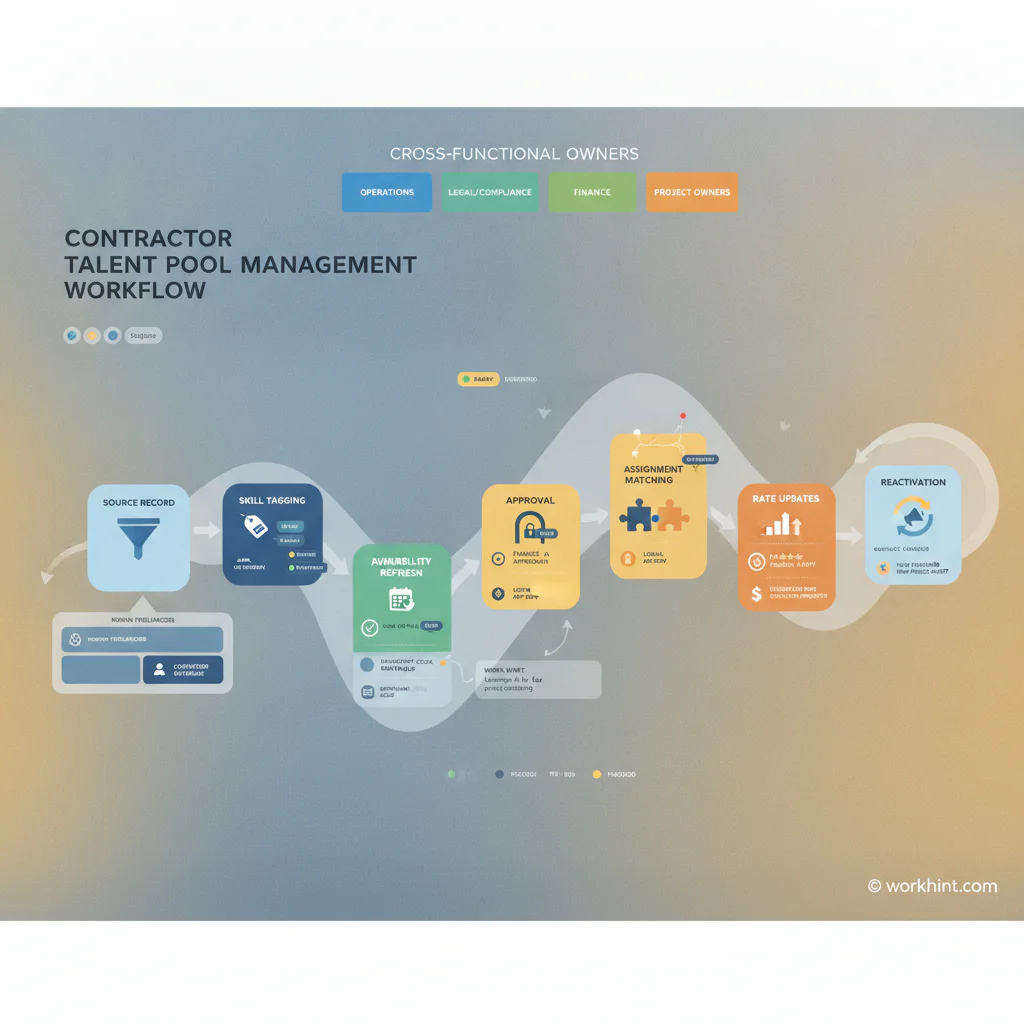
Contractor talent pool management workflow
The best workflow is lightweight but strict about ownership. Separate the pool record from the assignment record. The pool record says who the contractor is and what they are approved for. The assignment record says what work they are doing now, under which terms, with which access, evidence, and payment rules.
- Create the source record. Add the contractor, referral source, location, work category, skills, portfolio, and relationship owner.
- Tag fit signals. Capture role type, industries served, languages, certifications, timezone, location constraints, and tools.
- Set readiness status. Mark whether the person is new, screened, approved, active, paused, unavailable, expired, or needs review.
- Attach requirements. Track agreement status, tax form status, insurance or license requirements, safety checks, and access constraints.
- Refresh availability and rates. Use a recurring cadence for high-value contractors before work becomes urgent.
- Match against real work. Compare scope, risk, rate, location, availability, and approval status against the request.
- Record performance evidence. Capture accepted deliverables, feedback, issue notes, payment exceptions, and reuse status.
- Reactivate with approval. Confirm the pool record is current and route exceptions before work starts.
What to track in a contractor talent pool
Do not overbuild the database. Track the fields that change assignment decisions, approval routing, compliance review, or payment setup.
| Pool field | Owner | Why it matters | Update rule |
|---|---|---|---|
| Skills and work category | Operations or project owner | Supports faster matching to real work. | Update after each completed project. |
| Availability and location | Talent or operations owner | Prevents stale outreach and missed deadlines. | Refresh every 30 to 90 days for priority contractors. |
| Approved rate or range | Finance or business owner | Controls budget and invoice expectations. | Review before new scope or renewal. |
| Agreement and document status | Legal, HR, or compliance | Shows whether work can start safely. | Refresh when documents expire or scope changes. |
| Access risk and system needs | IT or security | Limits permissions to the work required. | Review for each assignment. |
| Performance and reuse notes | Project owner | Turns experience into better future matching. | Record at closeout. |
How to keep the pool useful
Use segments instead of one large list. A practical pool may have active contractors, priority alumni, specialists, backup capacity, agency-supplied workers, field providers, and people who need review before reuse.
Set a refresh cadence by value and risk. High-value contractors may need monthly or quarterly availability checks. Low-use specialists may only need a six-month check-in. High-risk roles should have stricter document, access, and approval refresh rules.
Keep classification separate from enthusiasm. A manager may love working with a contractor, but that does not answer whether the engagement is still properly structured. The Department of Labor warns that misclassification of employees as independent contractors can deny workers legal protections and create risk. Pool records should prompt review when scope, control, duration, location, or supervision changes. This is not legal advice; sensitive classification decisions need qualified review.
Make reactivation a workflow. Reusing a contractor should be faster than sourcing a stranger, but it should not bypass approvals. Before work starts, confirm availability, scope, rate, documents, access, and payment readiness.
Common contractor talent pool mistakes
The first mistake is confusing sourcing with management. Direct sourcing finds external talent. Contractor talent pool management keeps known talent usable after the first interaction. If the pool does not hold status, readiness, rates, history, and approval context, it is only a recruiting list.
The second mistake is making the pool too private. If one manager owns the spreadsheet, the business loses visibility when that manager leaves. Use clear permissions, but let operations, finance, legal, IT, and project owners see the fields they need.
The third mistake is over-contacting people without real work. A pool gets weaker when every update feels generic. Contact contractors with practical context: work category, likely timing, skill need, location, rate assumptions, or a short availability refresh.
The fourth mistake is treating past approval as permanent. Approval should follow the work, not just the person.
Where Workhint fits
Workhint fits when contractor talent pool management needs to become a working system instead of a spreadsheet of names. A business can use Workhint to create contractor profiles, capture skills and availability, route document and classification reviews, define approved work categories, assign role-based access, match contractors to requests, track status, collect deliverable evidence, and connect accepted work to invoice or payout readiness.
The value is making the pool operational: managers can find trusted people, compliance owners see what needs review, finance can see rate context, and contractors can be reactivated without scattered follow-up.
FAQ
What is contractor talent pool management?
Contractor talent pool management is the process of organizing, updating, and reactivating known freelancers, contractors, consultants, and external workers so they can be matched to future work with current skills, availability, rates, documents, and approval status.
How is a contractor talent pool different from a recruiting pipeline?
A recruiting pipeline usually tracks candidates moving toward a role. A contractor talent pool tracks known external workers who may be reused across projects, assignments, locations, or services. It needs operational fields such as readiness, approved scope, access limits, rates, and performance history.
How often should a contractor talent pool be updated?
Update active or high-priority contractors every 30 to 90 days. Update lower-priority contractors before outreach or assignment. Refresh records when scope, location, access, rate, compliance requirements, or availability changes.
Who should own contractor talent pool management?
Operations or talent teams often coordinate the pool, but ownership is shared. Project owners confirm skills and performance, finance reviews rates and payment terms, legal or HR reviews classification and documents, and IT or security reviews access risk.
What should be tracked before reactivating a contractor?
Track availability, scope fit, approved rate, agreement status, tax or payment setup, required insurance or licenses, access needs, prior performance, document expiration, and whether the new work needs classification or compliance review.
Conclusion
Contractor talent pool management gives businesses a practical way to reuse trusted external people without rebuilding the search every time work appears. The useful version is a living operating record that connects skills, availability, rates, approvals, documents, access, performance, and reactivation. When that record is current, teams can move faster while keeping outside work visible and easier to scale.
Leave a Reply