


A good invoice approval workflow protects cash, speeds up payments, and keeps every approval decision traceable.
An invoice approval workflow is the process finance teams use to receive, verify, route, approve, schedule, and archive vendor invoices before money leaves the business. It is where procurement intent, department ownership, budget control, tax documentation, fraud prevention, and vendor relationships meet.
For small teams, approval often starts in email. A vendor sends a PDF, someone forwards it to a manager, finance follows up twice, and payment depends on who remembered the thread. That breaks as the company adds more vendors, contractors, locations, departments, projects, payment terms, or approval limits.
What’s in this article?
- The core steps of an invoice approval workflow.
- A practical approval matrix finance teams can adapt.
- How to handle exceptions before they delay payment.
- Controls that create a cleaner audit trail.
- Where Workhint fits when invoice approval depends on vendors, owners, documents, and payment status.
Why invoice approval workflow matters
Invoice approval is not just an accounts payable task. It is a control point. Before payment, the business needs to know whether the vendor is approved, the invoice is real, the work was received, the amount is correct, the budget owner accepts the charge, and the payment is allowed under policy.
It also affects vendor trust. Slow approvals create missed due dates, duplicate follow-ups, and emergency payment runs. Loose approvals create a different problem: finance pays invoices without enough evidence. The right workflow should do both jobs at once. It should move clean invoices quickly and stop questionable invoices early.
Vendor setup is part of the workflow too. The IRS explains that Form W-9 is used to provide a correct taxpayer identification number to the person required to file an information return. The IRS instructions for requesters of Form W-9 explain why a properly completed and signed form matters for backup withholding. Finance should not discover missing vendor documentation after approval.
A practical invoice approval workflow
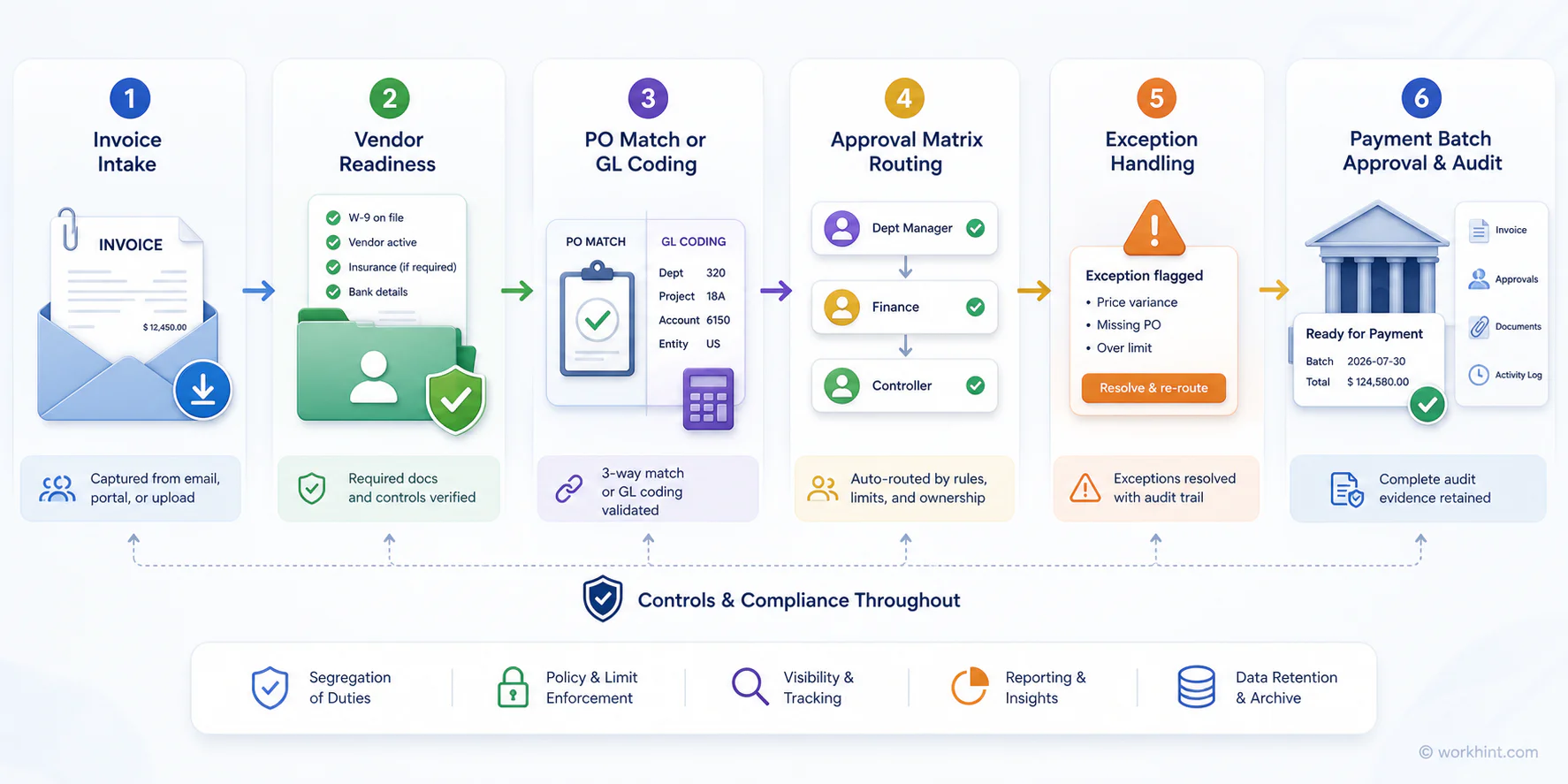
The best invoice approval workflow is simple enough for departments to follow and strict enough for finance to trust. A practical version looks like this:
- Receive and log the invoice. Capture the vendor, invoice number, amount, date, due date, purchase order, department, project, and payment terms.
- Check vendor readiness. Confirm the vendor is approved, payment details are current, tax forms are complete when required, and there are no open compliance blocks.
- Validate the invoice. Check for duplicates, math errors, missing line items, wrong legal entity, wrong currency, unexpected tax, or suspicious bank changes.
- Match or code the invoice. PO invoices should be matched against purchase orders and receipts. Non-PO invoices need GL coding, department ownership, and business justification.
- Route approval by policy. Send the invoice to the right budget owner, project owner, procurement owner, or executive based on amount, category, vendor, and exception status.
- Resolve exceptions. Hold invoices with missing evidence, disputed work, price variance, unapproved vendors, or policy issues until the owner provides a decision.
- Schedule payment. Approved invoices move into the payment batch based on due date, cash plan, discount terms, and release authority.
- Archive the evidence. Store the invoice, approvals, exception notes, payment confirmation, vendor record, and related documents in one place.
The sequence is important. Do not route every invoice for manager approval before finance checks basic readiness. Approvers should decide business legitimacy, not clean up missing vendor records or obvious duplicates.
Invoice approval matrix
An approval matrix removes guesswork. It tells finance who approves what, when a second approval is needed, and which invoices should pause before payment.
| Invoice type | Primary approver | Finance check | Escalation trigger |
|---|---|---|---|
| PO-backed vendor invoice | Requester or receiving owner | PO, receipt, amount, terms | Price or quantity variance |
| Non-PO service invoice | Department budget owner | GL code, business purpose, vendor status | No owner, unclear scope, missing contract |
| Contractor invoice | Project owner or operations lead | Work evidence, tax form, payment details | Missing deliverable or unapproved rate |
| High-value invoice | Budget owner and executive approver | Policy limit, budget, supporting documents | Above threshold or outside budget |
| Bank detail change | Finance lead | Independent vendor verification | Any new or changed payment instruction |
Thresholds should match the business. A startup may need executive approval above a few thousand dollars. A larger operation may route by department, entity, location, project, and vendor type. The principle is the same: approvals should follow risk and ownership.
Exception paths finance teams should define
Most invoice delays come from exceptions, not clean invoices. Build exception paths before volume increases.
- Missing W-9 or vendor tax information: Hold payment setup until vendor documentation is complete and reviewed.
- Duplicate invoice number: Block payment until finance confirms whether the duplicate is a correction, credit, or accidental resubmission.
- Amount does not match the PO: Route to procurement or the requester for variance approval.
- Work not confirmed: Send to the operational owner with the contract, service dates, and delivery evidence.
- Approver does not respond: Escalate after a defined number of business days, especially when a payment discount or due date is at risk.
- New bank details: Use a separate verification process before payment release.
Each exception needs an owner, a status, a deadline, and an outcome. Without that structure, exception queues become a hidden backlog.
Controls that make approval audit ready
Finance teams should design invoice approval so the audit trail is created while work happens. The IRS says business records should support income, deductions, and credits. Invoice evidence should therefore be easy to retrieve, not reconstructed after the fact.
A clean control file includes the original invoice, vendor record, PO or contract, receiving confirmation, approval history, exception notes, payment batch, and payment confirmation. For sensitive workflows, the business should also separate duties. The person requesting work should not be the only person approving payment release, and bank changes should not be approved through the same path as routine invoices.
Fraud control matters because invoice fraud often uses false representation, concealment, or abuse of trust. The Association of Certified Fraud Examiners describes fraud in those terms, which is why approval workflows need evidence, not just speed.
Where Workhint fits
Workhint helps teams turn invoice approval from scattered messages into a connected work system. Finance can map vendor intake, document collection, invoice submission, role-based approvals, exception routing, payment status, reminders, and reporting into one operating flow. For contractor-heavy finance operations, a contractor payment platform can connect rates, invoices, approvals, payout status, global payments, and reconciliation.
That is especially useful when invoice approval touches external vendors, contractors, agencies, project owners, procurement, and finance. Workhint is not replacing the accounting ledger. It helps structure the human and operational workflow around the invoice so the right people see the right work, the right evidence is attached, and finance has a clear path from request to approval to payment readiness.
FAQ
What is an invoice approval workflow?
It is the process a business uses to review, route, approve, schedule, and archive invoices before payment. It defines who approves each invoice and what evidence is required.
Who should approve invoices?
The budget owner or operational owner should approve business legitimacy. Finance should verify vendor readiness, payment details, policy compliance, and payment timing.
Should every invoice need approval?
Not necessarily. Low-risk recurring invoices may follow lighter rules if the vendor, contract, amount, and payment terms are already approved. Exceptions and high-value invoices need stronger review.
What causes invoice approval delays?
Common causes include missing vendor documents, unclear ownership, PO mismatches, disputed work, no approval deadline, and approvals handled through email threads.
Conclusion
An invoice approval workflow should make payment decisions faster, clearer, and easier to defend. Start with a simple intake process, define vendor readiness checks, route invoices by ownership and risk, create exception paths, and keep approval evidence attached to the invoice. Once the workflow is clear, automation becomes much easier because the system is supporting a real operating model instead of masking a messy process.
Leave a Reply