


A mileage form works only when every trip, rate, approval, and payment handoff is captured before reimbursement.
A mileage reimbursement form template gives employees, managers, HR, and finance one consistent way to document business driving before money is paid back. It should capture the trip, business purpose, mileage rate, reimbursement amount, approval owner, and payment status without forcing every request into a long expense report.
This resource is for business teams that reimburse employees, contractors, field staff, sales reps, service providers, or managers who use a personal vehicle for approved work travel. It is not tax or legal advice. Mileage rules and reimbursement treatment can vary by country, state, worker type, and policy design, so review sensitive language with finance, payroll, or counsel before adopting it.
What is included
- A copy-ready mileage reimbursement form template.
- A field-by-field guide for what each section should capture.
- A simple approval workflow from trip submission to payment.
- A practical example for a client-site visit.
- Common mistakes that cause reimbursement delays or weak records.
- FAQ for HR, finance, managers, and operations teams.
How to use this mileage reimbursement form template
Use the form whenever a worker drives a personal vehicle for approved business purposes and the company reimburses mileage instead of paying actual vehicle costs. Common use cases include client meetings, field visits, supply pickup, temporary site coverage, local errands for a project, and travel between approved work locations. Ordinary commuting is usually handled differently, so define that boundary in your expense policy.
Before the form goes live, choose the mileage rate, approval thresholds, submission deadline, payment method, and records owner. The IRS standard mileage rates page is the reference many U.S. businesses use when setting reimbursement or deduction assumptions. As of August 1, 2026, the IRS page lists 76 cents per mile for business use for July 1 through December 31, 2026. Federal government travel has its own POV reimbursement rules, and the GSA POV mileage page lists current federal rates. Private employers should set and document their own policy rather than assuming every public rate automatically applies.
Mileage reimbursement form template
| Section | Fields to include | Business note |
|---|---|---|
| Worker details | Name, employee or contractor ID, department, manager, email | Connect the request to the right worker record and approval owner. |
| Trip details | Date, starting location, destination, business purpose, project or client | Make the purpose specific enough that finance can understand why the trip was needed. |
| Mileage | Starting odometer, ending odometer, total miles, personal miles excluded | Use the same method consistently. If GPS tracking is used, keep the route record or export. |
| Rate and amount | Approved rate, reimbursement formula, total reimbursement | Show the math so the approver does not have to recalculate from scratch. |
| Supporting records | Receipts for tolls or parking, calendar invite, work order, visit note, client approval | Mileage may not need a fuel receipt, but the business purpose still needs evidence. |
| Approval | Manager decision, finance review, exception reason, approval date | Separate operational approval from payment review when the amount or policy risk is high. |
| Payment record | Payment method, payroll or AP batch, payment date, status, notes | Close the loop so workers do not chase reimbursement across email and spreadsheets. |
Mileage reimbursement workflow
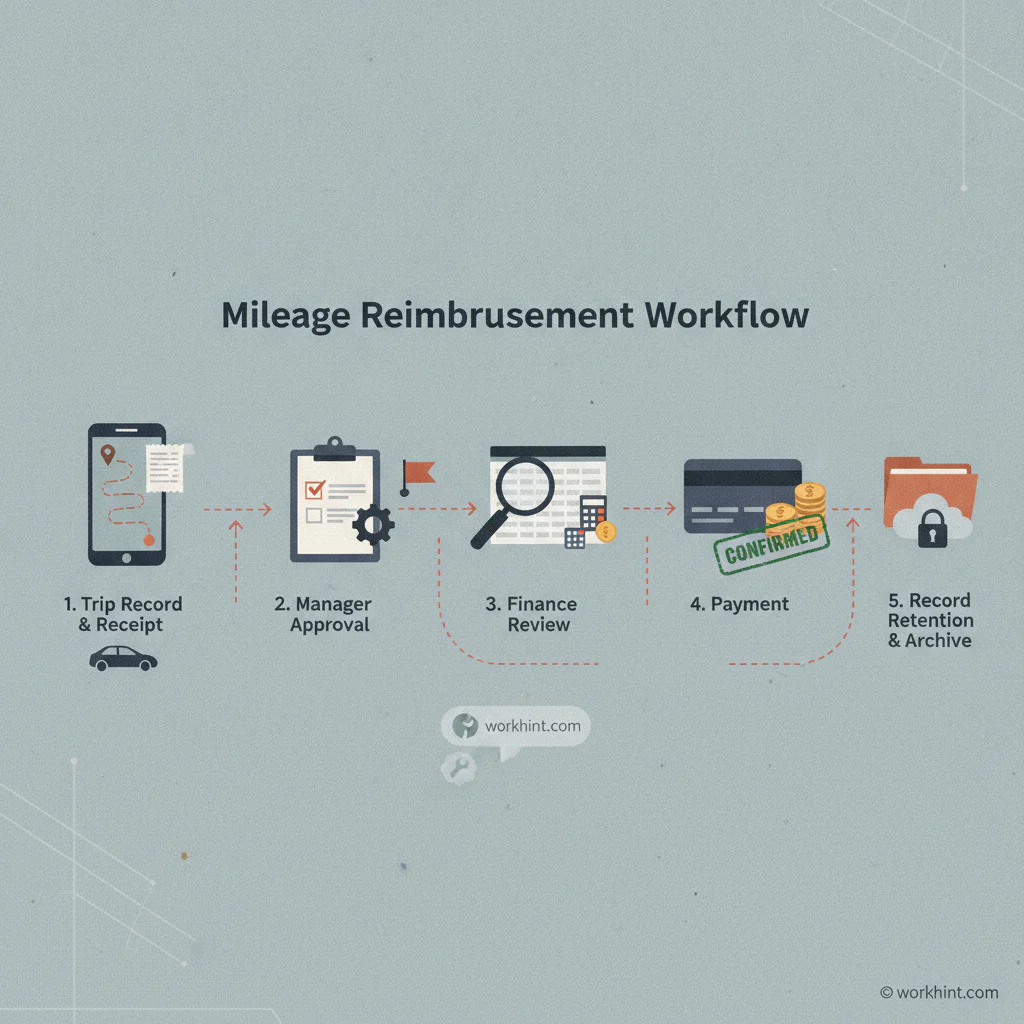
- Worker records the trip. The worker logs the trip date, destination, purpose, miles, and project context as soon as practical.
- Worker submits the form. The form includes required evidence, the approved mileage rate, and the calculated reimbursement amount.
- Manager reviews business purpose. The manager confirms the trip was work-related, necessary, and tied to an approved project or customer need.
- Finance checks policy and math. Finance confirms the rate, required documentation, duplicate submissions, and payment path.
- Payment is issued. Payroll, AP, or contractor payment operations sends the reimbursement through the approved channel.
- The record is retained. The final form, approvals, supporting records, and payment confirmation stay attached to the worker or project record.
The IRS explains in Publication 463 that travel and car expense records should be able to support the expense, reimbursement, and business purpose. Its sample mileage log fields include date, destination, business purpose, odometer readings, miles, and related expenses. The IRS recordkeeping guidance also emphasizes that good records help support deductions and reported items. For business operations, that means the form should be useful both before reimbursement and later if someone needs to reconstruct the decision.
Example mileage reimbursement form
Worker: Jordan Lee, Field Operations Coordinator
Department: Customer Operations
Manager: Priya Shah
Trip date: August 6, 2026
Starting location: Office
Destination: Client warehouse site
Business purpose: On-site workflow walkthrough for new inventory receiving process
Project: Warehouse onboarding rollout
Starting odometer: 41,208
Ending odometer: 41,266
Total reimbursable miles: 58
Approved mileage rate: $0.76 per mile
Total reimbursement: $44.08
Supporting record: Client visit agenda and site check-in note attached
Manager approval: Approved August 7, 2026
Finance status: Approved for next reimbursement batch
Common mistakes
- Using the wrong rate. Mileage rates can change, so store the effective date and source for the rate used.
- Accepting vague business purposes. “Client travel” is weaker than “on-site implementation review for Client A warehouse rollout.”
- Mixing commuting and business trips. Define commuting, approved travel, between-site travel, emergency callouts, and personal detours clearly.
- Letting approvals happen in chat only. Chat may explain context, but the final approval should live with the reimbursement record.
- Paying without closing the status loop. Workers need to know whether a request is submitted, approved, rejected, paid, or pending evidence.
Where Workhint fits
Workhint helps teams turn a mileage reimbursement form template into a live workflow. Instead of keeping the form in a spreadsheet, a business can use Workhint to collect mileage requests, route them to the right manager, trigger finance review, attach supporting documents, track payment status, and keep the reimbursement record connected to the worker, project, client, or department.
That matters when mileage reimbursement is part of larger operations: field teams, contractor networks, local service delivery, project rollouts, sales visits, or multi-location work. The form still provides the structure. Workhint helps the structure move through intake, approvals, payment handoff, reminders, reporting, and audit history.
FAQ
What should a mileage reimbursement form include?
It should include worker details, trip date, start and end locations, business purpose, miles driven, rate used, reimbursement amount, supporting records, approval fields, payment status, and final notes.
Can a company reimburse less than the IRS mileage rate?
Private employers generally set their own reimbursement policies, subject to applicable law and worker agreements. Many use IRS rates as a benchmark, but finance or counsel should review the policy before rollout.
Do employees need fuel receipts for mileage reimbursement?
Not usually when the company reimburses using a per-mile rate, because the rate is meant to cover vehicle operating costs. Tolls, parking, or other separate expenses may still require receipts under company policy.
How often should workers submit mileage?
Monthly works for many teams, but high-volume field teams may need weekly submission. The best cadence is frequent enough that trips are still easy to verify.
Who should approve mileage reimbursement?
The operational manager should confirm the business purpose, while finance or payroll should confirm rate, documentation, policy compliance, and payment handling.
Conclusion
A mileage reimbursement form template is useful because it turns scattered driving records into a clear business record. Use it to capture the trip, apply the right rate, document approval, and connect reimbursement to payment. The best version is simple for workers to submit and strong enough for finance to trust later.
Leave a Reply