


A good vendor payment process protects cash, vendors, and audit evidence before money leaves the business.
The vendor payment process is the workflow a finance team uses to approve, schedule, send, and reconcile payments to suppliers, contractors, agencies, service providers, and other business vendors. It sounds simple until volume grows. Then the process has to answer harder questions: who approved the spend, whether the invoice matches the purchase order, whether the vendor bank details are current, which payment method is safest, and how the transaction will be reconciled later.
For a small team, vendor payments may live in email, spreadsheets, accounting software, and bank portals. For a growing company, that creates risk. A payment can be late because the approver missed an email. A duplicate invoice can be paid because the records are split. A vendor bank change can be accepted without independent verification. A finance leader needs a process that is fast enough for operations and controlled enough for audit.
What’s in this article?
- The core vendor payment process finance teams should use.
- Where controls belong before payment execution.
- How to choose payment methods by risk, timing, and cost.
- Common mistakes that lead to late payments, fraud risk, and messy reconciliation.
Why the vendor payment process matters
Vendor payments sit at the intersection of cash management, supplier relationships, procurement, tax documentation, and internal controls. If the process is loose, finance may pay the right vendor late, the wrong vendor quickly, or the same invoice twice. If the process is too rigid, business teams work around it and finance loses visibility.
The best vendor payment process confirms the payment is legitimate, sends funds using the right rail and timing, and leaves evidence for accounting, tax reporting, and audit review. For U.S. vendors, finance teams commonly collect taxpayer identification details with Form W-9, and IRS requester guidance explains that a properly completed W-9 can help support withholding and reporting decisions.
Vendor payment process workflow
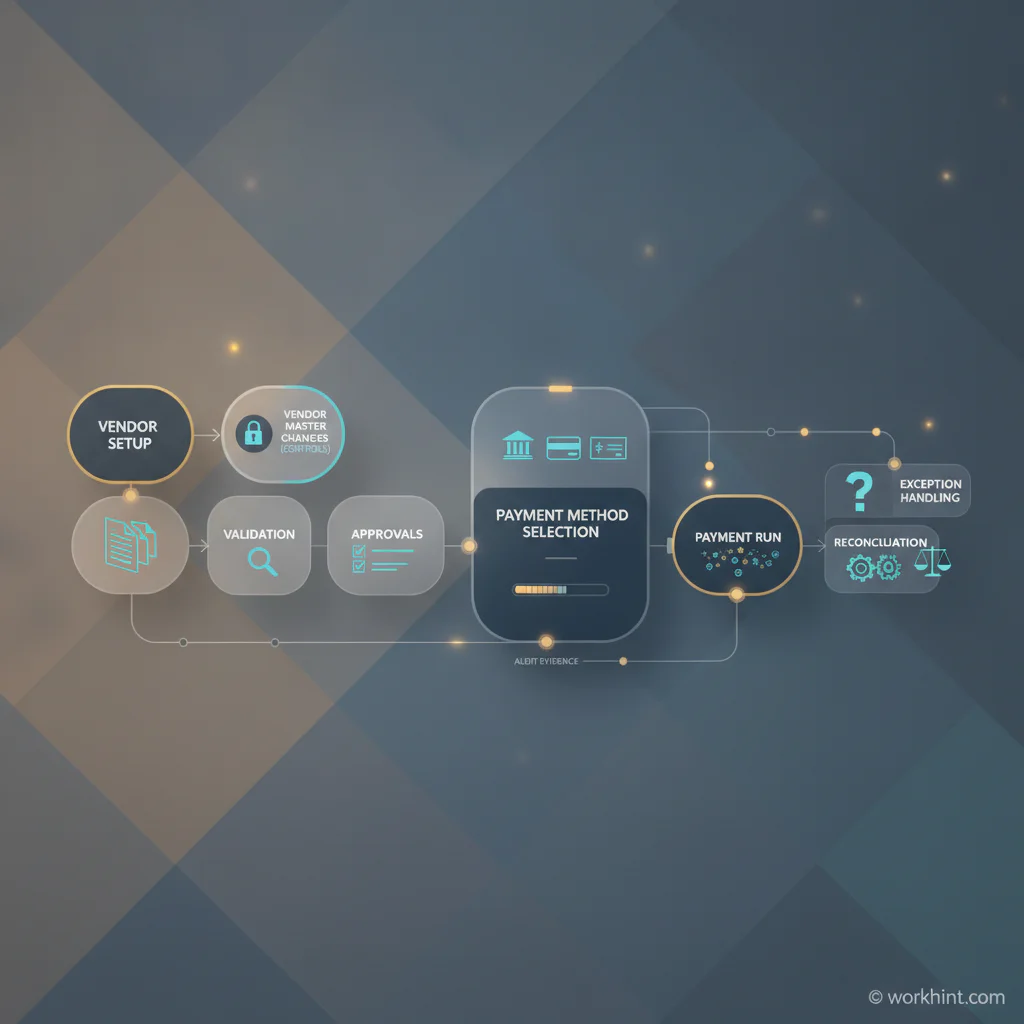
A practical workflow should separate the decision to buy, the decision to approve an invoice, and the authority to release cash. That separation protects the business without slowing every payment down.
| Step | Finance control | Common evidence |
|---|---|---|
| Vendor setup | Verify legal name, tax form, payment details, owner, and contract status. | Vendor record, W-9 or relevant tax form, contract, bank verification. |
| Invoice intake | Capture invoice date, amount, terms, PO, service period, and requester. | Invoice file, intake timestamp, coding fields. |
| Validation | Match invoice to PO, receipt, contract, milestone, or approved work. | PO, receipt, delivery note, timesheet, SOW, approval record. |
| Approval | Route by department, amount, budget owner, vendor risk, and exception status. | Approver, timestamp, comments, policy exception notes. |
| Payment run | Select ACH, wire, card, check, local transfer, or platform payout based on terms and risk. | Payment batch, method, due date, authorization, bank confirmation. |
| Reconciliation | Match payment confirmation to the invoice, bank transaction, and ledger entry. | Bank feed, remittance advice, GL posting, closed invoice. |
How to build the process
1. Start with a clean vendor master
Do not let payment execution begin with an unverified vendor record. Require legal name, tax documentation, payment terms, payment method, banking details, owner, and contract or purchase approval. Any bank account change should trigger a separate review, especially when the request arrives by email.
2. Standardize invoice intake
Every invoice should enter the same queue, even if it arrives through email, a vendor portal, a marketplace, or a project manager. Capture the vendor, amount, currency, due date, invoice number, department, and supporting document.
3. Validate before approval
Approval is weaker if the approver sees only a PDF. Finance should validate the invoice against the buying record: purchase order, contract, statement of work, delivery confirmation, timesheet, or project milestone. Stripe’s accounts payable process guide also treats approval, payment processing, and accounting entry as separate stages.
4. Route approvals by rule, not habit
Small invoices may need only the budget owner. Larger invoices may need department, finance, and executive approval. International wires, new vendor payments, changed bank details, and unusual currencies should require stronger checks.
5. Choose the payment method deliberately
ACH is often useful for routine domestic payments, cards may support certain supplier programs, wires may be needed for urgent or international transfers, and checks may remain necessary for some vendors. When using ACH, Nacha emphasizes the importance of compliant authorizations. Finance should also consider fees, timing, vendor preference, fraud risk, remittance detail, and reconciliation effort.
6. Reconcile before the trail goes cold
A vendor payment is not complete when the bank says funds were sent. It is complete when the invoice is closed, the ledger is updated, the bank transaction is matched, and any partial payment, credit, refund, fee, or FX difference is explained. This is where many manual processes fail because the payment team and accounting team are working from different records.
Common mistakes
- Approving from inboxes: Email approval is easy to lose, forward, or misunderstand.
- Skipping vendor setup controls: A payment process cannot compensate for bad vendor data.
- Treating urgent requests as exceptions: Urgency is exactly when bank changes and unusual instructions need more review.
- Ignoring payment terms: Paying too early can hurt cash flow; paying late can damage vendor relationships.
- Separating payment and reconciliation: Execution without accounting closure leaves open invoices and weak reporting.
The FTC has warned small businesses about fake invoices and payment scams. That is not just a cybersecurity issue. It is a finance workflow issue. Controls should make it difficult for a fake invoice, changed bank account, or rushed payment request to bypass normal evidence.
Where Workhint fits
Workhint helps teams turn the vendor payment process into an operational system instead of a chain of emails and spreadsheets. A finance team can structure vendor intake, tax form collection, role-based approvals, invoice routing, payment status, exception handling, document storage, and reconciliation follow-up in one workflow.
The point is not to replace accounting software or banking tools. The point is to coordinate the work around them so the right records, approvals, and evidence are ready before payment execution.
FAQ
What is the vendor payment process?
The vendor payment process is the finance workflow for setting up vendors, receiving invoices, validating charges, approving payment, sending funds, and reconciling the transaction.
Who owns vendor payments?
Finance usually owns the payment process, but procurement, operations, department leaders, and vendor owners all contribute evidence or approvals. Clear ownership prevents stalled payments and unauthorized spend.
What is the difference between vendor payments and accounts payable?
Accounts payable is the broader accounting function for money owed to vendors. Vendor payments are the execution and control workflow for paying those obligations accurately and on time.
How can finance reduce vendor payment risk?
Use verified vendor records, approval rules, tax documentation, bank-change controls, payment method policies, and timely reconciliation. For sensitive compliance questions, confirm requirements with qualified tax, legal, or banking advisors.
Conclusion
A strong vendor payment process is not just a faster way to pay bills. It is a control system for cash, vendor trust, documentation, and decision rights. Start with clean vendor setup, route invoices through consistent validation, make approvals visible, choose payment methods by risk and timing, and reconcile every payment back to the invoice and ledger.
Leave a Reply