

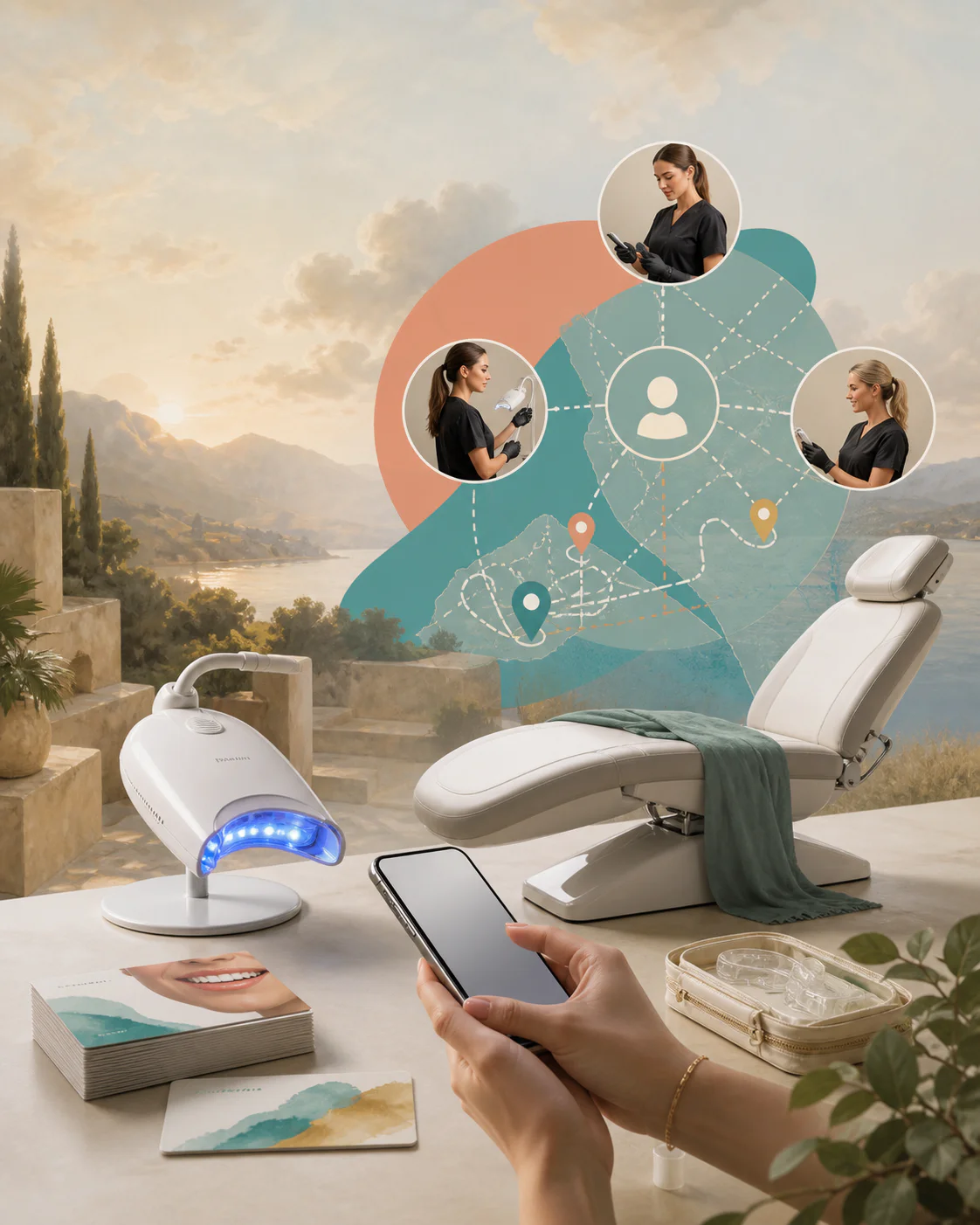
You can test demand for brighter smiles before renting a studio, hiring employees, or buying more equipment than your first customers need.
If you are searching for how to start a teeth whitening business, the smartest first move is not a storefront. It is a focused offer, a compliant service process, a small provider network, and a branded way for customers to book, approve, pay, and review appointments.
Teeth whitening is attractive because customers already understand the outcome. Brides, job seekers, sales professionals, content creators, and event guests often want a visible cosmetic improvement before a specific date. That creates a service business that can start small, sell locally, and grow by adding trained independent providers instead of immediately building a traditional clinic.
This guide shows how to launch a mobile teeth whitening business with minimal upfront investment, validate demand first, and use Workhint as the operating foundation before committing to a studio, kiosk, or full-time staff.
What’s in this article?
- Why a mobile teeth whitening business can work
- What you need before taking appointments
- How to price whitening sessions and packages
- How to find first customers without overspending
- How Workhint helps run the business from request to payout
- A 7-day launch plan, checklist, and FAQ
Why this business works
A teeth whitening business works when it combines convenience, trust, visible results, and a simple booking experience. The service is easy for customers to understand: they want a brighter smile before a wedding, photo shoot, interview, vacation, or sales-heavy week.
The mobile model lowers risk. Instead of renting a room, designing a spa, or signing a retail lease, you can start by serving customers at homes, offices, salons, wedding venues, pop-up events, or partner locations. You can also recruit trained independent providers in different neighborhoods once demand is proven.
The first offer should stay narrow. For example: one 30-minute mobile whitening session, one event package for bridal parties, and one monthly touch-up package. That is enough to learn who buys, what they ask before booking, what objections appear, and which partners send customers.
Customers buy teeth whitening because the result is personal, visible, and time-sensitive. Providers may join the network because they can earn per appointment without finding every customer themselves. Your job as the founder is to package the offer, create the customer flow, build trust, and coordinate service quality.
What you need to launch
Before launching, check your state and local rules. Teeth whitening regulations vary by location, especially for non-dentists, salons, mobile providers, and services that make dental or health claims. Get the right business license, seller permit if required, liability insurance, training, consent language, sanitation process, and advertising review before taking paid appointments.
You do not need a full studio on day one. You need a credible brand, a compliant service process, customer intake, provider onboarding, scheduling, payment collection, and enough supplies to deliver the first few appointments safely.
| Launch item | Lean starting range | Why it matters |
|---|---|---|
| Business registration and permits | $50-$500 | Creates a legal operating base and helps you check local requirements. |
| Training and procedure documentation | $100-$800 | Helps standardize safety, consent, sanitation, and customer expectations. |
| Starter whitening supplies | $200-$1,300 | Covers LED light, gels, barriers, retractors, PPE, and early consumables. |
| Insurance | $300-$1,000+ | Protects the business and may be required by partners or venues. |
| Brand, booking flow, and platform setup | $300-$1,500 | Lets customers request appointments, complete forms, approve terms, and pay. |
| Local launch marketing | $200-$1,000 | Funds partner outreach, local ads, events, and referral materials. |
Keep the first version simple. Use portable equipment, a tight service radius, and independent trained providers only after you can document the exact service standard. Avoid buying a kiosk, leasing a studio, or carrying deep inventory until repeat demand justifies it.
How to price it
Teeth whitening pricing depends on market, provider qualifications, session length, product cost, travel time, and whether you serve individuals, offices, events, or partner locations. Current market guides commonly show session pricing around $99 to $300, with premium mobile or event packages priced higher when convenience is part of the value.
Start with packages that are easy to explain. Customers should understand what is included, how long it takes, what results can and cannot be promised, and whether a touch-up is included.
| Offer | Example price | Best use |
|---|---|---|
| Single mobile session | $129-$199 | First-time customers who want one convenient appointment. |
| Premium event prep | $199-$299 | Customers preparing for weddings, photos, interviews, or public events. |
| Partner pop-up session | $99-$159 | Salon, gym, office, or venue days where travel time is shared. |
| Monthly touch-up plan | $49-$99 per month | Recurring revenue for customers who want maintenance reminders and priority booking. |
| Bridal or team package | $500-$1,500+ | Small groups served at one location with coordinated scheduling. |
Price with margin discipline. Track product cost per appointment, provider payout, travel time, booking fees, insurance, refunds, and no-shows. A platform-first model helps because every request, payment, provider assignment, and payout can be captured from the first appointment.
How to get first customers
Your first customers should come from places where people already care about appearance, convenience, and upcoming events. Start with bridal planners, photographers, salons, medspas, gyms, real estate teams, sales teams, modeling agencies, and local business communities.
Offer a simple partnership pitch: you bring a mobile whitening service to their clients or team, they get a useful add-on, and customers get an easy booking link. The goal is not to look huge. The goal is to prove that people will book, show up, pay, and refer.
- Create one branded booking page for your launch city.
- Offer a limited number of founding customer appointments.
- Run small partner pop-ups before renting space.
- Ask every happy customer for a review and referral.
- Use truthful before-and-after content only with consent and no exaggerated claims.
- Track which channel creates paid appointments, not just inquiries.
How Workhint helps launch it
Workhint lets you create the branded operating platform for the teeth whitening business before you invest in a studio or hire employees. Instead of stitching together forms, calendars, payment tools, spreadsheets, messaging apps, and contractor payout tracking, you can launch one customer-facing and operations-ready system.
A customer requests a whitening appointment through your branded portal, chooses mobile service or a partner pop-up, answers intake questions, reviews consent language, and pays or approves the booking. Workhint routes the request to the right independent provider based on location, availability, qualifications, and service type.
The provider sees the appointment, confirms it, follows the pre-service checklist, records required forms, completes the visit, uploads notes or review prompts, and marks the job complete. The customer receives status updates, payment confirmation, follow-up instructions, and a review request. You see the full operation from an internal dashboard: upcoming bookings, provider readiness, customer issues, revenue, refunds, and payouts.
That is the launch advantage. You can test demand with a branded platform, a small provider network, and a controlled service process before committing to fixed costs. If one neighborhood works, add another provider. If partner pop-ups convert better than home visits, shift the model. Workhint gives you the operating foundation while you focus on acquiring customers and improving the offer.
First 7-day launch plan
- Day 1: Choose your launch market, customer type, and first offer. Focus on one city or neighborhood and one primary use case such as bridal, event prep, or professional headshots.
- Day 2: Set up the branded Workhint platform basics: customer portal, request form, service area, appointment types, intake questions, and customer messages.
- Day 3: Configure pricing, consent steps, scheduling, payment collection, cancellation rules, service checklist, review flow, and provider payout logic.
- Day 4: Recruit the first qualified independent providers or partner locations. Confirm training, sanitation expectations, insurance requirements, and availability.
- Day 5: Contact salons, photographers, wedding planners, gyms, office managers, and local influencers with one clear launch offer.
- Day 6: Route every inquiry through the platform. Watch where customers hesitate, what questions repeat, and which partners can produce bookings.
- Day 7: Review demand, pricing, provider readiness, no-show risk, and customer feedback before buying more equipment or expanding the service radius.
Final launch checklist
- Pick one launch city and one primary customer segment.
- Check state and local rules for teeth whitening services.
- Register the business and secure required permits.
- Get liability insurance before taking paid appointments.
- Document the service procedure, consent process, sanitation checklist, and customer instructions.
- Create a branded Workhint customer portal and booking flow.
- Recruit the first independent providers or partner locations.
- Set pricing, payment, cancellation, and provider payout rules.
- Launch partner outreach before spending heavily on ads.
- Validate paid demand before leasing space, buying large inventory, or hiring staff.
FAQ
How much does it cost to start a teeth whitening business?
A lean launch can often start with a few hundred to a few thousand dollars if you use portable equipment, limited supplies, insurance, training, local marketing, and a branded booking platform. Costs rise quickly if you rent a studio, build a kiosk, or buy inventory before demand is proven.
Do you need a license to start a teeth whitening business?
Usually you need normal business registration, and some locations may require permits, seller registration, dental supervision, salon rules, or other compliance steps. Rules vary by state and city, so verify local requirements before offering paid services.
Can you start a mobile teeth whitening business with no staff?
Yes, if your local rules allow the model and you build a controlled provider network. Start by handling bookings yourself, then add trained independent providers after you have documented the service process, consent steps, quality standards, and payout model.
How much should you charge for teeth whitening?
Many services charge roughly $99 to $300 per session depending on market, session length, convenience, and positioning. Your pricing should cover product cost, provider payout, travel, software, insurance, marketing, and refunds while staying easy for customers to compare.
What equipment do you need for a teeth whitening business?
Typical supplies include a portable LED whitening light, whitening gel, cheek retractors, barriers, desensitizing products, PPE, sanitation supplies, forms, and customer instructions. Buy enough to validate demand first, then expand inventory when appointments justify it.
How do you get first teeth whitening customers?
Start with partner channels where appearance and events already matter: salons, bridal planners, photographers, gyms, offices, real estate teams, and local events. Give each partner a booking link and track actual paid appointments.
Is a teeth whitening business profitable?
It can be, but profit depends on pricing, product cost, provider payout, travel time, no-shows, refunds, and marketing efficiency. The best early test is whether paid customers book repeatedly without forcing you into high fixed costs.
Conclusion
A teeth whitening business is worth testing because it can start as a focused mobile service before becoming a larger beauty, wellness, or event-prep platform. The key is to validate demand before investing heavily.
Start with a branded customer platform, a narrow first offer, a compliant service process, and a small network of qualified providers. Workhint gives you the operating foundation to manage bookings, forms, scheduling, payments, reviews, and payouts while you learn where the market is strongest.
Leave a Reply