

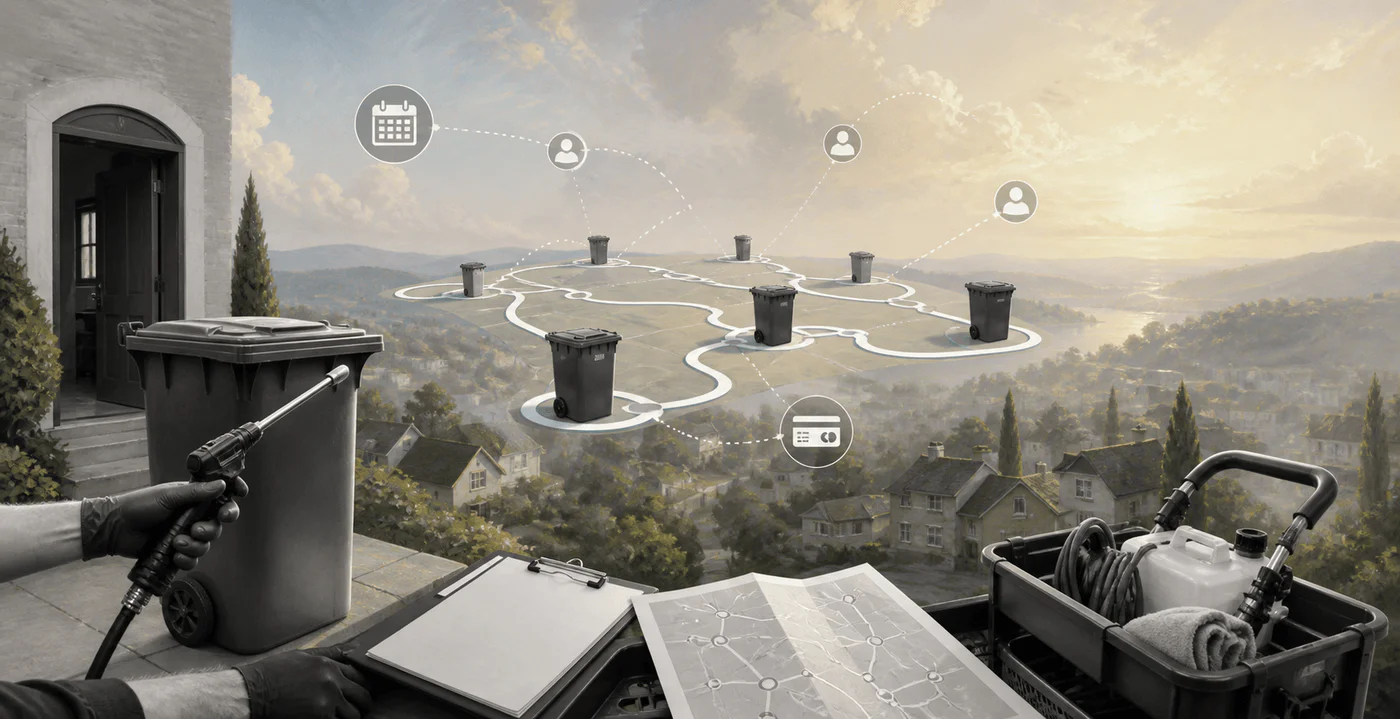
A bin cleaning business can launch as a recurring route service before you buy a dedicated cleaning trailer.
If you want to know how to start a bin cleaning business, the opportunity is simple: every home has trash bins, most bins get dirty, and very few people want to clean them by hand.
The traditional path is to buy a cleaning rig, wrap a trailer, and hope the route fills fast enough to cover the payment. A leaner path is to validate demand first. Start with a branded request platform, price a few simple plans, recruit independent cleaning providers or route partners, and prove that local customers will subscribe before you buy expensive equipment.
This guide shows how to launch a bin cleaning business with no staff, minimal upfront cost, and Workhint as the operational foundation for intake, scheduling, route coordination, payments, and provider payouts.
What’s in this article?
- Why a bin cleaning business works
- What you need to launch
- How to price bin cleaning services
- How to get first customers
- How Workhint helps launch it
- A first 7-day launch plan
- Final checklist and FAQ
Why this business works
A bin cleaning business works because the problem is visible, recurring, and local. Trash bins collect odor, residue, pests, and bacteria. Homeowners, HOAs, property managers, restaurants, apartment communities, and small businesses often want cleaner bins but do not want to handle the job themselves.
The recurring revenue model is the strongest part. A one-time clean can win attention, but monthly, bi-monthly, or quarterly plans create route density. Once several customers in the same neighborhood subscribe, each route becomes easier to schedule and more profitable.
The no-staff model is possible when you do not start by acting like a large sanitation company. Your first job is to validate demand, build the customer experience, and coordinate capable providers. Some providers may already own pressure washing equipment, water recovery systems, trailers, or cleaning tools. Your business can begin as the branded platform that brings local demand to those providers.
What you need to launch a bin cleaning business
Before spending heavily, define the smallest version of the offer. For many founders, that means one service area, two or three subscription plans, clear wastewater rules, a customer request form, and a small provider network that can complete jobs safely.
Check local rules before selling. Bin cleaning can involve wastewater, runoff, disinfectants, road use, and disposal requirements. Some cities may require business licensing, environmental approval, or specific handling practices. Insurance also matters because providers are working around homes, driveways, curbs, vehicles, and sanitation equipment.
| Launch item | Lean budget range | Notes |
|---|---|---|
| Business registration and local licensing | $100-$700 | Varies by state, city, and business structure. |
| Insurance and basic legal setup | $500-$2,000+ | General liability is important before paid work starts. |
| Brand, website, and local landing page | $300-$1,500 | Start with one clear service area and one booking path. |
| Workhint platform setup | Variable | Use it for requests, routes, provider onboarding, payments, and proof. |
| Provider onboarding and supplies | $200-$1,000 | Document standards, safety steps, photos, and customer communication. |
| Owned cleaning rig | Delay until demand is proven | Professional equipment can be a later investment once route density supports it. |
The key decision is whether you need to own the equipment on day one. If you are personally cleaning bins, you may need a pressure washer, water tank, recovery approach, transport, safety gear, and approved disposal process. If you launch as a branded service platform, you can recruit providers who already have compliant equipment and pay them per route or per completed job.
How to price it
Most bin cleaning businesses should price around frequency and route density. One-time service should be your highest price. Recurring service should cost less per visit because it is easier to plan and keeps customers on a schedule.
| Offer | Example customer price | Best use |
|---|---|---|
| One-time two-bin clean | $45-$99 | Great for first-time buyers, move-ins, and seasonal promotions. |
| Monthly two-bin plan | $25-$37 per visit | Best recurring residential offer once route density exists. |
| Extra bin add-on | $5-$15 per extra bin | Useful for homes with garbage, recycling, compost, or yard bins. |
| HOA or neighborhood route | Custom quote | Best for dense routes with many bins in one area. |
| Commercial dumpster or container clean | Custom quote | Requires stronger compliance review and provider capability. |
Do not underprice the route. Include travel time, provider payout, water handling, cleaning supplies, customer support, payment fees, failed access, and quality checks. The goal is not to win every customer. The goal is to build a repeatable local route that can be fulfilled profitably.
How to get first customers
Start with neighborhoods where bins are visible from the curb and pickup days are predictable. Offer a simple founding-customer plan for one service area, not the entire city.
Good first channels include neighborhood Facebook groups, Nextdoor, HOA boards, property managers, local real estate agents, apartment managers, and door hangers placed after trash pickup day. The best message is specific: clean, deodorized bins on the day they are already empty.
You can also sell routes before buying equipment. Put up a landing page, run a local waitlist, and ask customers to reserve a first cleaning window. If enough people in the same area request service, you have evidence before committing more money.
How Workhint helps launch it
Workhint helps you launch the bin cleaning business as a branded operating platform, not just a set of disconnected tools. The customer sees your brand, submits a service request, chooses the number of bins, selects a cleaning frequency, confirms pickup-day timing, and pays online.
Behind the scenes, Workhint can route the request into an operations dashboard, match it to an independent provider or route partner, schedule the cleaning after trash pickup, assign checklist steps, collect before-and-after photos, trigger customer updates, generate invoices, collect payment, and calculate provider payout.
That matters because bin cleaning is a route business. Missed access, wrong addresses, unclear bin counts, unpaid invoices, and weak proof can break trust quickly. Workhint gives the business a repeatable system from the first request through provider assignment, service completion, customer review, and payout.
The result is a faster launch path. You can validate demand with a branded customer portal and provider network before investing heavily in trucks, trailers, owned equipment, or employees.
First 7-day launch plan
Day 1: Pick one launch area, one customer type, and one first offer. Choose whether you are targeting homeowners, HOAs, property managers, or small commercial accounts.
Day 2: Set up the branded Workhint platform basics: customer request form, service area, bin count, frequency options, customer profile, and payment path.
Day 3: Build the quote, route, checklist, proof, payment, and provider payout workflow. Keep the first version simple enough to run manually if needed.
Day 4: Recruit the first independent providers or route partners. Verify equipment, insurance, wastewater handling, safety standards, availability, and photo proof process.
Day 5: Contact first demand sources. Post in local groups, message HOA managers, approach property managers, and offer founding-customer pricing for one neighborhood route.
Day 6: Route every request through Workhint. Confirm address, pickup day, bin count, provider availability, and payment before scheduling.
Day 7: Review demand, route density, provider reliability, price, and customer feedback. Invest more only after the route shows real pull.
Final launch checklist
- Choose the launch neighborhood and first customer segment.
- Register the business and check local wastewater, runoff, and licensing rules.
- Secure insurance before accepting paid work.
- Create one-time, monthly, and quarterly service plans.
- Configure the branded Workhint request, scheduling, payment, and provider payout flow.
- Recruit independent providers or partners with proper equipment and process discipline.
- Create a job checklist with before-and-after photo proof.
- Launch a local landing page and Google Business Profile.
- Sell the first route before buying expensive equipment.
- Use early results to decide whether to add owned equipment later.
FAQ
How much does it cost to start a bin cleaning business?
A lean platform-first version can start with business setup, insurance, a local landing page, provider onboarding, and customer acquisition. Buying a dedicated cleaning trailer or truck can raise startup costs significantly, so validate demand first.
Can I start a bin cleaning business without staff?
Yes. You can launch with independent providers or route partners who already have suitable equipment. Your role is to own the brand, acquire customers, coordinate routes, manage quality, collect payments, and handle provider payouts.
Do I need special permits to clean trash bins?
Requirements depend on your city and state. Check business licensing, wastewater rules, runoff rules, approved disposal practices, and environmental requirements before taking paid jobs.
What equipment is needed for bin cleaning?
Self-performing operators may need a pressure washer, water tank, recovery setup, cleaning supplies, safety gear, transport, and disposal process. A platform-first operator can begin by partnering with providers who already have compliant equipment.
How should I price bin cleaning services?
Use higher pricing for one-time jobs and lower per-visit pricing for recurring plans. Include route travel, provider payout, access issues, supplies, payment fees, and customer support in every price.
Who are the best first customers?
Start with neighborhoods, HOAs, property managers, real estate agents, apartment communities, and homeowners who already care about curb appeal, pests, odors, or sanitation.
Should I buy a cleaning rig right away?
Usually no. Prove customer demand and route density first. Buy or finance equipment when recurring revenue, provider availability, and margins show that owned equipment will improve the business.
Conclusion
A bin cleaning business is strongest when it starts as a local route system, not an expensive equipment purchase. Validate demand, build the branded customer experience, recruit capable providers, and prove that customers will subscribe before you scale.
Workhint gives the business an operating foundation from day one: requests, quotes, schedules, provider assignments, job proof, payments, and payouts in one branded system. That lets you launch faster, spend less upfront, and invest into equipment only when the market has earned it.
Leave a Reply