

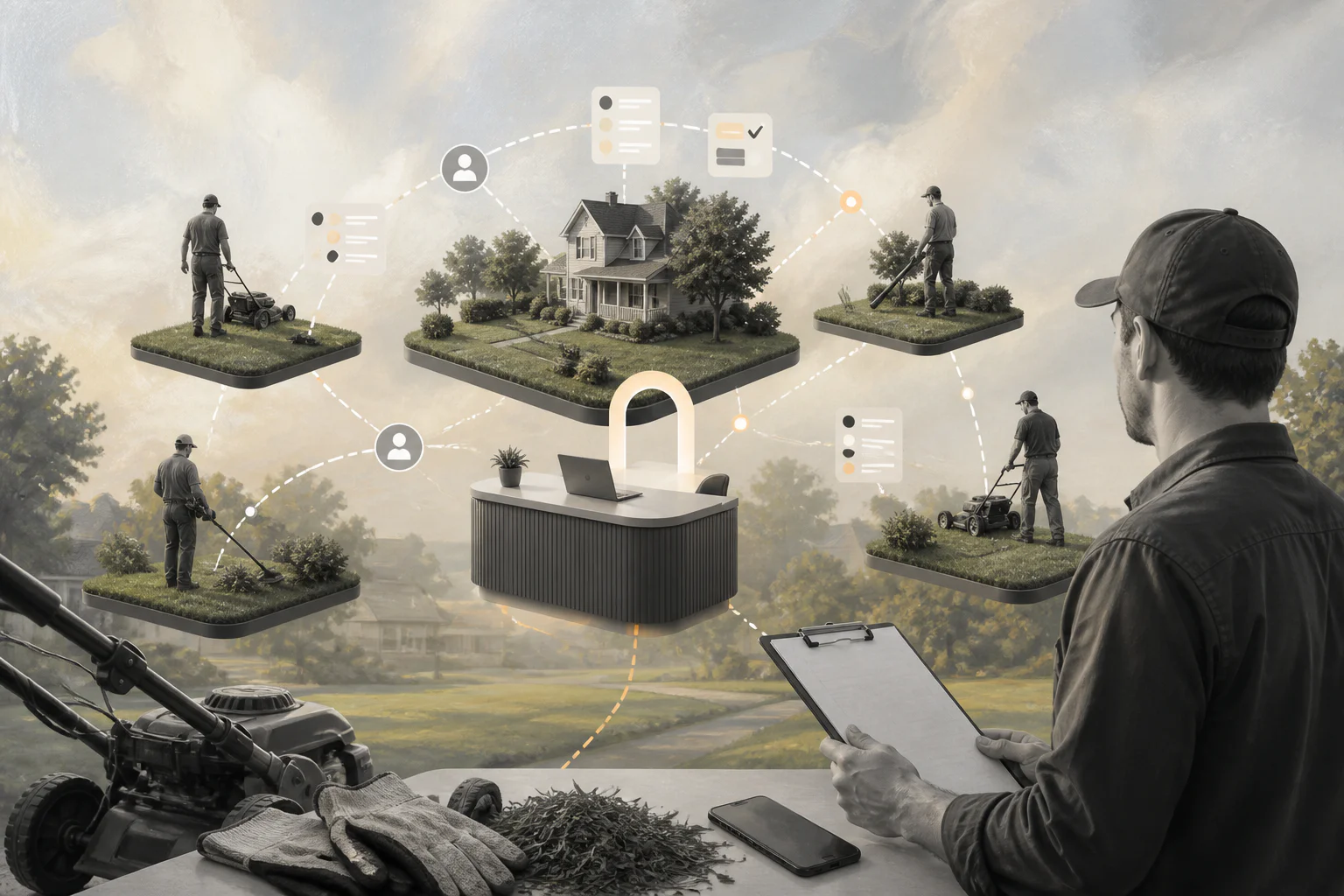
You can validate lawn care demand before buying trucks, hiring crews, or turning your garage into an equipment warehouse.
If you are researching how to start a lawn care business, the traditional advice usually begins with mowers, trailers, trucks, and a long equipment list. That can work, but it creates risk before you know whether customers will buy from you.
A leaner path is to start as the branded operator. You build the customer-facing platform, define the offer, recruit reliable independent lawn care providers, and validate demand before investing heavily in owned equipment or employees.
What’s in this article?
- Why lawn care is a practical local service business
- What you need before taking your first customer
- How to price mowing, cleanup, and recurring service
- How to get first customers without overbuilding
- How Workhint helps launch the operating platform
- A 7-day launch plan and final checklist
Why This Business Works
Lawn care works because the problem is visible, recurring, and local. Grass keeps growing. Homeowners get busy. Property managers need predictable service.
The opportunity is strongest when you focus on a narrow first offer: recurring mowing, edging, blowing, and light seasonal cleanup in one launch market.
The provider-network model lowers the barrier to entry. Instead of buying a truck and commercial equipment on day one, recruit independent lawn care operators who already own basic tools and want more booked jobs. You provide the brand, customer intake, scheduling, quoting, payments, quality checks, and follow-up. They provide capacity.
Customers buy because they want convenience and reliability. Providers join because a branded platform can send better-organized work, clearer job details, easier scheduling, and faster payment.
What You Need To Launch
You do not need a full fleet to test the market. You need a credible offer, a simple operating system, and enough vetted provider capacity.
| Launch item | Lean approach | Estimated first budget |
|---|---|---|
| Business registration | Register the business and confirm local requirements | $50-$300 |
| Insurance | General liability first; add coverage as services expand | $450-$1,500 per year |
| Branded platform | Customer requests, quotes, scheduling, payments, and provider payout flow | $0-$500 to configure |
| Brand and website | Simple local landing page with service area and booking flow | $100-$500 |
| Provider onboarding | Invite independent operators with equipment, availability, and service standards | $0-$300 |
| Marketing test | Flyers, local groups, referral offers, and small paid tests | $200-$1,000 |
| Owned equipment | Delay until demand is proven unless you plan to perform jobs yourself | $0-$2,000 early |
Check city and county rules before launch. Many lawn care operators need a basic business license. Pesticide application, fertilization, irrigation, tree work, and certain landscaping services may require separate licenses or certifications.
For insurance, start with general liability and ask about contractor relationships, customer property damage, equipment coverage, and commercial auto exposure.
How To Price It
Pricing should be simple enough for customers to understand and structured enough for providers to accept. Start with recurring packages because predictable routes are easier to schedule and more valuable than random one-time jobs.
| Offer | Example customer price | Best use |
|---|---|---|
| Standard mowing visit | $40-$75 per small residential lawn | Entry offer for weekly or biweekly customers |
| Mowing plus edging | $60-$110 per visit | Higher-value recurring package |
| Seasonal cleanup | $150-$500 per job | Spring, fall, and neglected-yard demand |
| Small commercial route | $150-$600 per month | Recurring accounts with predictable scheduling |
| Provider payout | 60%-75% of job revenue | Leaves margin for platform, support, marketing, and admin |
Use these numbers as starting ranges, not promises. Yard size, travel time, fuel, slope, disposal needs, and service frequency change the economics. Your margin comes from tight scheduling, clear scopes, fast payment, and recurring demand.
How To Get First Customers
The first customers usually come from concentrated local effort, not a broad brand campaign. Pick one service area and make the offer visible there.
Start with property managers, real estate agents, short-term rental hosts, neighborhood groups, senior communities, and busy homeowners. Offer recurring mowing with optional edging and seasonal cleanup. Make booking easy: request service, upload yard photos, approve a quote, choose availability, and pay online.
Do not spend heavily before you test demand. A few hundred dollars in flyers, local search ads, neighborhood posts, referral credits, and direct outreach can tell you whether people will request quotes.
How Workhint Helps Launch It
Workhint helps you launch the lawn care business as a branded operating platform before you invest like a traditional company.
A customer can land on your branded portal, request mowing or cleanup, enter the property address, upload yard photos, choose a service window, and receive a quote. Once approved, Workhint routes the job to an available provider based on area, schedule, job type, and capacity.
The provider gets job details, checklist, customer notes, photo requirements, and arrival window. Your dashboard shows every request, quote, scheduled visit, completed job, issue, invoice, payment, and provider payout. That gives you the operating foundation without stitching together forms, spreadsheets, calendars, payment tools, and text follow-ups.
This matters because lawn care gets chaotic quickly. Missed appointments, vague scopes, slow quotes, and manual payout tracking create friction early. Workhint lets you sell the service, coordinate providers, collect payments, verify completion, and pay providers from one system.
First 7-Day Launch Plan
Use the first week to validate demand and provider readiness, not to build a large operation.
- Day 1: Choose one market, one customer type, and one core offer, such as weekly mowing in three neighborhoods.
- Day 2: Set up the branded Workhint basics: customer request form, service area, provider roles, and dashboard.
- Day 3: Create quote, scheduling, payment, job checklist, customer update, and provider payout workflows.
- Day 4: Recruit the first independent providers. Confirm equipment, insurance, availability, service standards, and payout terms.
- Day 5: Contact first demand sources: property managers, neighborhood groups, real estate agents, and local homeowners.
- Day 6: Route every request through the platform. Quote fast, assign only jobs you can fulfill well, and collect payment online.
- Day 7: Review leads, approved quotes, provider performance, travel time, margins, and feedback before investing more.
Final Launch Checklist
- Choose a narrow first lawn care offer
- Pick one launch area instead of trying to serve the whole city
- Register the business and check local license rules
- Get appropriate insurance before taking jobs
- Create a branded customer intake and quote process
- Recruit independent providers with their own equipment and availability
- Define job checklists, photo proof, customer updates, and quality standards
- Set up online payments and provider payouts
- Run a small local marketing test
- Validate demand before buying trucks, trailers, or commercial equipment
FAQ
How much does it cost to start a lawn care business?
A lean launch can start with a few hundred dollars if you already have equipment or use independent providers. Many operators spend several thousand once they add tools, insurance, marketing, and transportation.
Can I start a lawn care business with no employees?
Yes. You can run the brand, customer platform, sales, scheduling, quality control, and payments while independent providers fulfill jobs. Use written agreements and follow labor rules.
Do I need a license to start a lawn care business?
Many cities require a general business license. Pesticide application, fertilization, irrigation, or tree work may require additional licenses or certifications.
What equipment do I need at the beginning?
If providers bring their own tools, you mainly need the platform, insurance, standards, and marketing. If you perform jobs yourself, start with only the essential mower, trimmer, blower, safety gear, and transportation.
How should I price lawn care services?
Price by yard size, service frequency, travel time, complexity, and add-ons. Recurring packages are easier to manage because routes become more predictable.
How do I get my first lawn care customers?
Start locally. Contact property managers, real estate agents, short-term rental hosts, neighborhood groups, and homeowners in one service area.
When should I buy my own truck or commercial equipment?
Buy only after demand justifies it. If recurring bookings and route density are strong, owned equipment may improve margins. Before that, it can trap cash.
Conclusion
The best way to start a lawn care business is to prove the market before overbuilding the company. Choose a simple offer, build a branded platform, recruit reliable independent providers, and use every early job to learn what customers actually want.
Workhint gives you the operating foundation to do that quickly: customer requests, quotes, scheduling, provider coordination, payments, checklists, and payouts in one branded system. That lets you launch like a serious local service company while staying lean enough to adapt.
Leave a Reply