


DMAIC works best when it becomes a practical operating rhythm, not a quality-improvement acronym trapped in a slide deck.
The DMAIC process improves an existing workflow by defining the problem, measuring current performance, analyzing root causes, improving the process, and controlling the new way of working. It is associated with Six Sigma, but operations teams can use the same logic without making every improvement a formal certification project.
The useful version is simple: do not jump from complaint to solution. First prove what is broken, why it happens, what fix should be tested, and how the team will keep the improvement from fading after launch.
What’s in this article?
- What the DMAIC process means for operations teams.
- When DMAIC is the right improvement method.
- A practical DMAIC table you can use to structure the work.
- Common mistakes that weaken DMAIC projects.
- How to turn DMAIC outputs into a live work system.
Why the DMAIC process matters
Many teams improve work by reacting to the loudest pain. A customer escalates, a manager complains, a dashboard turns red, and the team immediately adds a rule, reminder, checklist, or approval step. Often that treats the symptom while leaving the real cause untouched.
The DMAIC process creates discipline before action. iSixSigma describes DMAIC as a data-driven method for identifying a problem, finding root causes, developing a solution, and verifying that the solution remains effective. That sequence matters because operational problems are connected: unclear intake creates rework, rework creates delays, and delays create escalations.
Use DMAIC when the process already exists but underperforms. Good examples include late approvals, repeated order errors, slow onboarding, inconsistent handoffs, missed service-level targets, invoice exceptions, quality defects, and support escalations that keep returning.
When to use DMAIC
DMAIC is strongest when the problem is measurable, recurring, and important enough to justify structured analysis. It is weaker when the team needs to invent a new service, explore an uncertain market, or make a fast one-time decision. In those cases, a lighter PDCA cycle may fit better.
A practical test:
- Does the process already exist?
- Can we measure the problem with enough reliability?
- Would fixing it materially improve cost, speed, quality, risk, capacity, or customer experience?
- Will the fix need ownership, controls, and follow-up after implementation?
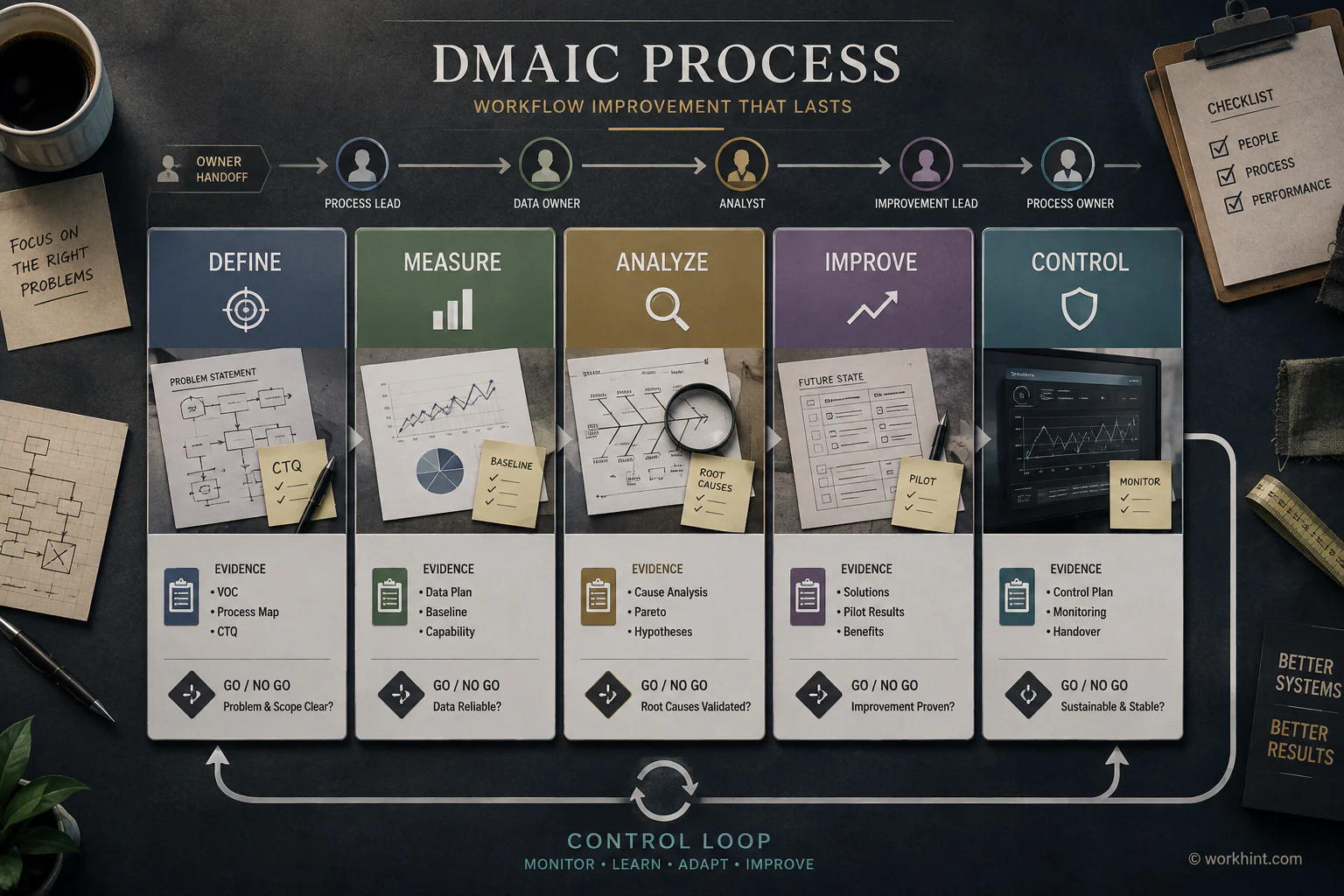
DMAIC process table for operations teams
DMAIC stands for Define, Measure, Analyze, Improve, and Control. GoSkills summarizes DMAIC as a Lean Six Sigma method for solving difficult problems with existing processes. For operations leaders, each phase should produce a concrete deliverable, not just a meeting discussion.
| Phase | Operating question | Useful output |
|---|---|---|
| Define | What problem are we solving, for whom, and within what scope? | Problem statement, process boundary, customer impact, owner, goal, and timeline. |
| Measure | How does the process perform today? | Baseline data, defect or delay rate, cycle time, queue size, rework count, and data-quality notes. |
| Analyze | What causes the gap between current and desired performance? | Root cause evidence, process map, Pareto analysis, failure pattern, and confirmed causes. |
| Improve | What change should we test and implement? | Improvement options, pilot plan, decision rules, owner assignments, training needs, and launch checklist. |
| Control | How will we keep the fix working? | Control plan, dashboard, review cadence, escalation path, SOP update, and accountable process owner. |
How to run DMAIC without overcomplicating it
Start by narrowing the problem. “Approvals are slow” is too broad. “Vendor approvals over $25,000 take a median of 12 business days because security review starts after legal review” is better because it names the process, segment, metric, and likely constraint.
During Measure, capture the current workflow as it actually runs. Pull timestamps, ticket histories, form submissions, exception logs, and manual handoff notes. If the data is weak, say so. Bad measurement is still a finding because it shows the control system is missing.
During Analyze, separate guesses from evidence. If most delay sits before assignment, the issue may be intake quality or triage ownership. If delay appears after assignment, the issue may be capacity, authority, unclear decision criteria, or dependencies.
During Improve, test the smallest change that can prove the fix. That might be a required intake field, a routing rule, a threshold-based approval path, a new owner role, an exception queue, or a weekly review. Avoid launching five changes at once; the team will not know which change worked.
During Control, make the improvement visible. UTRGV’s DMAIC training overview frames the method as a problem-solving process for business and process environments. In real operations, the control phase is where the improvement becomes normal work: dashboards, ownership, escalation rules, and recurring reviews.
Example DMAIC workflow
Imagine an operations team wants to reduce late customer onboarding handoffs. Define the issue as: “Thirty percent of new customer handoffs arrive without implementation requirements, causing rework and delaying kickoff.” Measure the last 90 days of handoffs, missing fields, rework loops, and kickoff delays. Analyze whether the misses come from sales notes, contract terms, customer data, unclear ownership, or late solution review.
The Improve phase might add a structured handoff intake form, required implementation fields, a pre-kickoff review owner, and a risk flag for complex accounts. The Control phase then tracks complete handoff rate, kickoff cycle time, rework count, and escalations until performance stabilizes.
Common DMAIC mistakes
- Starting with the solution: If the answer is chosen before Measure and Analyze, the project is not really DMAIC.
- Choosing a vague metric: “Better communication” is not enough. Use cycle time, error rate, rework count, backlog age, cost, or service-level performance.
- Skipping the process boundary: Define where the workflow starts and ends, or the project will expand until nobody owns it.
- Confusing correlation with root cause: A noisy process step may be visible without being the actual constraint.
- Underbuilding the Control phase: A fix without monitoring, ownership, and escalation becomes a temporary campaign.
Where Workhint fits
DMAIC produces the thinking. Workhint helps turn that thinking into execution. Once the team defines the process boundary, baseline metrics, root causes, improvement rules, and control plan, workflow automation software can help structure intake, route work, assign owners, enforce required evidence, trigger approvals, track status, surface exceptions, and keep the control dashboard connected to the work itself.
That is the important handoff: the DMAIC project should not end with a recommendation deck. It should leave behind a work system that tells people what to submit, who owns each step, what evidence is required, when to escalate, and how performance will be reviewed.
FAQ
What does DMAIC stand for?
DMAIC stands for Define, Measure, Analyze, Improve, and Control. Those five phases guide teams from problem definition through sustained process control.
Is DMAIC only for Six Sigma teams?
No. DMAIC is associated with Six Sigma, but operations, finance, HR, customer success, procurement, and service teams can use the same structure for recurring workflow problems.
What is the difference between DMAIC and PDCA?
DMAIC is usually more structured and data-heavy. PDCA is often lighter and more iterative. Use DMAIC for recurring, measurable problems that need root cause analysis and control. Use PDCA for smaller tests and continuous adjustment.
What should the Control phase include?
The Control phase should include an owner, updated SOP or workflow rule, dashboard or metric review, escalation path, and a cadence for checking whether the improvement is still working.
How long should a DMAIC project take?
It depends on scope and data availability. A narrow operations workflow can move faster than a formal enterprise Six Sigma project, but the team should not skip measurement and control.
Conclusion
The DMAIC process helps operations teams fix recurring workflow problems with more discipline. Define the problem tightly, measure the current state, analyze root causes, improve with a focused test, and control the new process with ownership and visibility. The payoff is not just a better process map. It is a work system that keeps performing after the improvement project is over.
Leave a Reply