

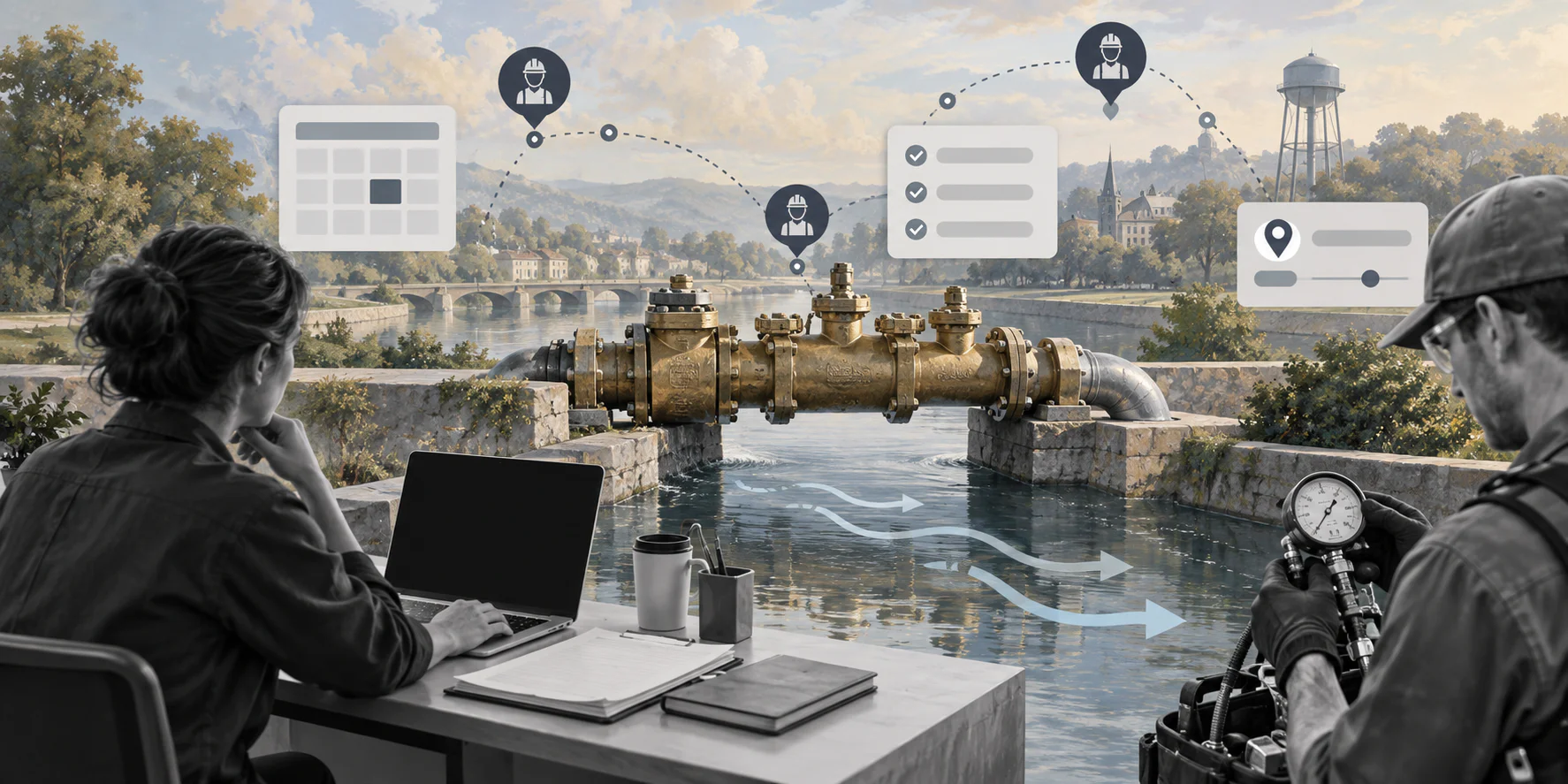
Backflow testing is a recurring compliance business you can validate before hiring a field team.
If you want to start a backflow testing business, the opportunity is simple: many properties must test backflow prevention devices regularly, but owners often treat the notice like another confusing compliance task. They need someone reliable to schedule the test, send a certified tester, file the report, and keep records clean.
You do not need to begin by hiring employees or building a plumbing company. A leaner path is to create a branded customer platform, recruit certified independent testers, and validate demand from property managers, commercial buildings, irrigation customers, restaurants, schools, and facilities.
What’s in this article?
- Why a backflow testing business can work as a lean service platform
- What you need to launch without staff
- How to price testing, reports, and recurring accounts
- How to get first customers from compliance demand
- How Workhint helps run the business from request to payout
- A 7-day launch plan, checklist, and FAQ
Why this business works
Backflow testing has a strong feature many startup ideas lack: repeat compliance demand. Depending on the water authority and property type, many devices must be tested on a recurring schedule. That creates a natural reason for customers to book, renew, and keep records.
The customer is not usually buying excitement. They are buying certainty. They want the notice handled, the appointment scheduled, the device tested by a qualified person, and the report submitted correctly. If you can make that process easier than calling around for a tester, you have a practical business.
A provider-network model fits because certified testers already exist in many markets. Your early value is not owning every tool. It is building the demand engine, customer experience, scheduling layer, records process, and tester network that make the service easier to buy.
What you need to launch
Start by confirming local rules. Backflow tester certification, registration, report submission, and device requirements vary by state, city, county, and water purveyor. Some markets require approved tester lists or specific reporting portals. Build the business only around providers who meet the rules for the service area.
The first version should focus on one market and one clear buyer. For example, you might serve small commercial properties with annual notices, irrigation customers in one county, or property managers with multiple devices. Keep the scope narrow until the process is reliable.
| Launch item | Lean approach | Typical early budget |
|---|---|---|
| Business registration | Register the company and confirm local testing rules | $150-$750 |
| Certification research | Map which credentials testers need in each service area | $0-$500 |
| Insurance and agreements | Set liability expectations and provider terms before dispatch | $500-$2,500 |
| Branded customer platform | Create intake, scheduling, report collection, payments, and renewal reminders | $300-$1,500 |
| Tester recruitment | Recruit certified independent testers instead of hiring staff first | $100-$750 |
| Local demand testing | Build one local page and contact property managers, irrigation companies, and facilities | $250-$1,500 |
How to price it
Backflow testing prices vary by device, market, travel distance, report requirements, and whether repairs are included. Public price examples often range from roughly $30 to $300 per device, with many simple tests landing around $75 to $150 or more. Your pricing should be local, transparent, and tied to the actual service complexity.
The cleanest early model is to separate testing, reporting, rush service, and repairs. If your platform does not handle repairs yet, say so. You can coordinate repair referrals later after you know which certified partners can support them.
| Offer | Customer pricing model | Provider payout model |
|---|---|---|
| Standard device test | Flat price per device in a defined service area | Fixed payout after report upload |
| Multiple devices | Per-device price with account discount | Per-device payout with route efficiency bonus |
| Rush appointment | Premium for short-notice scheduling | Higher payout for urgent availability |
| Annual compliance account | Recurring reminder and scheduling package | Payout per completed annual test |
How to get first customers
Start where compliance notices already create urgency. Contact property managers, irrigation installers, commercial landlords, small facilities, restaurants, schools, churches, HOAs, and real estate operators. Many do not want to become backflow experts. They want the notice handled correctly.
Build one local landing page around the exact service area and buyer. Use plain language: upload your notice, choose a time, get matched with a certified tester, receive confirmation, and keep the report on file. Then reach out to local businesses that likely have devices and ask whether they want a simpler annual testing process.
The first goal is not to dominate the region. The first goal is to prove that customers will submit notices through your platform and that certified testers will complete jobs reliably at your target margin.
How Workhint helps launch it
Workhint can become the operating foundation for the backflow testing business before you hire staff. Instead of managing notices, appointment times, tester credentials, report files, invoices, and payouts across disconnected tools, you can launch a branded platform that connects the full workflow.
A customer uploads a backflow test notice through your portal. The intake form captures property address, device count, deadline, water authority, access instructions, photos if helpful, and preferred appointment windows. The internal dashboard matches the job with a certified tester based on service area, availability, and approved credentials.
Workhint can then manage scheduling, customer reminders, field checklists, report upload, quote approvals for follow-up work, invoice generation, payment collection, and tester payout. This makes Workhint a practical contractor management platform for launching the business itself, because the operating system exists before you invest in a full-time team.
The founder can track open notices, overdue tests, provider performance, customer accounts, annual renewal opportunities, payments, and reports in one place. That is the difference between running a compliance service through a spreadsheet and building a repeatable service platform.
First 7-day launch plan
| Day | Focus | Outcome |
|---|---|---|
| 1 | Choose one service area and customer segment | A narrow launch market, such as commercial properties or irrigation devices |
| 2 | Confirm local certification and reporting rules | A compliance checklist for accepted jobs |
| 3 | Set up the branded Workhint intake and operations flow | Notice upload, scheduling, provider records, payment, and report fields |
| 4 | Recruit certified independent testers | A small provider bench with credentials and service areas |
| 5 | Publish one local page and contact first buyers | Initial demand conversations and notice uploads |
| 6 | Route test requests through the platform | Proof that assignment, reminders, reports, and payments work |
| 7 | Review pricing, margins, deadlines, and provider reliability | A decision on whether to expand outreach or narrow the offer |
Final launch checklist
- Pick one city, county, or water authority area.
- Confirm backflow tester certification and reporting requirements.
- Register the business and set insurance expectations.
- Define which device types and customer segments you will serve first.
- Create the branded Workhint customer platform.
- Recruit certified independent testers and verify credentials.
- Build notice intake, scheduling, field report, invoice, payment, and payout flows.
- Create one local landing page and simple outreach list.
- Contact property managers, irrigation companies, facilities, and commercial landlords.
- Validate demand before hiring staff or buying equipment.
FAQ
Can you start a backflow testing business without staff?
Yes, if you launch as a branded platform that coordinates certified independent testers. You still need to follow local rules and only send qualified providers to jobs.
Do backflow testers need certification?
Usually, yes. Requirements vary by state and local water authority. Some markets require specific training, exams, registration, approved tester lists, or reporting systems.
How much does backflow testing cost customers?
Prices vary by market and device. Public examples commonly range from about $30 to $300 per device, with many standard tests priced around $75 to $150 or more.
What equipment is needed?
Certified testers typically need approved test kits and reporting tools. A platform founder can delay buying equipment by partnering with certified testers who already own the required tools.
Who are the best first customers?
Property managers, commercial buildings, irrigation customers, facilities, restaurants, schools, churches, and HOAs are strong early targets because they often receive recurring testing notices.
Can this become recurring revenue?
Yes. Annual testing, renewal reminders, multi-device accounts, and property manager relationships can create repeat demand if the service is reliable.
What mistakes should beginners avoid?
Avoid ignoring local rules, sending unqualified providers, accepting every device type too early, losing test reports, using vague pricing, and hiring staff before demand is proven.
Conclusion
A backflow testing business is attractive because the work is practical, local, and often recurring. The lean launch path is to build the customer platform, verify the rules, recruit certified testers, and prove demand before adding employees or buying equipment.
When the platform can turn a confusing compliance notice into a scheduled test, filed report, paid invoice, and completed provider payout, you have the foundation for a real service business.
Leave a Reply