


Role confusion rarely looks dramatic at first. It shows up as duplicated work, slow decisions, and handoffs nobody owns.
A role clarity framework gives business operations teams a practical way to define who owns outcomes, who makes decisions, who contributes, who must be informed, and what happens when work gets stuck. The point is not to create a prettier org chart. It is to make everyday execution easier to run.
Quick answer
A role clarity framework should define outcomes, process owners, decision owners, contributors, handoff rules, escalation paths, and review rhythms. It works best when it is tied to the actual workflow, not only to job titles. Clear roles help teams reduce duplicate effort, prevent stalled decisions, and know where work moves next.
What’s in this article?
- Why role clarity matters in business operations
- A practical framework for assigning ownership
- A template operations teams can adapt
- Common role clarity mistakes
- Where Workhint fits when the framework becomes a live workflow
Why role clarity matters in operations
Operations teams rarely fail because nobody cares. They fail because ownership is spread across too many people, decisions wait for the wrong approver, and handoffs depend on memory. The University of Minnesota’s guidance on clarifying roles and responsibilities notes that clear responsibilities can reduce conflict and improve teamwork and decision-making.
That matters most when work crosses functions. A customer onboarding process may involve sales, operations, finance, support, legal, and implementation. A vendor approval process may involve procurement, security, finance, legal, and the business owner. If nobody can answer who owns the next step, the workflow slows down even when every individual task looks reasonable.
Role clarity framework template
Use this framework for processes that repeat, cross teams, require approvals, or create customer impact. It is intentionally broader than a simple RACI chart because operations teams need decision rights, escalation rules, and review rhythms as much as task ownership.
| Layer | Question to answer | Example |
|---|---|---|
| Outcome owner | Who is accountable for the result? | Head of Operations owns onboarding completion time. |
| Process owner | Who maintains the workflow? | Operations manager updates steps, rules, and reporting. |
| Decision owner | Who can approve, reject, or change direction? | Finance approves payment terms above a threshold. |
| Contributors | Who provides inputs or completes tasks? | Legal reviews contract exceptions. |
| Handoff rule | What must be true before work moves? | Security review must be complete before vendor activation. |
| Escalation path | Who handles blocked or overdue work? | Unanswered approvals escalate after two business days. |
| Review rhythm | How often is the role model checked? | Monthly workflow review compares blockers and ownership gaps. |
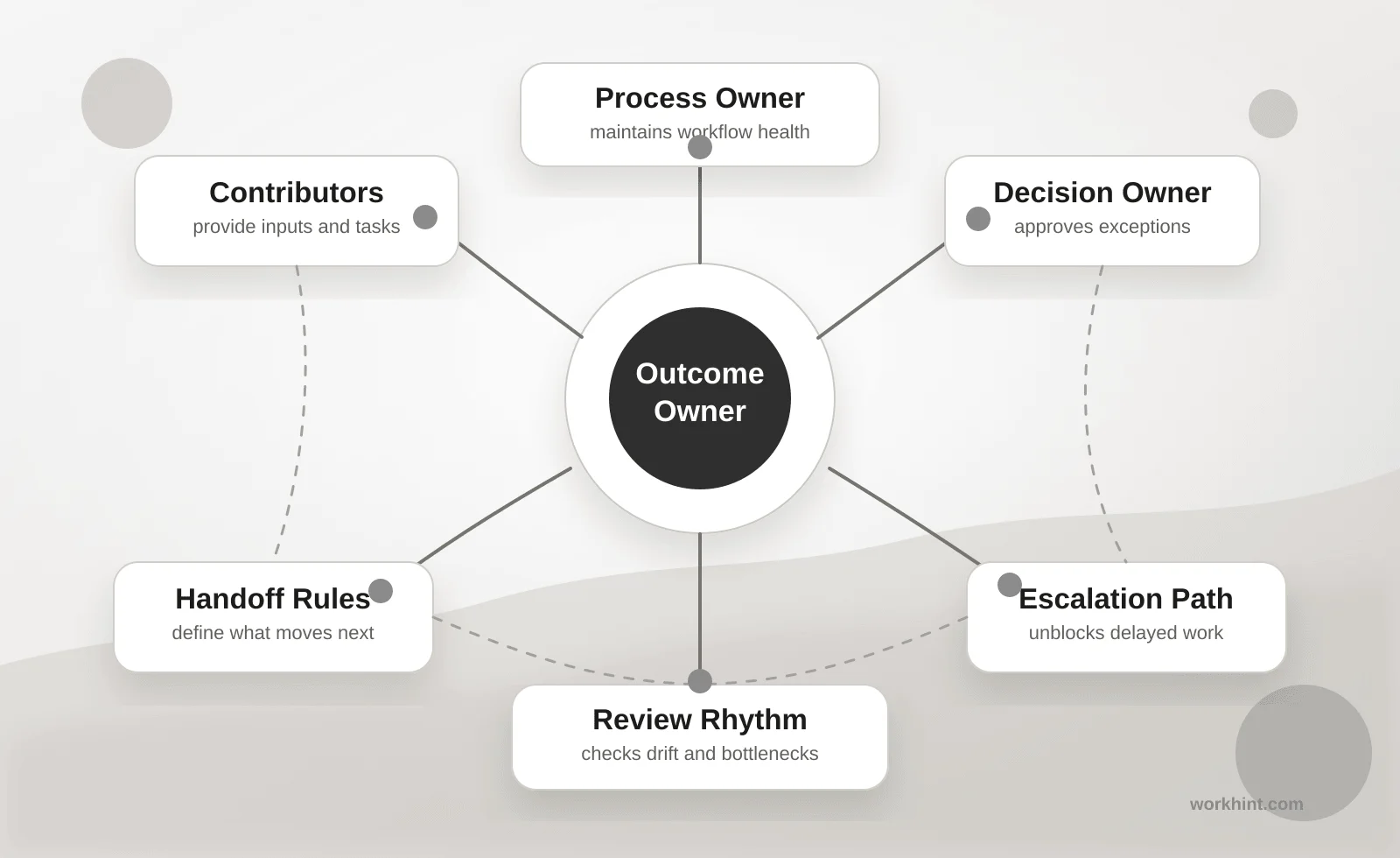
How to create role clarity step by step
- Start with the workflow, not the org chart. Pick one recurring process and map the work from intake to completion. Role clarity is easier when tied to real steps.
- Name the business outcome. Decide whether the process is optimizing speed, quality, risk control, customer experience, cost, compliance, or capacity.
- Assign one outcome owner. This person is accountable for whether the process works. They do not need to perform every task.
- Assign a process owner. The process owner keeps the workflow current, watches performance, and coordinates improvements. APQC’s overview of business process owners emphasizes governance, performance targets, documentation, monitoring, and improvement.
- Separate task owners from decision owners. A person can complete work without having authority to approve the next move. Write both down.
- Define handoff conditions. Each handoff should say what must be complete, what evidence is required, and where the next owner receives the work.
- Set escalation rules. Clarify what happens when a task is late, blocked, disputed, missing data, or outside normal policy.
- Review the model with the people doing the work. The fastest way to find hidden confusion is to ask each role what they believe they own, what others expect from them, and where they see repeated delays.
When RACI is useful and when it is not enough
RACI can help teams define who is responsible, accountable, consulted, and informed. It is useful for simple projects and repeated deliverables. But many operations workflows need more precision than RACI gives by itself.
McKinsey has argued that RACI can become too limited for decision-making and suggests clearer decision roles when speed matters. In operations, the common failure is similar: a team knows who is consulted, but not who can make the final call, what evidence they need, or what happens if they do not respond.
Use RACI as one input. Then add decision authority, thresholds, handoff requirements, escalation paths, and review cadence. That turns role clarity from a static responsibility chart into an operating model.
Common mistakes
- Giving ownership to a group: Teams can contribute, but outcomes need a named owner.
- Confusing seniority with ownership: The highest-ranking person is not always the best process owner.
- Skipping decision rights: If nobody knows who can approve exceptions, the workflow will stall.
- Documenting roles once: Roles drift as teams grow, tools change, or exceptions increase.
- Ignoring handoffs: Many delays happen between steps, not inside steps.
Where Workhint fits
Once the role clarity framework is agreed, the next challenge is making it operational. Workhint helps teams turn the framework into a live work system: intake forms, role-based permissions, assigned owners, approval routes, handoff rules, escalation triggers, dashboards, and review records.
For teams moving beyond spreadsheets and disconnected task lists, workflow automation software can make role clarity visible inside the work itself. Instead of relying on a document people forget to check, the process can route work to the right owner, request the right approval, and show where responsibility sits at every stage.
FAQ
What is a role clarity framework?
A role clarity framework is a structured way to define who owns outcomes, decisions, tasks, handoffs, escalations, and reviews in a workflow or team.
What is the difference between role clarity and RACI?
RACI is one responsibility mapping tool. Role clarity is broader because it also covers outcomes, decision rights, escalation paths, handoff requirements, and operating rhythms.
Who should own role clarity in operations?
The outcome owner should sponsor it, the process owner should maintain it, and the people doing the work should validate it against real execution.
How often should roles be reviewed?
Review roles whenever the process changes, ownership confusion causes delays, volume increases, a new team joins, or at least once per quarter for critical workflows.
Conclusion
Role clarity is not an HR exercise tucked away in a document. For operations teams, it is execution infrastructure. Clear ownership helps work move, decisions happen, exceptions escalate, and teams improve the workflow instead of arguing about who was supposed to act.
Start with one important process. Define the outcome, owner, decision rights, contributors, handoffs, escalations, and review rhythm. Then turn that model into the system where work actually happens.
Leave a Reply