

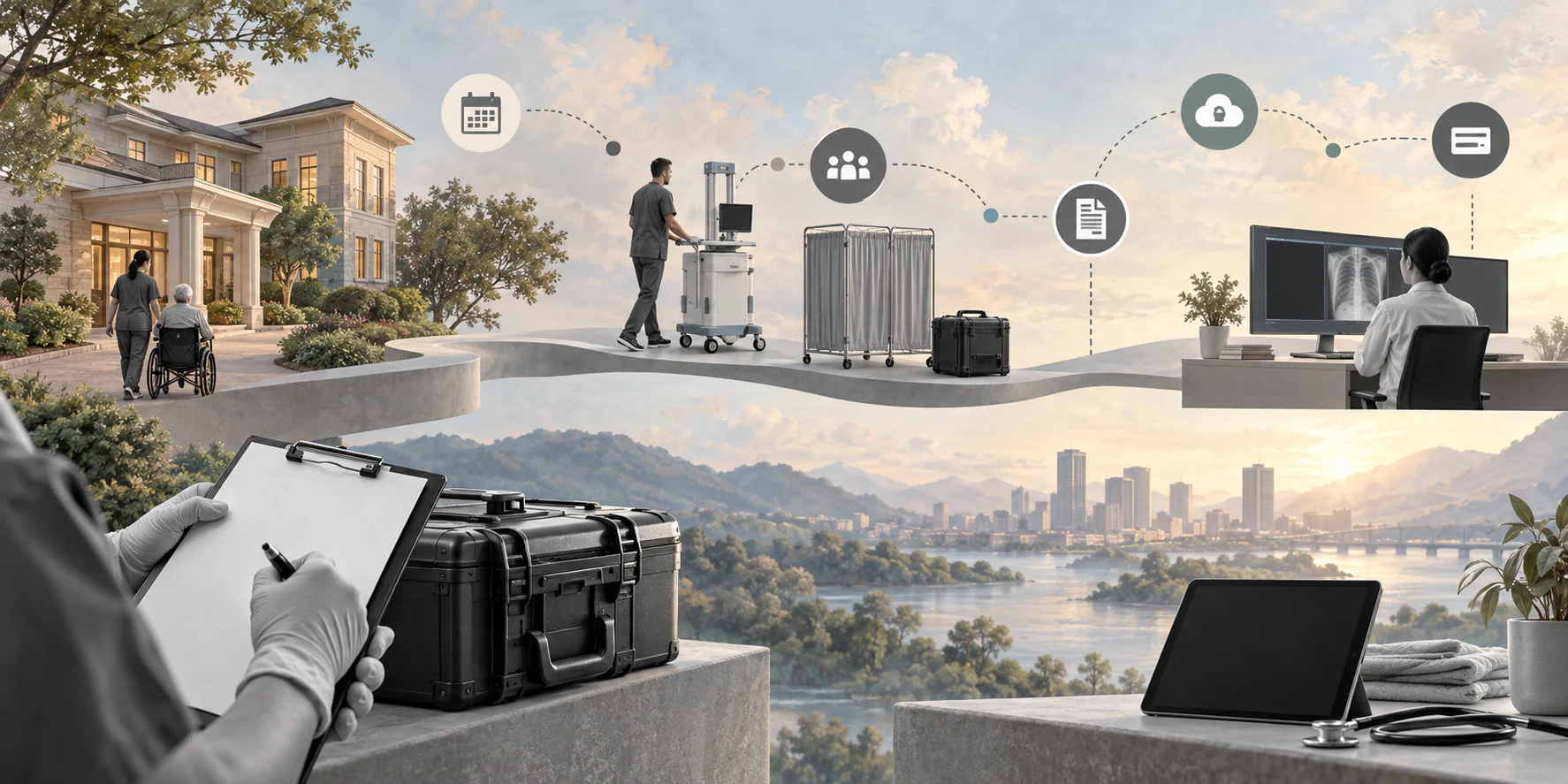
A mobile X-ray business can start as a coordinated provider network before it becomes a capital-heavy imaging company.
A mobile X-ray business brings portable imaging to nursing homes, senior living, home health patients, urgent care groups, correctional facilities, and sites where moving a patient is slow or risky.
The mistake is assuming you need to open a clinic, hire a full staff, and buy every asset before proving demand. This is a regulated healthcare service, so compliance matters from day one. But the smarter early model is to validate facility demand, recruit qualified independent radiologic technologists or mobile imaging partners, build the request-to-report workflow, and only invest deeply once the market is proven.
Quick answer
You can start a mobile X-ray business without a clinic by choosing a narrow market, confirming state radiation and business requirements, partnering with qualified radiologic technologists and reading physicians, setting up intake and scheduling, and selling to facilities that need on-site imaging. Workhint can provide the branded platform that connects requests, provider assignment, documentation, approvals, payments, and payouts.
What’s in this article?
- Why mobile X-ray works
- What you need to launch
- How to price mobile imaging services
- How to get first facility customers
- How Workhint helps operate the business
- A 7-day launch plan and checklist
Why a mobile X-ray business works
Mobile imaging solves a clear operational problem. Facilities often need diagnostic imaging but do not want to transport fragile patients, coordinate family approvals, wait for outside appointments, or lose staff time managing logistics.
The best first buyers already feel this pain repeatedly: skilled nursing facilities, assisted living communities, home health agencies, occupational health groups, and urgent care operators with overflow needs.
This business also fits a network model. Instead of hiring a large staff immediately, the founder can coordinate qualified technologists, reading partners, and facility accounts through a controlled operating process.
What you need to launch
Start by validating three things: which facilities need mobile imaging, which credentialed providers can legally deliver the service, and which state rules govern radiation equipment, supervision, reporting, privacy, billing, and business registration.
Do not treat licensing as a generic checklist. Requirements vary by state and service model. Talk to a healthcare attorney, radiation control office, billing advisor, and insurance broker before taking patient work.
| Launch item | Lean startup approach | Why it matters |
|---|---|---|
| Market validation | Interview 20 facility administrators or directors of nursing | Confirms demand before equipment investment |
| Compliance review | Map state radiation, credentialing, HIPAA, insurance, and billing rules | Prevents an illegal or unbillable service model |
| Provider network | Recruit qualified radiologic technologists and reading partners | Creates capacity without premature full-time hiring |
| Equipment strategy | Partner, lease, or start with limited owned equipment only after demand proof | Protects cash until request volume is visible |
| Operating platform | Use a branded portal for requests, scheduling, documents, payments, and reporting | Turns the business into a reliable service system |
Portable X-ray systems can be expensive. Validate demand and partner capacity before buying a van and equipment outright.
How to price it
Pricing depends on customer type, travel distance, urgency, reading arrangement, and payment model. Keep the first offer simple.
For early validation, sell a facility-ready service package: mobile X-ray visits, clear appointment windows, documentation collection, secure image routing, report delivery, and consolidated invoicing. Emergency, after-hours, and long-distance work should cost more.
| Offer | Example price logic | Best use case |
|---|---|---|
| Standard facility visit | Base visit fee plus study fee | Recurring nursing home or assisted living demand |
| Same-day mobile visit | Premium for faster dispatch | Urgent but non-emergency facility needs |
| Monthly facility account | Minimum monthly volume or preferred-rate plan | Facilities with predictable imaging requests |
| Partner network model | Customer fee minus provider payout and reading cost | Early launch without full-time employees |
The margin test is simple: after provider payout, reading cost, travel, billing, insurance, software, and admin time, each job still needs to make sense.
How to get first customers
Start with facilities where imaging delays create visible friction. Build a short list of skilled nursing facilities, rehab centers, assisted living operators, home health agencies, occupational medicine clinics, and urgent care groups.
Your first outreach should not sound like a generic startup pitch. Ask about imaging delays, patient transport burden, after-hours gaps, report turnaround, documentation problems, and vendor reliability. If a facility already uses a provider, look for gaps such as weekend coverage, overflow, rural routes, faster scheduling, or clearer communication.
Early customer acquisition should focus on proof. One pilot facility with repeat orders is more useful than one-off appointments.
How Workhint helps launch it
Workhint helps the founder create the branded operating platform before investing in a clinic, custom software, or full-time operations team.
A facility can submit an imaging request through a branded customer portal. The request captures patient location, ordering provider details, required study, urgency, consent status, facility notes, and billing instructions. Workhint then routes the request, checks required documents, and helps assign it to a qualified provider.
The provider receives the assignment, visit window, facility instructions, checklist, and documentation steps. After the visit, the workflow can track image routing, reading status, report delivery, invoice creation, customer payment, and provider payout.
As the model expands, service marketplace software can centralize facility intake, qualified provider onboarding, routing, documents, approvals, payments, and service quality.
First 7-day launch plan
Day 1: Choose the launch market and the first buyer type, such as skilled nursing facilities within a tight local radius.
Day 2: Map state requirements for radiation equipment, technologist credentials, insurance, HIPAA, physician orders, billing, and business registration.
Day 3: Build the first Workhint request flow for facility intake, scheduling, provider assignment, document collection, report status, invoicing, and payouts.
Day 4: Speak with qualified radiologic technologists, reading groups, and mobile imaging partners who could support the first pilot.
Day 5: Contact 20 facilities and ask about current imaging delays, transport costs, vendor gaps, and pilot interest.
Day 6: Price a narrow pilot offer and route sample requests through the platform before accepting live patient work.
Day 7: Review demand, compliance readiness, provider capacity, and unit economics before buying equipment or expanding the service area.
Final launch checklist
- Choose a narrow launch market and facility segment.
- Confirm state radiation, healthcare, privacy, insurance, and billing requirements.
- Recruit qualified radiologic technologists or mobile imaging partners.
- Confirm reading physician or radiology group workflow.
- Create a branded Workhint portal for facility requests.
- Set up provider onboarding, credentials, availability, assignments, and payouts.
- Define pricing for standard visits, urgent visits, and recurring facility accounts.
- Run a controlled pilot before purchasing major equipment.
- Validate demand before expanding geography or hiring employees.
FAQ
How much does it cost to start a mobile X-ray business?
Costs vary widely. A traditional launch with owned portable X-ray equipment, vehicle setup, software, insurance, compliance, and working capital can require significant investment. A leaner launch validates facility demand first, builds provider and reading partnerships, and delays major asset purchases until volume is proven.
Do I need a clinic to start a mobile X-ray business?
No clinic is required for the platform-first model, but you still need the right legal, healthcare, radiation, privacy, billing, and provider requirements. Design the business around compliance from the beginning.
Can I use independent contractors?
You may be able to work with independent qualified providers or partner organizations, but classification, credentialing, supervision, and healthcare compliance rules matter. Get legal guidance before relying on contractors for patient services.
Who are the best first customers?
Skilled nursing facilities, assisted living communities, rehab centers, home health agencies, hospice providers, occupational health groups, and urgent care operators are strong first targets because imaging logistics affect their operations repeatedly.
What equipment do I need?
The full model may require portable X-ray equipment, detectors, secure imaging software, transportation, radiation safety controls, documentation tools, and communication systems. Early validation may be done through partnerships before buying equipment.
How do mobile X-ray businesses make money?
Revenue can come from per-visit fees, per-study charges, facility account pricing, urgent visit premiums, or contracted provider-network margins. The model must account for travel, provider payouts, reading costs, billing costs, insurance, software, and compliance overhead.
Conclusion
A mobile X-ray business is a regulated healthcare operation that needs careful compliance, qualified providers, and reliable execution.
But it does not have to begin with a clinic, a full-time team, or a major equipment purchase. Start by proving demand, building a qualified provider network, and using Workhint to run the operational foundation from the first facility request through scheduling, service delivery, reporting, payment, and payout.
Leave a Reply