


A contractor training matrix turns readiness from a manager’s memory into a visible control before external work begins.
A contractor training matrix is a practical record that shows which contractors, freelancers, agency workers, subcontractors, or field partners have completed the training required for the work they are approved to perform. It helps operations teams answer a simple question before assigning work: is this external worker ready for this role, location, risk level, and customer requirement today?
The matrix should not become a fake employee file or a generic spreadsheet of names. Contractors may work under different agreements, schedules, clients, locations, and access rules. The useful version connects training evidence to the actual assignment: safety orientation, site rules, equipment authorization, system access, data handling, customer procedures, incident reporting, and current credentials.
What’s in this article?
- What a contractor training matrix should track.
- How to separate skills, training, credentials, and work authorization.
- A practical matrix structure business teams can adapt.
- Common mistakes that make contractor readiness unreliable.
- Where Workhint fits when contractor training needs a live workflow.
Why contractor training matrices matter
External workers often move faster than internal systems. A manager needs a specialist next week. A staffing agency confirms a worker for tomorrow. A field partner needs access to a site. A freelancer needs customer data to begin delivery. If training status lives in email, shared drives, or a vendor’s spreadsheet, the business may not know whether the person is actually ready.
That gap matters most when training is tied to safety, compliance, access, quality, or customer trust. OSHA says employers must provide training to workers who face job hazards, and that workers should receive appropriate safety training before potentially hazardous activities. OSHA also explains that required training must be presented in a manner workers can understand. Even when a vendor owns part of the training, the hiring company still needs a clear operating record.
A contractor training matrix gives that record one place to live. It shows which requirements apply, who completed them, who reviewed the evidence, when the evidence expires, and whether the contractor can be assigned.
Contractor training matrix fields
A useful matrix is narrow enough to maintain and detailed enough to drive assignment decisions. Start with these fields, then adjust by role, risk, location, and client requirement.
| Field | What it captures | Why it matters |
|---|---|---|
| Contractor identity | Legal name, business name, supplier, role, and internal owner. | Prevents training records from floating away from the approved engagement. |
| Work type | Project, service line, site, client, equipment, or system involved. | Training requirements should match the work, not a generic worker category. |
| Required training | Orientation, safety briefing, policy acknowledgement, tool training, privacy training, or customer process. | Shows what must be complete before assignment. |
| Evidence | Completion record, certificate, signed acknowledgement, assessment, supervisor review, or vendor attestation. | Turns a checked box into an auditable decision. |
| Status and expiration | Not started, in progress, complete, expired, exception approved, or blocked. | Keeps assignments from relying on stale documents. |
| Reviewer and decision | Named owner, review date, exception note, and assignment authorization. | Makes it clear who decided the contractor was ready. |
How to build the contractor training matrix
Start with the work categories that create real risk or delay. A remote copywriter, warehouse temp, field technician, implementation consultant, data analyst, and agency account lead do not need the same training record. Define the roles where readiness affects safety, quality, access, customer delivery, or payment approval.
Next, split training from skills and credentials. A skill describes capability, such as forklift operation, customer escalation, implementation configuration, or data cleanup. Training describes instruction completed for a policy, tool, site, or process. A credential is evidence from a third party, such as a license, certification, or required card. Work authorization is the business decision that this contractor can perform this assignment now. Mixing those four ideas into one column makes the matrix hard to trust.
Use an external reference when you define role requirements. The O*NET Content Model organizes occupational information around worker characteristics, worker requirements, experience requirements, occupational requirements, and occupation-specific information. That structure is useful when teams need a neutral way to think about skills and work activities before turning them into training and readiness requirements.
Then set review rules. Some training is one-time orientation. Some must renew annually. Some expires with a certificate. Some must be repeated when a contractor changes location, client, equipment, scope, or access level. The matrix should show the trigger, not just the completion date.
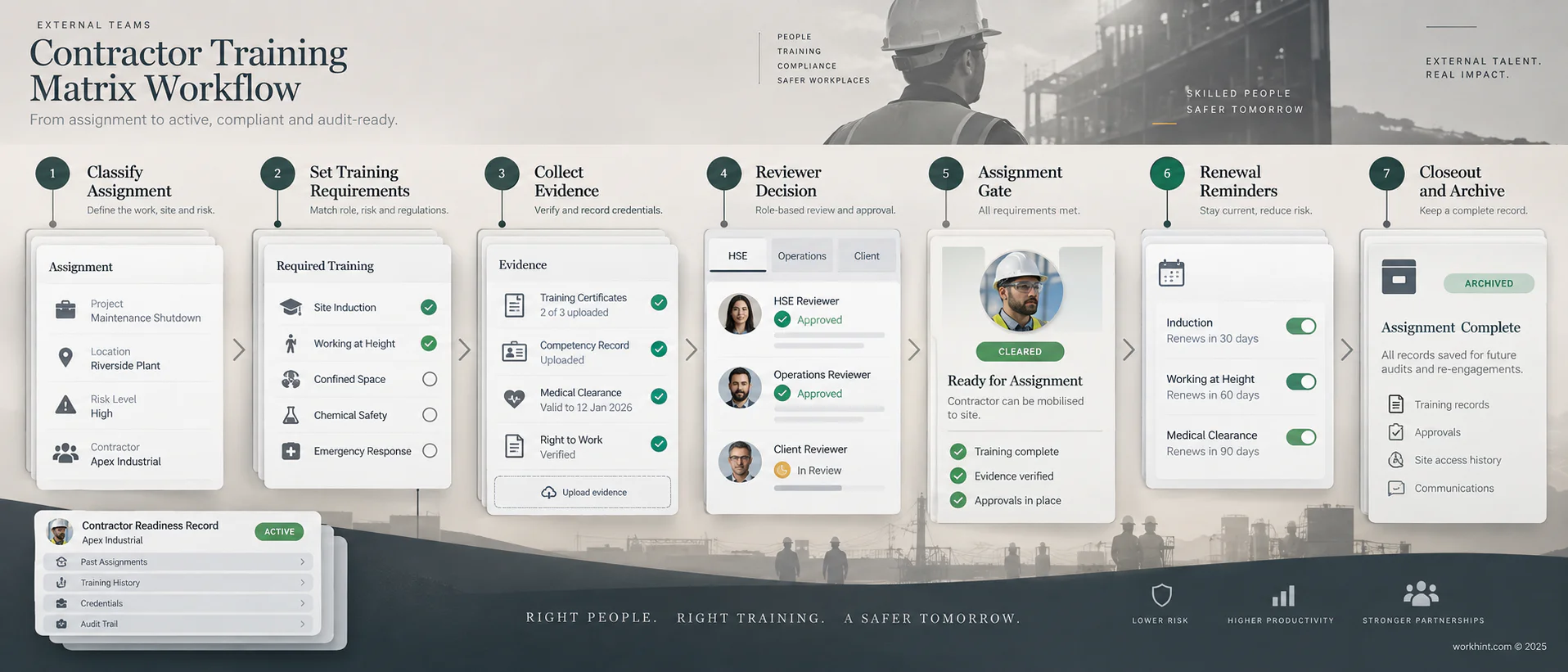
Contractor training matrix workflow
The matrix only works if it is connected to the contractor lifecycle. Use this workflow before work starts, then repeat it at renewal, scope change, incident, or reassignment.
- Classify the assignment. Define the work type, location, systems, customer exposure, safety exposure, and data access.
- Select requirements. Match the assignment to required training, acknowledgements, credentials, and evidence.
- Collect evidence. Ask the contractor, staffing supplier, agency, or internal owner for only the records needed for the assignment.
- Review and decide. A named owner confirms completion, rejects gaps, or approves a documented exception.
- Gate assignment. Do not release access, schedule work, or approve deployment until required items are complete or formally waived.
- Monitor renewals. Trigger reminders before training, certifications, or site approvals expire.
- Archive closeout evidence. Keep the training record with the contractor profile, work order, project, or vendor relationship.
Common mistakes in contractor training matrices
The first mistake is using the same requirements for every contractor. That creates unnecessary friction for low-risk work and weak control for high-risk work. Requirements should scale with the assignment.
The second mistake is accepting evidence no one reviews. A folder full of certificates is not a readiness process. Assign the owner who checks whether the record matches the person, work type, date, location, and requirement.
The third mistake is ignoring language and comprehension. OSHA’s training policy says required training must be presented in a way workers are capable of understanding. A signed acknowledgement is weak if the contractor did not receive the instruction in a usable format.
The fourth mistake is treating the matrix as a static spreadsheet. Training and readiness change when contractors renew, switch projects, move locations, receive new access, or take on different risk. The matrix should create reminders and assignment gates, not sit untouched until an audit.
Where Workhint fits
Workhint fits when contractor training needs to become part of a live external workforce system. A business can use contractor compliance software to structure contractor intake, define role-specific requirements, collect evidence, route reviews, block assignments until readiness is confirmed, trigger renewal reminders, and keep decisions attached to the contractor record.
That matters because training status is rarely owned by one team. Operations may own the assignment. Safety may own worksite readiness. IT may own system access. Legal or compliance may own policy acknowledgements. Finance may need proof before payment. Workhint connects those owners so readiness is visible before the work, not reconstructed after a problem.
FAQ
What is a contractor training matrix?
A contractor training matrix is a structured record that shows which training, acknowledgements, credentials, and readiness checks apply to each contractor before they perform approved work.
What should a contractor training matrix include?
It should include contractor identity, supplier or business name, work type, required training, evidence, completion date, expiration date, reviewer, status, exception notes, and assignment authorization.
Who should own contractor training records?
Ownership is usually shared. Operations should own assignment readiness, while safety, compliance, IT, procurement, HR, or the vendor owner may review specific requirements. One business owner should remain accountable for the final readiness decision.
How often should contractor training be reviewed?
Review it before first assignment, before renewal, when scope or location changes, after incidents, when requirements change, and before expiration dates. High-risk field or customer-facing work may need a more frequent review cadence.
Conclusion
A contractor training matrix is useful when it helps the business decide who is ready to work, where, and under what conditions. Keep the matrix focused on assignment risk, separate skills from training and credentials, require evidence, assign reviewers, and connect the record to onboarding, access, scheduling, renewals, and closeout. That is how external teams move quickly without turning readiness into guesswork.
Leave a Reply