

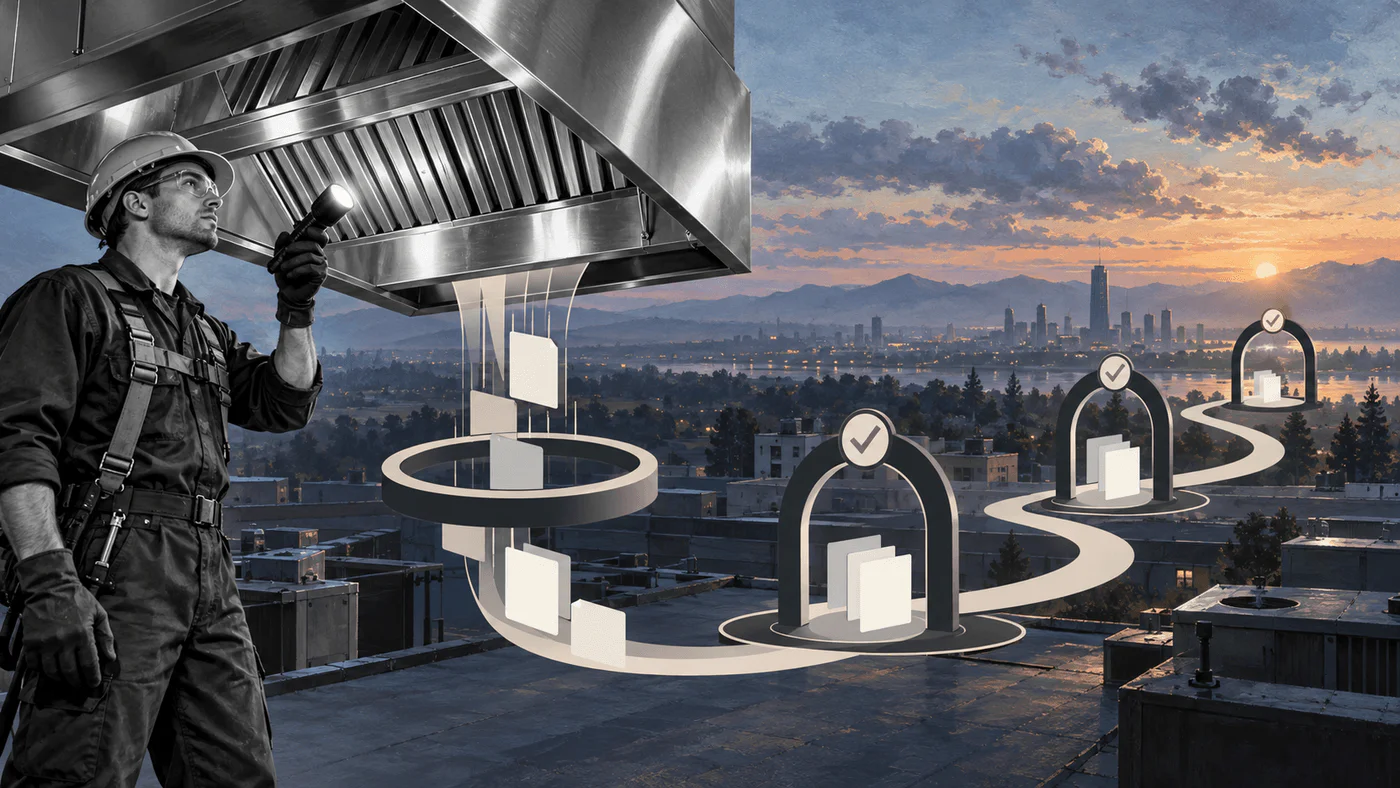
Kitchen-exhaust cleaning can become a recurring B2B service, but it is not ordinary janitorial work. A restaurant is buying a provider that can protect the kitchen, control runoff, work safely around roof and fan access, document the result, and return on the right schedule. If you cannot build those controls before selling, do not launch yet.
Map intake, scheduling, evidence, and exceptions before scaling.
Quick answer
Start a kitchen-exhaust hood cleaning business only after you can prove four things: a reachable group of food-service buyers has a recurring need, you can perform or supervise the work safely and to the requirements of the local authority having jurisdiction, your job price covers labor, travel, containment, disposal, insurance, and rework, and every visit creates a complete service record. Begin with a narrow service area and a validation run of ten qualified accounts—not a truck purchase or broad advertising campaign.
What business are you actually building?
The offer is not “we clean kitchens.” It is scheduled cleaning of commercial cooking exhaust hoods, ducts, fans, and accessible related components, with containment, cleanup, photo evidence, deficiencies, and a next-service date. The customer may be an owner, facilities lead, restaurant group, property manager, or kitchen operator. The payer wants a dependable record and an uninterrupted operation—not simply a low cleaning price.
This is distinct from a general commercial cleaning business. General cleaning can often start with simpler daytime scopes. Exhaust work can involve overnight access, greasy runoff, ladders or roof work, equipment lockout, and local fire or sanitation expectations. That complexity is the opportunity and the reason to be conservative.
Go/no-go: test the model before buying a full setup
Use a small, evidence-led test. The numbers below are planning thresholds, not market facts.
| Hypothesis | Test | Signal | Threshold | Decision |
|---|---|---|---|---|
| Local operators will switch or add a qualified provider. | Interview 15 restaurant or facility decision-makers in one route area. | They disclose current service cadence, dissatisfaction, or an upcoming need. | At least 5 agree to a site assessment or quote conversation. | Continue; otherwise change segment or stop. |
| You can deliver a compliant scope safely. | Review a real site with a qualified trainer or experienced operator; map access, containment, shutdown, and disposal. | Every required step has an owner and a local verification path. | No unresolved high-risk step. | Continue; otherwise do not sell that scope. |
| A route can support a margin. | Build three job estimates using observed travel, labor, supplies, disposal, and rework assumptions. | Price exceeds fully loaded job cost with a contingency. | All three are positive before owner pay. | Continue; otherwise redesign route, scope, or price. |
| Recurring work is sellable. | Offer a written service agreement to the first qualified prospects. | Buyers accept a defined cadence and record package. | Two signed recurring pilots or documented objections you can resolve. | Continue; otherwise revise the offer. |
Verify safety, wastewater, and local requirements first
Do not treat a generic business registration as permission to clean kitchen exhaust. The exact requirements can depend on the location, fire authority, building owner, contract, and system. Confirm who the authority having jurisdiction is, what proof it expects, whether a credential or registration is required, and whether your proposed scope includes work you are not qualified to perform.
Roof or elevated fan access is a real operating gate. OSHA’s fall-protection rule requires employers to protect workers exposed to fall hazards; plan the site-specific access and protection before accepting the job. For wash water, never assume a roof drain or storm drain is acceptable. EPA guidance explains that non-stormwater discharge to a storm-drain system is generally an illicit discharge; verify the legal collection and disposal method with the relevant local utility or authority.
Stop condition: do not launch if you cannot establish safe access, lawful disposal, required qualification, or insurance coverage for the job you plan to sell. Hiring independent contractors does not remove those requirements; validate qualifications, insurance, and responsibility in writing.
Build the unit economics around a completed job
Price each service from the work required to finish and document it, not from a competitor’s headline rate. A simple planning model is:
Contribution per job = quoted price − direct labor − travel − chemicals and consumables − containment/disposal − job-specific access or equipment − expected rework reserve.
Then test whether route density can absorb fixed costs such as insurance, equipment maintenance, training, sales time, and administration. A seemingly profitable single job can fail if the crew spends too long driving, waiting for the kitchen to close, setting containment, or returning to correct incomplete work. Use a separate line for owner labor so you do not confuse revenue with profit.
Illustrative estimate worksheet
- Scope: hood count, fan/duct access, operating hours, roof access, photos required, and exclusions.
- Time: setup, cleaning, cleanup, documentation, travel, and contingency.
- Direct costs: crew time, supplies, containment, disposal, access equipment, and subcontracted qualified work.
- Risk reserve: rework, a failed access attempt, or a missed defect—not a hidden promise to fix an unknown system.
- Decision: minimum acceptable price, next-service date, and whether the route is worth adding.
Design the first operating workflow
Your operational advantage is a complete chain of custody from inquiry to recurring service. Create a workflow with these states:
- Inquiry received: capture location, kitchen type, current service record, requested date, and decision-maker.
- Site assessed: record scope, access, hazards, local-requirement verification, containment/disposal plan, and exclusions.
- Quote pending approval: send a defined scope and service agreement; flag missing access approval or insurance requirements.
- Scheduled: assign a qualified crew, confirm shutdown/access window, and stage the job checklist.
- On site: complete pre-job controls, lockout/access checks where applicable, containment, cleaning, and cleanup.
- Evidence review: attach before/after photos, service notes, deficiencies, customer acknowledgment, and next-service recommendation.
- Closed or exception: invoice only after evidence review; route blocked access, unsafe conditions, missing evidence, or rework to an owner.
Exceptions are not edge cases in this model. Use a deliberate workflow exception-handling process for an inaccessible roof, a customer who will not shut down equipment, uncontained runoff risk, missing photos, or a scope change. An exception should stop the normal closeout—not disappear into a crew text message.
The service record your customer should receive
Create one record per visit. At a minimum, include customer and site identity; equipment/scope; access and safety checks; service date and crew; before/after photos; work completed; observed deficiencies; containment/disposal notes; customer acknowledgment; next due date; and the person responsible for follow-up. Do not certify compliance or claim work outside your verified scope.
How to sell the first recurring accounts
Start with one narrow geography and a buyer you can reach repeatedly—independent restaurants, a small restaurant group, or a facilities operator. Ask for a site assessment rather than pitching a blanket price. The conversation should surface their current provider, service record, access window, decision-maker, renewal date, and the problems that cause rework or inspection anxiety.
A useful offer is a bounded pilot: one documented cleaning visit, a clear scope, a list of any deficiencies outside your scope, and a proposed recurring schedule only after the site assessment. Avoid promising a compliance outcome you cannot control. Earn the recurring agreement by making the record, scheduling, and communication better than the status quo.
Venture canvas: should you pursue it?
| Question | Founder answer to validate |
|---|---|
| Customer and urgency | Which local operator has a recurring cleaning obligation and a costly consequence for missed or undocumented service? |
| Offer | What exact equipment and evidence package are included—and what is excluded? |
| Supply | Who is qualified to do the work, who supervises quality, and how is availability covered overnight? |
| Money flow | Can the account be priced per completed visit or annual agreement without financing unsafe shortcuts? |
| Risk | How will roof access, chemical handling, runoff, property protection, and local requirements be verified before work? |
| Growth trigger | At what route density and documented closeout quality will you add a crew or geography? |
Verdict: conditional, not an easy side business
This model is conditional. Recurring B2B demand and route density can make it attractive, but it is difficult for a founder who treats it as simple cleaning or relies on unqualified labor. Pursue it only when you can validate local requirements, safe access, disposal, documented quality, and positive job economics. If any one of those remains unresolved after the validation run, stop or narrow the service rather than trying to scale around the gap.
Build this business in Workhint
Once the pilot works, you can map the operating system with Workhint rather than manage service records and exceptions across texts and spreadsheets.
Build an operating system for a commercial kitchen-exhaust cleaning service. Create customer and site intake for restaurant and facilities buyers; capture hood, duct, fan, access, and current-record details; verify provider eligibility, insurance, training, and service-area coverage; route site assessments; manage quote approval and recurring service schedules; assign qualified crews; require pre-job access, shutdown, containment, safety, and disposal checks; move jobs through Scheduled, On Site, Evidence Review, Closed, Rework Required, and Blocked states; require photos, service notes, deficiencies, customer acknowledgment, and next due date before closeout; route roof-access, unsafe-condition, missing-evidence, rescheduling, and scope-change exceptions to an administrator; provide customer and provider portals; and report scheduled jobs, incomplete evidence, blocked work, rework, next due dates, route capacity, and closeout quality. Do not configure payment, escrow, or integrations that have not been verified.
FAQ
Can I start by subcontracting the cleaning?
Possibly, but only after validating the subcontractor’s qualification, insurance, local acceptability, responsibility for evidence, and the contract’s allocation of risk. A subcontractor does not make the sales, safety, documentation, or customer-accountability problem disappear.
How many customers do I need before buying equipment?
There is no universal number. Use the validation threshold: buy only after qualified prospects and pilot economics show that the equipment supports a repeatable, positive contribution model in a route you can serve safely.
What should make me stop the test?
Stop when safe access, lawful disposal, required qualifications, reliable provider supply, or positive fully loaded job economics cannot be established. Those are structural gates, not marketing problems.
Leave a Reply