

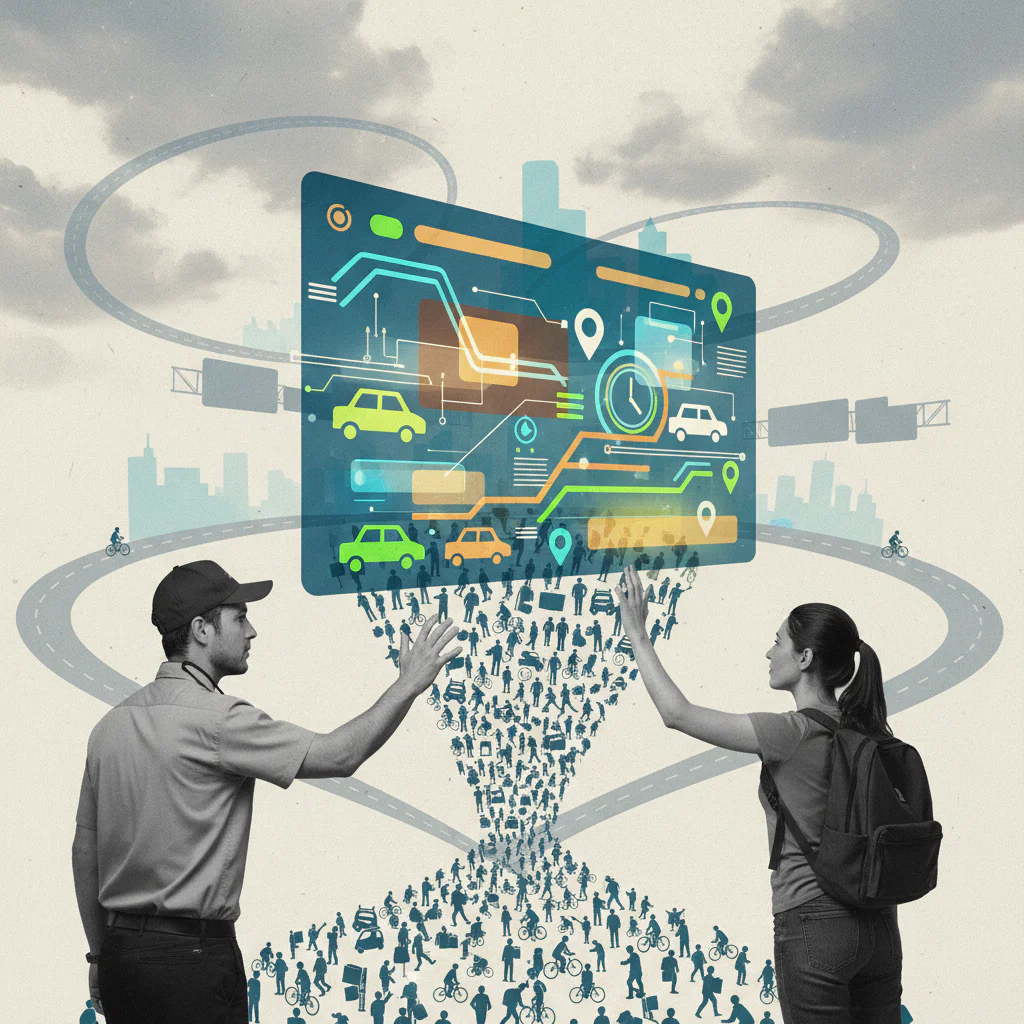
A founder turned a fragmented gig market into a billion‑dollar engine by mastering network effects, pricing, and global scaling.
Quick answer
Uber's platform illustrates the operating mechanics of an on-demand marketplace: attract participants on both sides, match demand with available supply, coordinate location and timing, set or present prices, support transactions, manage trust and safety, and resolve exceptions. The model also raises important questions about worker classification, local regulation, incentives, data, market power, and the reliability of platform rules.
On-demand workforce platform operating model
- Create a clear value exchange for customers and service providers.
- Build matching, availability, location, pricing, communication, and transaction flows.
- Establish identity, quality, safety, cancellation, dispute, and support controls.
- Monitor liquidity, service reliability, economics, worker outcomes, and local requirements.
When you look at the streets of a city at rush hour, you see a choreography of cars, bikes, and scooters that seems almost accidental. Yet behind that apparent chaos is a decision‑making engine that turns spare time into a $50 billion business. It’s the story of a founder who saw a fragmented gig market not as a problem to fix, but as a canvas to paint a new kind of workforce.
Most people assume the gig economy is simply a collection of independent contractors doing odd jobs. What they miss is the hidden architecture that aligns incentives, balances supply and demand, and scales across continents without a single central office dictating schedules. The core insight is that network effects, dynamic pricing, and relentless global scaling aren’t just buzzwords—they’re the levers that convert scattered effort into a reliable, on‑demand engine.
I’ve spent years watching platforms rise and fall, watching founders claim they’ve cracked the code only to see it crumble under real‑world friction. That perspective gives me a front‑row seat to the subtle forces that make or break a gig‑based model, without needing a title on a wall.
If you’ve ever wondered why some on‑demand services feel effortless while others stumble, you’re about to see the invisible scaffolding that makes the smooth rides possible. It’s not magic; it’s a disciplined application of economics and technology that most companies overlook.
Let’s unpack this.
Why network effects matter more than scale
The moment a rider sees a car appear within minutes, they are not just buying a ride; they are buying confidence that the system will always be there. That confidence is the product of network effects. Each new driver makes the platform more reliable, and each new rider makes it more profitable for a driver to stay. Uber turned this invisible loop into a growth engine by focusing on the quality of the match rather than the sheer number of cars. When the balance tips toward excess supply, prices fall and riders flood in, reinforcing the loop. When supply thins, prices rise, attracting more drivers. The magic is not in the number of markets entered, but in the ability to let each market feed the other. Readers who think scale alone drives success will see that the real lever is the strength of the connection between supply and demand.
How dynamic pricing keeps the market alive
Imagine a city where every ride costs the same no matter the time of day or weather. Riders would wait for the perfect moment, and drivers would abandon the platform during slow periods. Dynamic pricing solves that by adjusting rates in real time, turning scarcity into opportunity. Uber uses algorithms that watch traffic, events, and weather to raise fares when demand spikes and lower them when supply surges. The result is a self correcting market that rarely sees empty streets. For the driver, it feels like a fair wage that reflects effort. For the rider, it feels like a promise that a ride will appear when they need it most. The lesson for any on demand business is simple: price must be fluid, not fixed, and the technology that powers it must be transparent enough to earn trust.
What hidden traps derail on demand platforms
Every founder hears the story of a platform that grew overnight, but the real challenge lies in the quiet moments after the hype fades. One common trap is ignoring the quality of the experience once the platform reaches critical mass. A flood of low quality drivers can erode brand trust faster than any competitor. Another pitfall is over reliance on incentives that cannot be sustained, such as endless bonuses that drain cash flow. Finally, many platforms forget that regulation is not a roadblock but a roadmap; failing to engage with local authorities creates costly legal battles. Uber learned these lessons the hard way, adjusting its driver support, refining its incentive structures, and building teams to work with city officials. The takeaway for readers is to anticipate friction before it appears, design safeguards that protect both supply and demand, and treat regulation as a partner in growth.
A modest start
Founders who have studied the larger success stories often begin by gathering the handful of freelancers they already know into one shared workspace. They create a single list, assign a few pilot jobs, and watch how quickly the assignments are accepted, completed, and reported back. The focus is on keeping the data in one place—profiles, availability, and simple task descriptions—so they can see the basic supply‑demand rhythm without building a full‑scale platform. By recording the outcomes in a central sheet, they can spot bottlenecks, adjust rates, and decide whether the model holds up under real work. When they need a minimal tool to hold that information, they sometimes turn to Workhint for a quick, white‑labeled environment that lets them test the flow without writing code. The early iteration remains a low‑cost experiment, ready to be expanded only after the core exchange proves reliable.
The streets you see at rush hour are not chaos; they are the result of a decision‑making engine that turns spare minutes into a $50 billion promise. The question we began with—how a fragmented gig market became a reliable workforce—answers itself when you realize the engine runs on one simple principle: every extra driver, every extra rider, adds confidence, and confidence fuels more of both. If you can let that loop breathe, let price breathe with it, and guard the experience that keeps trust alive, the platform will sustain itself without a central scheduler. So the next time you design an on‑demand service, start by asking, “What tiny incentive will make the next participant feel the system is already working for them?” That tiny incentive is the spark that turns a handful of rides into an enduring network.
FAQ
What makes an on-demand workforce platform scalable?
Scalability depends on repeat demand, reliable supply, efficient matching, trust, local density, operational controls, sustainable economics, and a consistent participant experience.
Can another business copy Uber's model directly?
No. The workflow may offer lessons, but regulations, labor models, customer needs, risk, geography, unit economics, and service operations differ by market.
How can Workhint support this process?
Workhint can connect intake, roles, permissions, assignments, approvals, records, and reporting in one operational system. See how service marketplace software can support the workflow described above.
Leave a Reply