
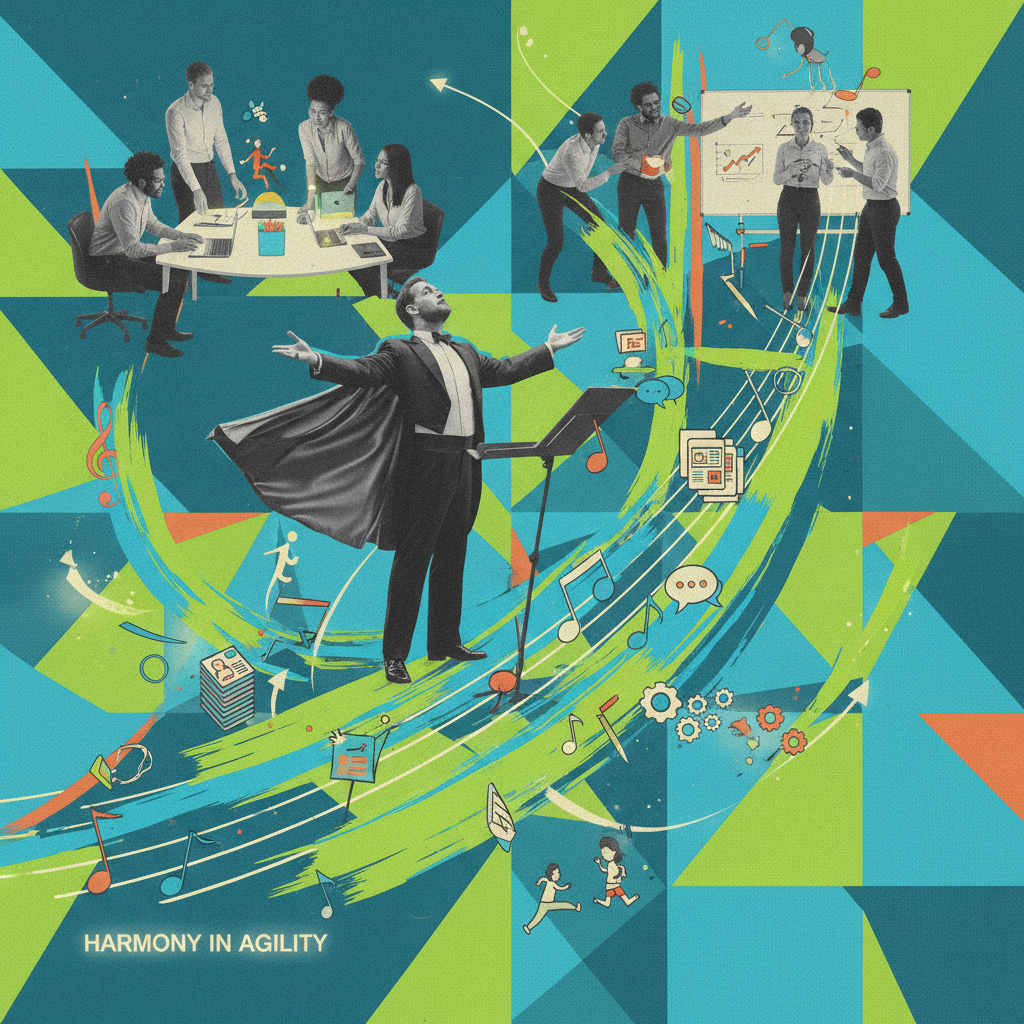
You feel lost in a maze of agile promises, wondering if there’s a clear map to unite many teams without chaos.
You’ve spent weeks watching sprint boards fill and empty, hearing the same promise that a shared rhythm will magically align dozens of groups. The reality is that most of the friction lives not in the backlog but in the invisible handoffs where one team passes a piece of work to another. When the handoff is vague, the next group spends time guessing intent, recreating context, and ultimately delaying delivery. That pause is the quiet thief of speed, the moment when ownership dissolves and responsibility drifts. I have sat in rooms where a product leader asks why a feature stalls after the design team signs off, only to discover that the operations crew never saw the final spec. Naming that gap—an unspoken contract that never existed—lets you see why scaling agile feels like wandering without a compass. The first step is to examine how we make work visible across the boundaries that separate us.
Why visible handoffs matter more than sprint velocity
When a piece of work moves from design to operations the moment it is unclear who owns the next step, the whole rhythm stalls. That pause is not a problem of capacity, it is a problem of visibility. Teams spend hours reconstructing intent, re‑creating context, and often deliver something that does not match the original promise. By making every handoff a shared artifact – a brief note, a diagram, a recorded conversation – you create a contract that travels with the work. The contract tells the next group exactly what was decided, why it matters, and what the acceptance criteria are. The result is a reduction in wasted time and a boost in trust, because no one is left guessing.
A simple experiment can illustrate the impact. Pick a feature that currently passes through three groups. Add a single line of shared documentation at each transition and measure the time from start to finish. Most teams see a noticeable shrink in cycle time, not because they work faster, but because the invisible friction disappears. The lesson is clear: make the handoff visible and the whole system moves smoother.
What the four team shapes really solve
The concept of four team shapes comes from Scaled Agile Framework. Each shape addresses a specific kind of work and a specific kind of dependency. Stream aligned teams own the flow of value to a customer segment, so they can deliver continuously without waiting for another group. Complicated subsystem teams handle deep technical challenges that would slow a stream aligned team if they tried to own it themselves. Platform teams build reusable services that multiple stream aligned teams can consume, removing the need for each to reinvent the same capability. Enabling teams coach and support other teams when they encounter obstacles that require new skills or knowledge.
Understanding these shapes helps leaders stop assigning work by function and start assigning by purpose. When a product manager sees a backlog item, they first ask: does this need a new platform, a deep technical solution, or can a stream aligned team take it straight through? The answer directs the work to the right shape, preventing the common bottleneck where a single team becomes a gatekeeper for many downstream groups. The payoff is a system that scales by design rather than by heroic effort.
How to turn stakeholder input into shared rhythm
Stakeholder voices are often heard in meetings that feel like a chorus of opinions, yet the output rarely reaches the teams that need to act. The missing link is a lightweight ritual that captures intent, validates assumptions, and then hands the refined story to the delivery crew. One approach is a short alignment session that happens after each major decision. The product owner presents the decision, the team asks clarifying questions, and a concise agreement is recorded in a shared space. This creates a single source of truth that every team can reference.
The practice does not require a massive ceremony. A five minute sync, a shared note, and a quick check that the note lives in the same tool used for sprint planning are enough. When teams see that stakeholder input is already distilled and visible, they can start work without waiting for another meeting. The rhythm becomes a loop of input, clarification, and execution, turning what used to be a series of interruptions into a predictable cadence. For further reading on practical collaboration, see an article on LinkedIn.
The invisible handoff gap
When work moves between groups without a shared record, ownership drifts and execution stalls. Informal coordination relies on memory, email threads, or ad-hoc messages, which are easy to lose and hard to audit. Because each participant assumes the next will infer intent, the handoff becomes a blind spot where context is recreated and timelines slip. A centralized work system eliminates that blind spot by making the work artifact the single source of truth that travels with the task, attaching explicit responsibility and visible status at every transition. In such a system the moment a piece of work changes hands the new owner sees the exact definition, acceptance criteria, and any prior decisions, removing guesswork. One example of a centralized work system is Workhint, which treats the work object itself as the anchor for coordination. By anchoring handoffs to a shared structure, the pattern of stalled execution recurs far less often, and visibility becomes an inherent property of the process.
You entered this piece wondering whether a map exists for the tangled promises that keep teams drifting. The journey showed that the invisible pauses between groups are the true compass points; when every transition is written into a shared artifact, the map appears without a single extra line of code. The insight that sticks is simple: a work item arrives at its next owner already carrying the story, the why and the acceptance, and the system flows as if the handoff never existed. With that clarity you can step back from the noise of velocity charts and watch the rhythm emerge from plain sight. Carry this vision into your next planning session and notice how the space once filled with guesswork suddenly feels open. The quiet question remains – what other hidden handoffs are waiting for a contract?
Leave a Reply