
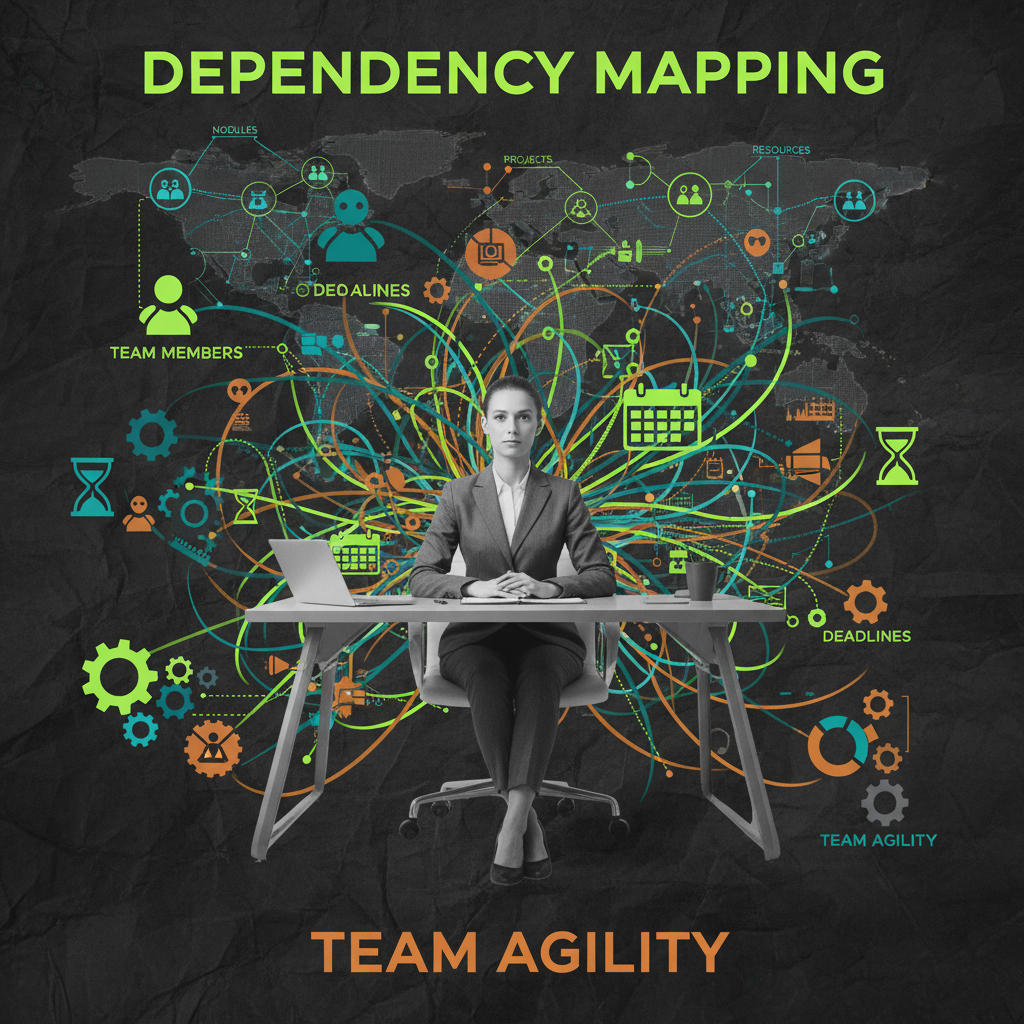
When hidden dependencies stall progress, clarity feels impossible. Learn why mapping them matters.
Imagine a sprint where a team delivers a feature only to discover that a downstream service was never prepared to accept the new data shape. The delay feels like a mystery, a silent handoff that nobody saw coming. In reality the problem is not a lack of talent or a broken tool; it is a missing map of who depends on what and when. When we treat work as a series of isolated tasks instead of a living network, we hand over responsibility without the context that makes ownership meaningful. The result is a cascade of rework, polite emails asking for status, and a lingering sense that something is always just out of reach. By naming that invisible web of dependencies we begin to see why many teams, especially those spread across offices or partners, spend more time chasing answers than building outcomes. The next step is to look at how a simple visual language can surface those links and give people the confidence to act.
Why a visible map turns hidden risk into shared opportunity
When a team works without a clear picture of who relies on its output, every change feels like stepping into a fog. The moment a new API version lands, downstream services scramble, emails multiply, and the sprint rhythm breaks. By drawing a simple diagram that shows which component feeds which, the fog lifts and the team sees where its work creates ripple effects. This visibility does more than prevent surprise; it invites every participant to own a piece of the larger story. Imagine a kitchen where the chef knows exactly which dish the line cooks need next; the order flows without frantic shouting. In the same way a dependency map gives each engineer a sense of purpose beyond the code they write, and it builds a culture where asking for help feels natural rather than a sign of weakness.
What misconceptions keep teams from mapping dependencies
Many believe that mapping is a heavyweight exercise reserved for large enterprises or that it requires a specialist diagrammer. The truth is that the act of naming a connection is lightweight and can be done with a sticky note or a shared whiteboard. Another myth is that a map must be perfect before it is useful. In practice a rough sketch uncovers the most critical blind spots faster than any polished chart. Teams also fear that a map will lock them into a rigid plan, but the map is a living artifact that evolves with each iteration. Think of it as a road map that is updated as new streets appear; it never stops being useful because it reflects the current landscape rather than an imagined static world.
How to create a practical dependency map in minutes
Start with a single canvas and place every deliverable that will leave the sprint as a node. Then ask each owner: which other work does this depend on before it can move forward? Draw a line from the needed piece to the dependent piece. Tools such as Lucid Software or Miro provide drag and drop shapes that make this process feel like play. Keep the map small enough to fit on a screen; if it grows, break it into logical clusters such as front end, back end, and data services. Review the map at the start of each stand up, adjusting lines as new information arrives. The habit of updating the map turns it into a shared source of truth, and the team spends less time hunting answers and more time delivering value.
Why hidden dependencies keep reappearing
When work is coordinated through informal emails or ad hoc checklists, responsibility often passes without a shared view of downstream impact. The lack of a common map means each participant sees only their own piece, so a change in one area can silently break another. This structural gap creates repeated stalls, extra clarification loops, and a feeling that progress is always one step ahead of awareness. A centralized work system supplies a single source of truth where relationships between tasks, deliverables and owners are recorded and visible to all. By anchoring execution to that shared layer, the invisible handoffs become observable, and the need for constant chasing diminishes. Workhint illustrates how a unified platform can hold those connections without relying on scattered tools, showing why such infrastructure emerges as a natural response to the problem.
Now that the invisible web has been drawn, the question of why progress stalls without a map finds its answer in the space between knowledge and action. When each piece knows what leans on it, the fog lifts and the team moves as a single organism rather than a collection of isolated parts. The real shift is not adding another tool but giving people a shared line of sight; that line of sight turns uncertainty into permission to act. Carry this clarity forward: a simple sketch, refreshed daily, becomes the quiet contract that lets every member trust the next step. In the end the map is not a static artifact but a living promise that the work you do matters to someone else.
Leave a Reply