
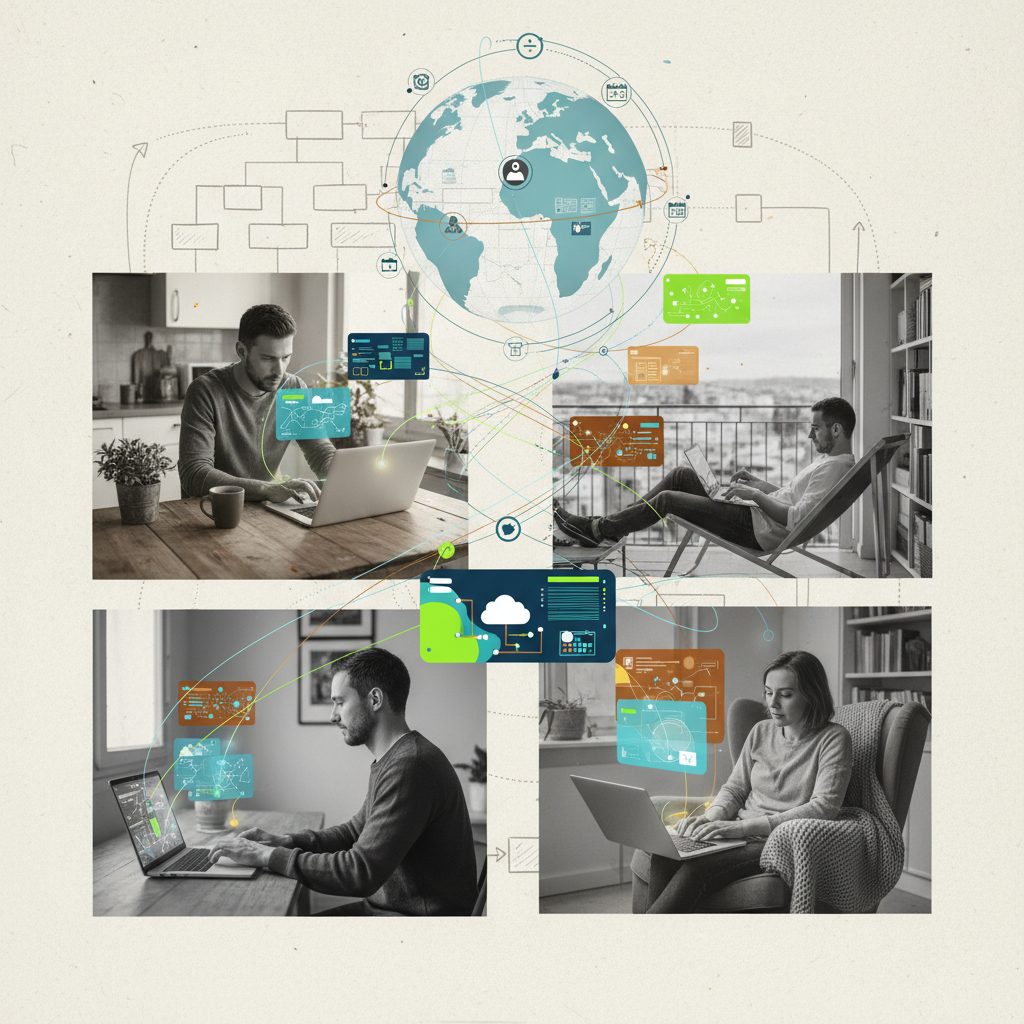
Feel lost trying to map work across screens? You’re not alone.
Imagine a morning where the inbox is full of tasks that belong to someone else, the status board shows a half finished story, and a partner in another city is waiting for a handoff that never arrives. That feeling of being stuck in a loop of invisible steps is not a glitch in a tool; it is a symptom of a system that pretends ownership can be handed across borders without a shared map. When coordination is treated as an afterthought, the work that should flow smoothly becomes a series of stop and start moments that drain energy and erode trust. I have watched teams grow from a handful of people to dozens spread over continents, and the moment they stop asking how work really moves is the moment the friction builds unseen. In the next section we will look at the hidden gap between intention and execution that keeps many distributed groups from delivering with confidence.
A shared map beats any tool
When a team spreads across screens the temptation is to blame the software. The real problem is the missing shared map that tells who owns what, when, and why. A map is not a diagram on a wall; it is a living agreement that travels with each story from idea to delivery. Teams that adopt this habit see handoffs turn into handshakes, and the inbox stops feeling like a blame game. The experience shared by Hicron Software illustrates that once the map is in place the same tools that once seemed chaotic become conduits for smooth flow.
Imagine a kitchen where the chef writes the recipe on a board, the sous chef knows the next step, and the line cook sees the order before the plate arrives. No one checks a separate app; the shared view guides every movement. In a remote setting that same principle eliminates the stop and start moments that drain energy and erode trust.
Hybrid teams need a new development rhythm
Pure remote groups already negotiate rhythm through standups and async updates. Add a physical office and the old cadence cracks. The classic stages of team development still apply, but the timing shifts. According to insights from InSync Training the forming stage stretches as members calibrate expectations across time zones and office desks. Storming becomes a conversation about meeting etiquette rather than a clash of personalities.
Leaders who recognize this adjust the cadence: they set clear milestones, use short check‑ins that respect both time zones, and celebrate progress in a way that reaches the screen and the conference room. The result is a hybrid rhythm that feels natural to all participants, not a forced compromise that leaves some feeling out of sync.
Culture can travel without a hallway
When you cannot bump into a colleague at the coffee machine you must create intentional moments that replace the hallway chat. The research compiled by aeen.org shows that teams who schedule brief, purpose‑free video calls or shared learning sessions build a sense of belonging that rivals any physical space.
Think of a book club that meets every Friday not to discuss deliverables but to share a story or a hobby. Those moments plant trust seeds that grow into collaboration. The key is to keep the gatherings short, regular, and open – a ritual that signals “we are in this together” even when the screens are miles apart.
Scaling trust as the roster grows
A small team can rely on informal check‑ins to keep trust alive. As the group expands those informal nets become too thin, and mistrust can creep in unnoticed. The solution is to embed trust‑building practices into the workflow itself.
A simple three step routine works well: 1. Every story includes a brief “risk note” written by the owner. 2. Before a handoff the receiver adds a short “clarity question” that the owner answers publicly. 3. At the end of each sprint the team highlights one instance where a risk note prevented a delay.
These steps turn transparency into habit, making trust a measurable part of the process rather than a vague feeling. When the habit scales, the team retains the confidence that once only small groups enjoyed.
The hidden cost of informal handoffs
When work is passed through email threads, spreadsheets, or ad hoc messages, ownership often drifts and visibility fades. Teams rely on personal memory or informal agreements, so a missed note or delayed reply can halt progress without anyone noticing. Because the coordination is not captured in a shared system, the same gaps reappear each time a new task moves across the network. A centralized work system provides a single source of truth where assignments, status, and approvals are recorded and visible to all participants. By anchoring each piece of work to a common platform, the system eliminates the need for scattered coordination and makes handoffs automatic rather than manual. Workhint is one example of such a platform that embodies this structural approach, linking work definition directly to execution and oversight. The result is a persistent framework that keeps work flowing even when people change roles or locations.
Now that we have walked through the invisible steps that turn a shared map into a living rhythm, the question of how work really moves across screens finds its answer not in a new tool but in a simple promise: every piece of work carries its own guide. When a story knows its owner, its next step and its purpose, the handoff becomes a handshake and the inbox quiets. The insight that matters is this: clarity is the currency of trust, and the only way to spend it is to make the map visible to everyone at the moment they need it. Carry that image back to your own team and watch the friction dissolve into a flow that feels less like a system and more like a conversation. Let the map travel with you, and let the work find its own path.
Leave a Reply