

You can validate a house cleaning business before buying equipment, hiring employees, or building expensive software.
Learning how to start a house cleaning business with little money is not about looking like a large cleaning company on day one. The smarter path is to create a branded service platform, recruit a small network of independent cleaners, validate demand in one local market, and invest only after real bookings prove the model works.
House cleaning is attractive because demand is local, repeatable, and easy to understand. Busy families, professionals, landlords, short-term rental hosts, and move-out customers all need reliable cleaning. The opportunity is to build a dependable service brand that connects customers with vetted cleaners through a clear operating system.
What’s in this article?
- Why a house cleaning business works
- What you need to launch
- How to price house cleaning services
- How to get first customers
- How Workhint helps launch a house cleaning platform
- A first 7-day launch plan
- A final launch checklist
- Frequently asked questions
Why a house cleaning business works
A house cleaning business works because the job repeats. A customer who likes the first standard clean may book weekly, biweekly, monthly, move-out, deep cleaning, or short-term rental turnover work. That recurring pattern makes residential cleaning one of the clearest local service businesses to validate quickly.
The mistake is starting like a traditional operator before you know what the market wants. New founders often buy supplies, print uniforms, hire employees, and build a complicated website before speaking with customers. A better first move is to create a branded request flow, recruit a few independent cleaners who already know how to deliver the work, and test whether customers will request and pay for a specific cleaning package.
What you need to launch
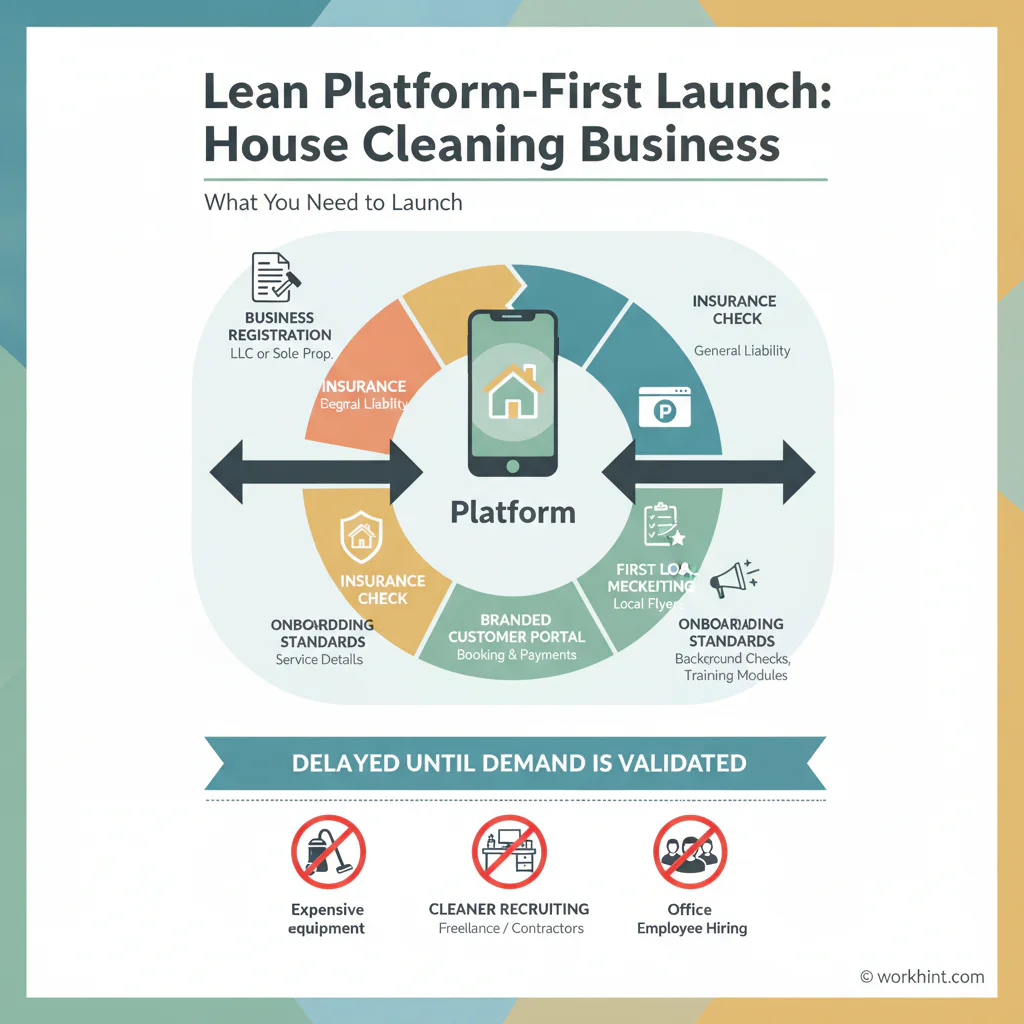
You do not need a fleet, office, employee roster, or warehouse of supplies to validate demand. You need a legal foundation, insurance research, a simple service promise, a branded customer platform, and a process for recruiting, screening, onboarding, assigning, and paying independent cleaners.
Check your city and state rules before using contractors. Worker classification laws vary, and some markets make it difficult to use independent cleaners unless they operate their own business, control their work, carry proper insurance, and are treated as independent providers.
| Launch item | Lean budget | Why it matters |
|---|---|---|
| Business registration, local license checks, and EIN | $0-$500 | Creates the basic legal setup for banking, taxes, and local compliance. |
| Insurance and bonding research | $300-$1,500 per year | Protects the business and gives customers confidence. |
| Branded customer platform | Start lean | Lets customers request cleaning, approve quotes, book visits, pay online, and manage service. |
| Independent cleaner recruiting and onboarding | $0-$500 | Builds delivery capacity without hiring employees before demand is proven. |
| Basic marketing and local outreach | $100-$750 | Drives first requests through referrals, local groups, search, and partnerships. |
The independent cleaner network is the core asset. Recruit cleaners with residential cleaning experience, reliable transportation, references, and availability in your launch area. Onboard them with service standards, accepted supplies, arrival windows, photo requirements, communication rules, payout terms, and customer privacy expectations.
How to price house cleaning services
Pricing should protect customer trust, cleaner earnings, and business margin. If the cleaner is underpaid, quality drops. If the customer is underpriced, every job becomes expensive to manage. If the platform margin is too thin, the business cannot afford support, marketing, refunds, software, insurance, or growth.
| Service | Best launch use | Pricing logic |
|---|---|---|
| Standard clean | First recurring offer | Flat package based on bedrooms, bathrooms, and expected cleaner time. |
| Deep clean | Higher-ticket first-time job | Higher rate because the home usually needs more labor and detail. |
| Move-in or move-out clean | Project-based demand | Quote by property size, condition, appliance cleaning, and urgency. |
| Recurring weekly or biweekly plan | Retention and predictable volume | Offer a lower per-visit price after the first clean if scope is stable. |
A simple model is to collect the customer payment upfront or at booking, reserve the cleaner payout, and keep the platform margin for customer acquisition, support, payment fees, refunds, insurance, and profit. Track estimated time versus actual time from the first job so pricing improves quickly.
How to get first customers
The first goal is demand validation, not brand theater. Start with one focused service area. Post in neighborhood groups where allowed, ask friends for introductions, contact apartment communities, short-term rental hosts, real estate agents, property managers, relocation services, and local employers.
Create a Google Business Profile, simple landing page, and referral offer. Send every interested customer into the same request form so you can measure demand instead of managing scattered messages. Strong early outreach is specific: the service area, the package, how cleaners are vetted, how booking works, and how payment is handled.
How Workhint helps launch a house cleaning platform
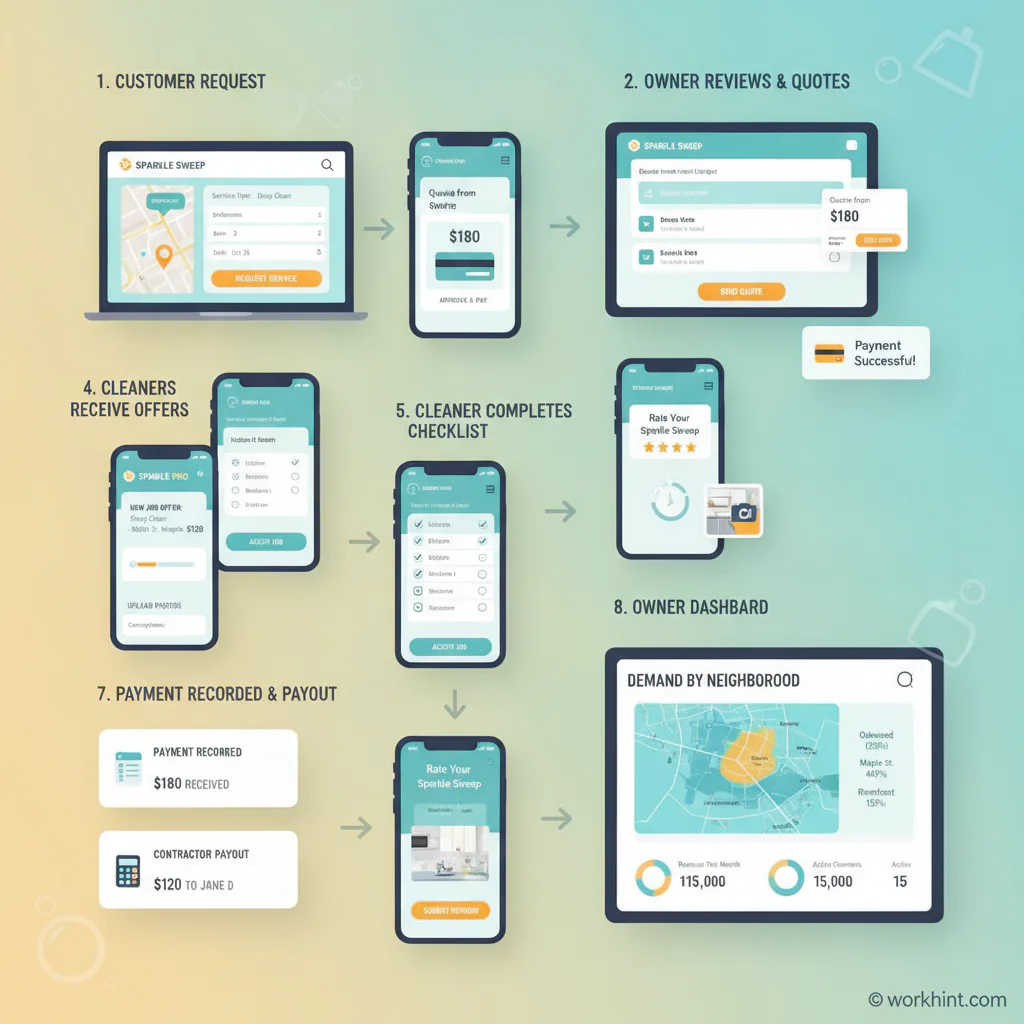
Workhint can help a founder launch the house cleaning business as a fully branded service platform before investing heavily in employees, equipment, or custom software. The founder can create a customer-facing portal with the business name, logo, service area, packages, intake questions, quote approvals, online booking, payments, and customer dashboards.
A customer can request a standard clean, deep clean, move-out clean, or recurring plan through the branded portal. They enter bedrooms, bathrooms, square footage, home condition, pets, parking instructions, preferred dates, add-ons, and photos. The owner reviews scope, sends a quote, and lets the customer approve and pay online.
Cleaners can be invited as independent providers. Each cleaner can complete onboarding, upload documents, list service areas, set availability, review standards, and receive job offers. When a booking is approved, Workhint can match the job to qualified cleaners by location, availability, service type, rating, and payout amount. For a cleaning business built around independent cleaners, service marketplace software can connect customer intake, cleaner onboarding, job matching, scheduling, quality checks, and payments.
During the job, the cleaner follows a room-by-room checklist, marks tasks complete, uploads completion notes or photos, reports issues, and closes the job. The customer receives reminders, arrival updates, completion notes, invoice records, and review requests. The customer pays through the platform, the job is marked complete, and the contractor payout can be calculated from the approved rate.
This lets the founder grow by expanding the cleaner network instead of immediately adding employees. If requests increase in a neighborhood, recruit more vetted independent cleaners there. If a new service area shows demand, onboard providers before spending heavily on local advertising.
First 7-day launch plan
Use the first week to create a real request flow, recruit initial cleaners, and test whether customers will book.
- Day 1: Choose one launch area, one target customer, and three services: standard clean, deep clean, and move-out clean.
- Day 2: Set up the branded Workhint platform basics: customer request form, cleaner onboarding, quote approval, scheduling, payment, and payout rules.
- Day 3: Define pricing, service checklists, cancellation rules, customer communication, cleaner standards, and quality review steps.
- Day 4: Recruit the first five to ten independent cleaners.
- Day 5: Launch local outreach through referrals, neighborhood groups, apartment communities, landlords, and real estate contacts.
- Day 6: Route every inquiry through the platform, send quotes, collect approvals, and offer jobs to available cleaners.
- Day 7: Review requests, conversion rate, cleaner acceptance, job timing, customer questions, pricing, and provider capacity.
Final launch checklist
- Choose a narrow launch market and service area.
- Define the first cleaning packages and what each one includes.
- Check local license, tax, insurance, bonding, and worker classification rules.
- Create a branded customer request, quote approval, scheduling, payment, and review process.
- Recruit and onboard independent cleaners with standards, documents, availability, payout terms, and checklists.
- Build the first customer acquisition list.
- Send every inquiry through the platform so demand can be measured.
- Track cleaner acceptance, job time, customer satisfaction, complaints, payouts, and profit on every booking.
- Expand the cleaner network only where customer demand is showing up.
- Delay major equipment, office, and employee costs until volume justifies them.
FAQ
How much money do I need to start a house cleaning business?
A lean residential cleaning business can often be validated with a small budget for registration, insurance research, a branded platform, basic marketing, and cleaner onboarding. Traditional models cost more when you buy equipment, hire staff, or launch commercial services immediately.
Can I start a cleaning business without doing the cleaning myself?
Yes, if you build a reliable provider network and follow worker classification rules. The business becomes a service platform: you acquire customers, vet providers, coordinate bookings, manage quality, collect payment, and pay cleaners for completed work.
Do I need a license to clean houses?
Most founders need basic business registration and may need local business licenses or tax registrations. Requirements vary by location, so check official local sources before taking paid jobs.
How do I recruit independent cleaners?
Look for cleaners with experience, references, reliable transportation, availability in your service area, and comfort using a mobile platform. Onboard them with written standards, checklists, payout rules, and clear job acceptance terms.
When should I hire employees?
Do not hire just to look established. Consider employees only when demand, margins, legal requirements, control needs, and customer expectations justify the added cost and responsibility.
Conclusion
The lowest-risk way to start a house cleaning business is to validate demand before committing to heavy costs. Build the brand, launch the request flow, recruit independent cleaners, sell a clear first offer, route jobs through a real operating system, and expand only where bookings prove the market exists.
Leave a Reply