


Good contractor onboarding gets work moving quickly without blurring the line between external talent and employees.
Learning how to onboard independent contractors is not just an HR exercise. It is an operating question: how do you bring external talent into real work quickly while collecting the right documents, setting clear outcomes, limiting access, protecting the company, and preparing payment?
Most contractor onboarding advice starts and ends with a checklist. That helps, but it misses the harder part. Contractors touch projects, customers, data, tools, deadlines, invoices, and internal teams. If the process is loose, work starts before the agreement is signed. If the process is too heavy, contractors wait days for approvals and access.
What’s in this article?
- Why contractor onboarding matters
- The independent contractor onboarding workflow
- What to collect before work starts
- How to set expectations without treating contractors like employees
- Where Workhint fits
- Frequently asked questions
Why contractor onboarding matters
Independent contractors are useful because they give a company access to specialized capacity without adding every person to payroll. That flexibility also creates risk. The company needs enough structure to protect work, data, payments, and compliance, but not so much control that the contractor relationship starts looking like employment.
The best onboarding process answers six questions before work begins: who approved this contractor, what outcome are they responsible for, what documents are complete, what systems can they access, how will progress be reviewed, and how will they be paid?
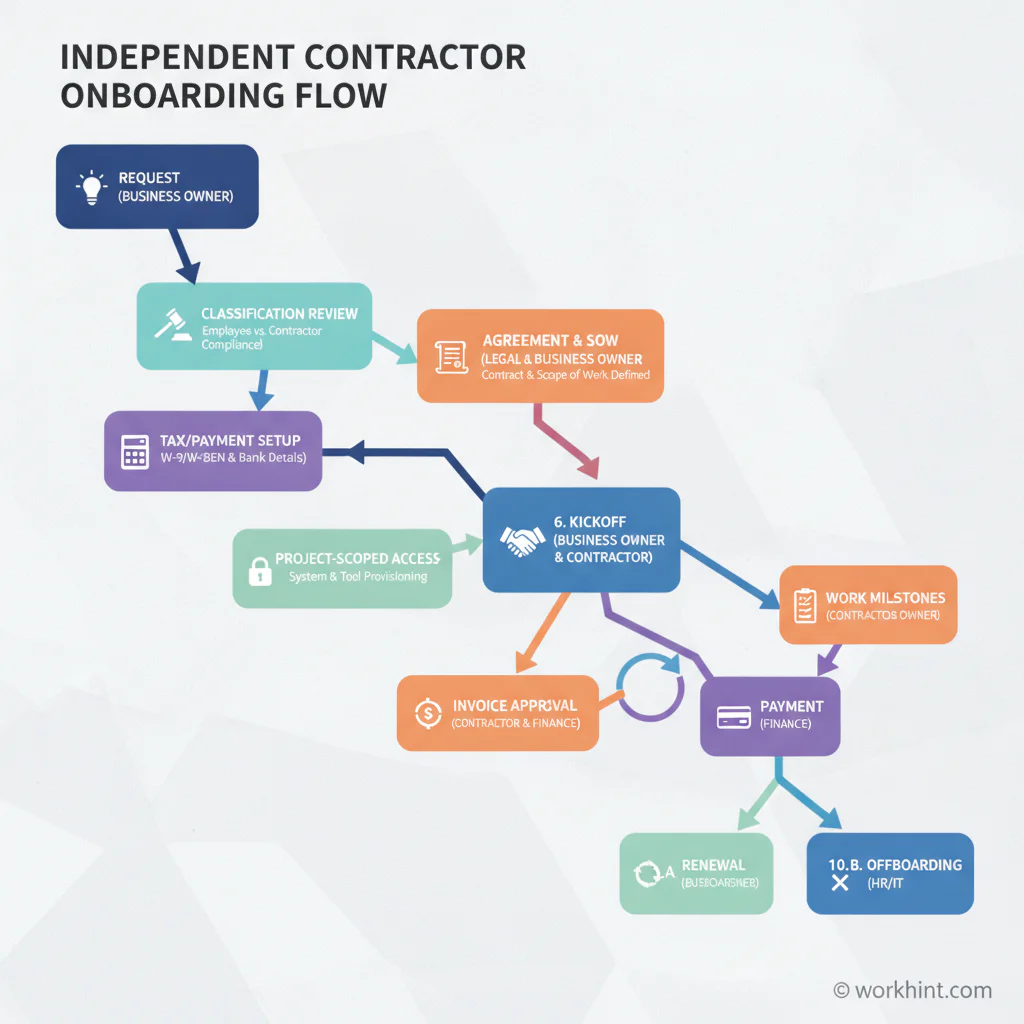
That is why contractor onboarding should be designed as a workflow, not a folder of forms. A workflow makes ownership visible. Legal can review contract terms, finance can confirm payment setup, IT can grant limited access, the project owner can define deliverables, and the contractor can see what is still blocking the start date.
The independent contractor onboarding workflow
The safest way to onboard contractors is to separate the process into clear stages. Each stage should have an owner, a completion rule, and a record. Do not let work begin just because someone sent a Slack message saying the contractor is ready.
| Stage | Owner | What must be clear |
|---|---|---|
| Request | Business owner | Why the contractor is needed, expected outcome, budget, timeline, and project sponsor. |
| Classification review | HR, legal, or compliance | Whether the work can be structured as independent contractor work in the relevant location. |
| Agreement | Legal or operations | Contract, statement of work, confidentiality, IP ownership, termination, and payment terms. |
| Payment setup | Finance | Tax form, billing details, payment method, invoice process, currency, and approval route. |
| Access | IT or systems owner | Project-scoped tools, data permissions, security requirements, and access end date. |
| Work start | Project owner | Deliverables, milestones, communication cadence, review points, and acceptance criteria. |
This workflow helps companies move fast because the next step is always visible. It also reduces rework. Nobody has to ask whether the W-9 was collected, whether the SOW is final, whether access should be removed after the project, or whether finance knows how the contractor expects to invoice.
What to collect before work starts
The exact requirements depend on jurisdiction, company policy, project type, and risk level. Treat this as an operating checklist, not legal advice. For anything sensitive or cross-border, involve legal, tax, or compliance specialists.
- Basic profile: legal name, business name if applicable, address, email, phone, and emergency contact where appropriate.
- Scope: statement of work, deliverables, milestones, deadlines, acceptance criteria, and project owner.
- Agreements: contractor agreement, NDA, IP assignment or work product terms, and any client-specific terms.
- Tax and payment: W-9, W-8BEN, or local equivalent, payment details, invoice requirements, currency, and payment cadence.
- Risk documents: insurance certificate, licenses, background checks, safety acknowledgements, or data handling rules when relevant.
- Access plan: tools needed, permission level, data exposure, start date, end date, and offboarding trigger.
The key is sequencing. Do not grant broad tool access before the agreement and classification review are complete. Do not let the contractor begin billable work before finance knows how invoices will be approved. Do not leave access open after the project ends.
How to set expectations without treating contractors like employees
Contractors need clarity, but clarity is not the same as employee-style control. In many contractor relationships, the company should define the outcome, timeline, quality bar, communication channel, security rules, and acceptance process. The contractor generally controls how the work is performed.
That distinction should show up in onboarding. Instead of assigning a daily schedule, define milestones. Instead of training the contractor like a new employee, provide the project context and systems needed to deliver the contracted outcome. Instead of giving permanent internal access, grant project-scoped access with an expiration date.
A strong kickoff includes the project owner, contractor, and any internal reviewers. Cover the deliverable, acceptance criteria, source materials, communication cadence, invoice process, and escalation path. The meeting should make the work easier, not absorb the contractor into the company like a staff member.
Where Workhint fits
Workhint fits when contractor onboarding needs to become a repeatable operating system instead of a manual chain of forms, emails, spreadsheets, and access requests. It can turn the onboarding workflow into role-based steps: business owner request, legal review, document collection, finance setup, IT access, project kickoff, work milestones, payment approval, and offboarding. For ongoing contractor operations, contractor management software can connect onboarding, assignments, access, records, performance, and offboarding in one operating system.
A contractor can receive a branded onboarding link, complete required fields, upload documents, acknowledge project rules, and see what is still pending. Internal teams can review only the steps they own. Finance sees payment readiness. IT sees approved access requests. The project owner sees whether the contractor is cleared to start.
Once work begins, the same system can connect assignments, deliverables, approvals, status updates, invoices, payout status, renewal decisions, and access removal. That matters because contractor onboarding is not finished when the agreement is signed. It is finished when the contractor can do the right work, with the right permissions, under the right terms, and be paid cleanly when the work is accepted.
FAQ
What is contractor onboarding?
Contractor onboarding is the process of approving an independent contractor, collecting the right documents, setting scope and payment terms, granting limited access, and preparing the contractor to begin project work.
How is contractor onboarding different from employee onboarding?
Employee onboarding usually includes payroll, benefits, company training, and manager-directed work. Contractor onboarding should focus on scope, agreements, tax documents, payment setup, project access, deliverables, and independence.
What documents are usually needed for independent contractors?
Common documents include a contractor agreement, statement of work, NDA, IP terms, tax form such as a W-9 or W-8BEN, payment details, and insurance or license records where relevant.
How long should contractor onboarding take?
Low-risk contractors can often be onboarded quickly when the workflow is clear. Delays usually come from missing approvals, unclear scope, incomplete tax forms, access requests, or contract review.
Who should own contractor onboarding?
Ownership is usually shared. The business owner defines the need and scope, legal or HR reviews classification and terms, finance handles payment setup, IT controls access, and the project owner manages kickoff and acceptance.
Can contractor onboarding reduce misclassification risk?
It can help by documenting scope, independence, project terms, and approval decisions. It does not replace legal advice, and companies should review local rules before engaging contractors.
Conclusion
The practical answer to how to onboard independent contractors is to build a workflow that starts before work begins and ends after access, payment, and offboarding are handled. Forms matter, but ownership matters more. When scope, documents, approvals, access, expectations, and payment all move through one clear process, contractors can start faster and companies can stay in control without turning contractor work into employee management.
Leave a Reply