


A bookkeeping business can start lean, but the real advantage is building the client platform before hiring a team.
If you want to know how to start a bookkeeping business from home, the opportunity is simple: small businesses need clean books, clear reports, and someone reliable to keep the financial back office from turning into a mess.
The old way was to become a solo bookkeeper, buy software, find clients one by one, and manage every request through email. The faster model is different. Start with a clear offer, validate demand, launch a branded client platform, and build a small network of independent bookkeepers or tax partners as volume grows.
This keeps the business light. You do not need an office, employees, or expensive infrastructure on day one. You need enough credibility to sell the first service, enough process to deliver it consistently, and enough operating structure to avoid drowning in files, follow-ups, approvals, and monthly deadlines.
What’s in this article?
- Why a home-based bookkeeping business works
- What you need before launching
- How to price bookkeeping services
- How to find the first customers
- How Workhint helps launch the operating platform
- A 7-day launch plan, checklist, and FAQ
Why a bookkeeping business from home works
Bookkeeping is attractive because demand is recurring. Businesses need reconciliations, financial reports, receipt organization, payroll coordination, sales tax support, and clean records every month. Once a client trusts the process, the relationship can become a monthly retainer instead of a one-off project.
It is also a good fit for a platform-first model. The founder can sell a narrow first offer, such as monthly bookkeeping for local service businesses, and use independent bookkeepers or specialist partners only when demand justifies it.
Customers buy bookkeeping because they want fewer surprises, cleaner tax preparation, better cash visibility, and less owner time spent on admin. Providers join the network because the platform can send organized work, clear checklists, document access, deadlines, and payout expectations without forcing them to chase clients directly.
What you need to launch a bookkeeping business from home
Start with the pieces that prove demand and protect delivery. Do not spend months building a full firm before one customer says yes.
| Launch item | Lean budget | Why it matters |
|---|---|---|
| Business registration and EIN | $0 to $500 | Creates a legal and banking foundation. |
| Professional liability insurance | $300 to $1,200 per year | Helps protect against bookkeeping errors and client disputes. |
| Training or certification | $0 to $1,500 | Builds credibility if you are new or changing fields. |
| Accounting software familiarity | $0 to $100 per month | Lets you support common tools such as QuickBooks or Xero. |
| Branded client platform | Start lean | Handles intake, document collection, approvals, work routing, and client communication. |
| Website and local marketing | $100 to $1,000 | Gives prospects a place to understand the offer and request help. |
You may not need a CPA license to offer bookkeeping services, but you do need competence, honesty about scope, and clear boundaries. Avoid tax advice, audit work, or regulated services unless you are properly qualified or partnering with licensed professionals.
How to price bookkeeping services
New bookkeeping founders often underprice because they compare themselves to hourly admin help. That is the wrong frame. The client is buying financial order, monthly confidence, and fewer year-end emergencies.
| Package | Example monthly price | Best for |
|---|---|---|
| Starter cleanup and monthly books | $250 to $500 | Small businesses with low transaction volume. |
| Growth bookkeeping | $600 to $1,200 | Businesses needing monthly reports, reconciliations, and owner review. |
| Catch-up bookkeeping project | $500 to $3,000+ | Clients behind on books before taxes, funding, or cleanup. |
| Advisory add-on | $300 to $1,500+ | Clients who want cash flow, margin, and decision support. |
Use packages instead of vague hourly pricing. Define what is included, what costs extra, when clients must upload documents, and how quickly questions are answered.
How to get first bookkeeping customers
The first customers usually come from trust, not ads. Start with a narrow market where bookkeeping pain is obvious: home service businesses, clinics, agencies, contractors, consultants, restaurants, ecommerce operators, or funded startups.
- Contact local business owners with a specific offer, such as a free books-readiness review.
- Build referral relationships with CPAs, payroll providers, fractional CFOs, and business coaches.
- Post practical bookkeeping tips for one niche instead of generic finance content.
- Offer a fixed-price cleanup assessment for businesses that are behind.
- Ask every satisfied client for one introduction to another owner.
The goal is not to look large. The goal is to prove a painful problem, close the first few retainers, and learn which client segment is easiest to serve profitably.
How Workhint helps launch the bookkeeping business
Workhint can become the branded operating foundation for the bookkeeping business before the founder builds custom software or hires a full internal team.
A prospect lands on the branded portal, chooses a bookkeeping package, completes an intake form, uploads current files, and approves the engagement. The founder sees the request in an operations dashboard, assigns the work to an internal role or approved independent bookkeeper, and tracks each monthly checklist through completion.
For recurring clients, Workhint can organize document requests, bank statement reminders, month-end checklists, review approvals, client questions, invoice generation, online payments, and contractor payouts. If the business uses independent bookkeepers, the platform can handle provider invitations, role-based access, task assignments, due dates, quality review, and payout rules without exposing every client record to every provider.
This makes the business feel like a real firm from day one. The founder can sell a professional client experience, validate demand, and add provider capacity only when the workload justifies it.
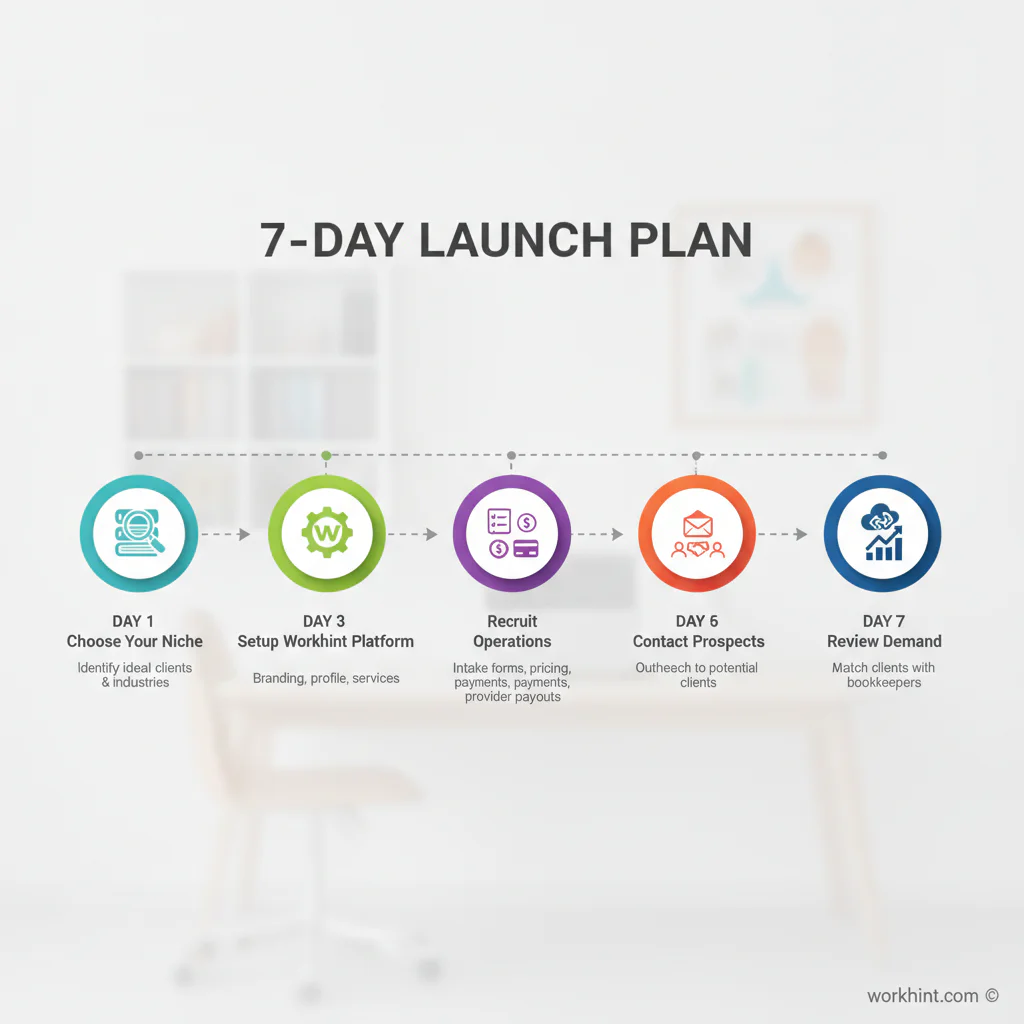
First 7-day launch plan
- Day 1: Choose one niche, one first offer, and one launch market.
- Day 2: Set up the branded platform basics, including intake, service packages, and client request flow.
- Day 3: Define pricing, monthly checklist, document requirements, payment terms, and provider payout logic.
- Day 4: Recruit one to three independent bookkeepers, CPA partners, or specialist reviewers for overflow and credibility.
- Day 5: Contact 25 target businesses and five referral partners with a clear bookkeeping cleanup or monthly support offer.
- Day 6: Route interested prospects through the platform and test intake, file upload, quoting, and approval steps.
- Day 7: Review demand, pricing objections, provider readiness, and delivery risk before spending more money.
Final launch checklist
- Choose the bookkeeping niche and first service package.
- Register the business and open a business bank account.
- Confirm insurance, licenses, and professional boundaries for your location.
- Create the branded client portal and intake process.
- Build monthly bookkeeping, cleanup, review, payment, and payout workflows.
- Recruit the first independent provider or review partner if you plan to scale beyond yourself.
- Publish a simple website with one clear call to action.
- Contact first customers and referral partners.
- Validate demand before buying expensive software, hiring employees, or building a large team.
FAQ
How much does it cost to start a bookkeeping business from home?
Many founders can start lean with business registration, insurance, basic software, training, a website, and a branded client platform. A realistic early budget often ranges from a few hundred dollars to several thousand, depending on certification and insurance choices.
Do I need to be a CPA to start a bookkeeping business?
No federal CPA requirement applies to ordinary bookkeeping in the US, but rules vary by service and location. Stay within bookkeeping scope and partner with licensed professionals for tax, audit, or regulated advisory work.
Can I run a bookkeeping business with independent contractors?
Yes, if the work is structured carefully. Use clear agreements, role-based access, quality review, documented checklists, and payout rules. Do not treat contractors like employees unless the legal relationship supports it.
How do bookkeeping businesses get clients?
Strong channels include referrals from CPAs, direct outreach to niche businesses, local networking, helpful educational content, and fixed-price cleanup offers for owners whose books are behind.
What should I charge for bookkeeping services?
Many small-business packages start in the low hundreds per month and rise with transaction volume, reporting needs, payroll coordination, cleanup work, and advisory support. Price by scope and outcome instead of guessing an hourly rate.
What software do I need?
You need accounting software proficiency, secure document collection, client communication, task tracking, approvals, invoicing, payments, and reporting. Workhint can provide the branded operating layer that connects those steps into one client and provider workflow.
Is bookkeeping profitable?
It can be profitable because revenue is recurring and overhead can stay low. Profit depends on pricing, niche focus, client quality, delivery systems, and whether the founder avoids taking messy work without charging appropriately.
Conclusion
A home-based bookkeeping business is not just a solo freelance path. It can become a branded professional services platform with recurring clients, clear monthly workflows, and a small network of trusted providers.
Start by validating demand. Sell one practical offer, route every request through a clean operating process, and invest only after customers prove the business deserves more capacity.
Leave a Reply