


Contractor performance tracking works when you measure outcomes, evidence, and approvals instead of hovering over how every hour is spent.
How to track contractor performance without micromanaging is a real operating question, not just a management style preference. Companies need to know whether external work is on time, on scope, high quality, and ready for payment. Contractors need enough autonomy to deliver the result they were hired for. The system has to protect both sides.
This article is for operations, finance, HR, program, marketplace, agency, and field teams that use freelancers, consultants, vendors, or independent contractors. It is not legal advice. If classification or employment law is sensitive, confirm the model with counsel before changing how work is supervised.
What’s in this article?
- Why contractor tracking is different from employee performance management.
- The metrics that show whether contractor work is healthy.
- A practical workflow for milestones, evidence, approvals, and renewals.
- A simple scorecard businesses can use across teams.
- Common mistakes that create noise, friction, or compliance risk.
- Where Workhint fits when performance tracking needs to become a live workflow.
Why contractor performance tracking matters
External work is now a normal part of business operations. The U.S. Bureau of Labor Statistics describes alternative work arrangements as including independent contractors, on-call workers, temporary help agency workers, and workers provided by contract firms. That creates speed and flexibility, but also a visibility problem when work is spread across email, spreadsheets, invoices, drives, and chat.
The wrong answer is to manage contractors like employees. Contractor relationships should be structured around agreed outcomes, scope, milestones, acceptance criteria, and payment terms. The U.S. Department of Labor’s independent contractor rulemaking reinforces that classification analysis looks at the real economic relationship, not just the label in a contract. That is why performance tracking should focus on the result and the evidence of delivery, not daily control over how the contractor does the work.
Harvard Business Review makes a similar point: leaders need to know what is on track, what is blocked, and where resources are going without constant interference. That principle matters even more with contractors.
How to track contractor performance without micromanaging
The cleanest model is outcome-based tracking. Every contractor engagement should have a defined result, an owner, a review cadence, evidence requirements, and a payment trigger. If those pieces are clear, managers do not need daily updates.
- Start with a written scope. Define the work product, acceptance criteria, due date, budget, revision process, and owner before work begins.
- Separate milestones from tasks. Contractors should not report every activity. Track meaningful checkpoints such as draft delivered, review complete, field visit done, asset approved, invoice submitted, or issue resolved.
- Ask for evidence, not surveillance. Evidence can be a completed deliverable, signed work order, approved file, client confirmation, QA result, status note, or milestone artifact.
- Use a predictable review cadence. Weekly, biweekly, milestone-based, or per-work-order reviews beat ad hoc pings.
- Connect acceptance to payment. Finance should know which work is accepted, who approved it, what invoice applies, and whether any holdback, revision, or dispute exists.
- Review renewals using the record. Renewal decisions should use delivery, quality, reliability, communication, compliance, and cost data instead of memory or personal preference.
Contractor performance metrics to track
The right contractor performance metrics depend on the work. A creative freelancer, field technician, implementation partner, staffing supplier, and compliance consultant should not be scored with the same template. Still, most businesses can start with a small set of practical measures.
| Metric | What it tells you | Good evidence |
|---|---|---|
| On-time milestone delivery | Whether the contractor meets agreed dates without repeated chasing. | Milestone timestamps, submitted files, work order status, delivery logs. |
| Acceptance rate | Whether work is approved without excessive rework. | Approved deliverables, QA checks, client signoff, revision counts. |
| Scope discipline | Whether the engagement stays inside the agreed statement of work. | Change requests, out-of-scope flags, budget variance, approval notes. |
| Responsiveness at key moments | Whether the contractor responds when decisions, blockers, or approvals matter. | Response timestamps on milestone questions, escalation notes, blocker updates. |
| Compliance readiness | Whether required documents, credentials, insurance, access rules, or tax records are current. | Document status, credential dates, access approvals, renewal reminders. |
| Payment readiness | Whether accepted work can move cleanly to invoice approval and payment. | Approved invoice, matched milestone, payment status, dispute record. |
ADP’s guidance on tracking an independent contractor workforce also points operators toward visibility into contractor statuses, assignments, compliance, and cost. The practical lesson: measure where contractor work becomes operational risk, not every movement the contractor makes.
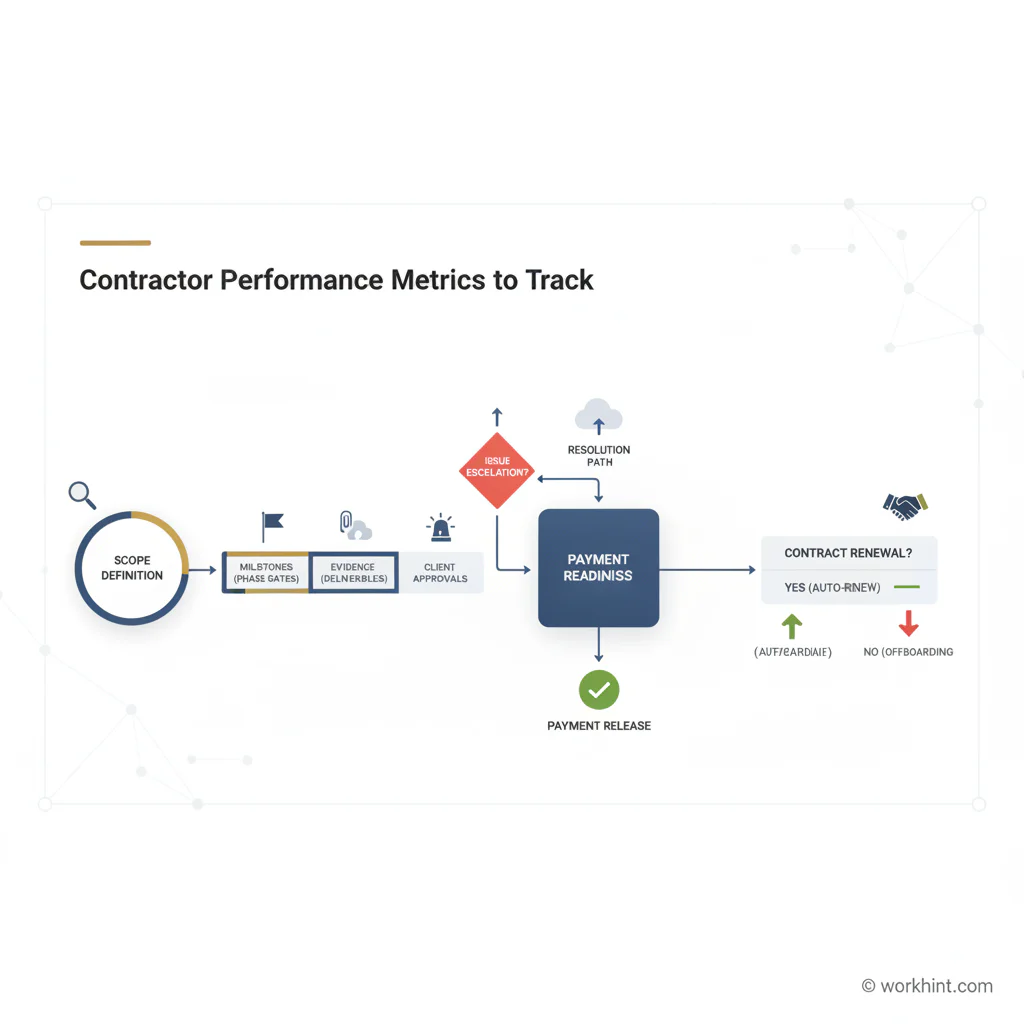
A simple contractor performance workflow
Use this workflow when multiple teams touch the same external workforce.
- Intake: the owner requests contractor work and states the outcome, budget, deadline, and reason external support is needed.
- Setup: operations confirms the contractor record, scope, access, documents, payment details, and review cadence.
- Milestone tracking: the contractor submits agreed evidence at each checkpoint. The owner reviews outcomes, not activity.
- Issue handling: blockers, missed milestones, quality problems, and scope changes move into a visible escalation path.
- Approval: accepted work receives a clear approval record tied to the milestone, statement of work, and invoice.
- Performance review: the business reviews delivery, quality, communication, compliance, and cost before renewal or offboarding.
Common mistakes
- Tracking hours when outcomes matter more: hours can help for some contracts, but they do not prove quality, acceptance, or value by themselves.
- Letting each department invent its own scorecard: legal, finance, operations, and business teams need one shared contractor record.
- Confusing responsiveness with availability: contractors should respond at agreed checkpoints, but constant availability can blur the relationship.
- Approving invoices without acceptance evidence: payment should connect to accepted work, not just an email saying the job is done.
- Using the same metrics for every contractor type: field work, creative work, consulting, delivery operations, and agency services need different proof.
Where Workhint fits
Workhint fits when contractor performance tracking needs to move from scattered updates into a repeatable work system. A business can use Workhint to structure contractor intake, define roles and permissions, collect documents, assign milestones, request evidence, route approvals, track blockers, connect accepted work to payment readiness, and report on the active external workforce.
That makes performance tracking less personal and more operational. Instead of asking a manager to remember who is reliable, Workhint helps the team see active contractors, late milestones, waiting approvals, ready invoices, and renewals that need review.
FAQ
What is the best way to track contractor performance?
Track agreed outcomes, milestones, acceptance evidence, quality, responsiveness at key checkpoints, compliance readiness, and payment readiness. Avoid daily employee-style supervision.
Which contractor performance metrics matter most?
Start with on-time delivery, acceptance rate, scope discipline, responsiveness, compliance readiness, budget variance, and invoice approval status. Add specialized metrics for field, creative, technical, or vendor work.
How often should contractors be reviewed?
Review contractors at natural business points: milestone approval, monthly or quarterly review, project close, renewal, or before assigning larger scope. High-risk work may need a tighter cadence.
How do you avoid micromanaging contractors?
Define the result, agree on milestones, request evidence at checkpoints, and review deliverables against acceptance criteria. Do not require constant updates, employee-style schedules, or unnecessary control.
Should contractor performance affect payment?
Payment should follow the contract. Invoices should connect to accepted deliverables, approved milestones, or completed work orders. Disputes, revisions, and holdbacks should be documented clearly.
Conclusion
Contractor performance tracking should create clarity, not pressure. The business needs a reliable view of scope, status, quality, approval, compliance, and payment. The contractor needs enough autonomy to deliver the result. When performance is measured through outcomes and evidence, companies can scale external teams without relying on memory, scattered updates, or micromanagement.
Leave a Reply