


Use this policy template to make reimbursable expenses, approval steps, receipts, and payment timing clear before spending happens.
An expense reimbursement policy template gives employees and managers a shared rulebook for business spending. It explains which expenses the company will reimburse, what documentation is required, who approves the claim, and when payment should happen.
Without a policy, reimbursement turns into case-by-case negotiation. Employees guess what is allowed. Managers approve inconsistently. Finance teams chase receipts after month-end. A clear policy reduces disputes, protects budgets, and keeps employees from waiting too long for money they spent on legitimate business needs.
What’s included
This resource includes a copy-ready expense reimbursement policy template, a category table, an approval workflow, common mistakes, and a short FAQ. It is designed for companies with employees, contractors, field teams, sales teams, event teams, consultants, or distributed workers who occasionally spend money on behalf of the business.
The exact legal requirements vary by location and worker type, so review the policy with counsel or an HR advisor before rollout. For example, SHRM’s expense reimbursement policy resource treats reimbursement as an HR and total rewards policy area, while SAP Concur’s reimbursement guidance emphasizes clarity around what can and cannot be reimbursed.
How to use this expense reimbursement policy template
- Set the scope. Decide whether the policy applies to employees only, contractors, consultants, temporary staff, or specific departments.
- Define reimbursable categories. List common approved expenses such as travel, meals, mileage, software, supplies, training, and client-related costs.
- Add limits and exceptions. Include spending caps, pre-approval thresholds, non-reimbursable items, and who can approve exceptions.
- Specify documentation. State whether receipts, invoices, attendee names, business purpose, mileage logs, or project codes are required.
- Publish the workflow. Tell people where to submit expenses, when claims are due, who reviews them, and when reimbursement is paid.
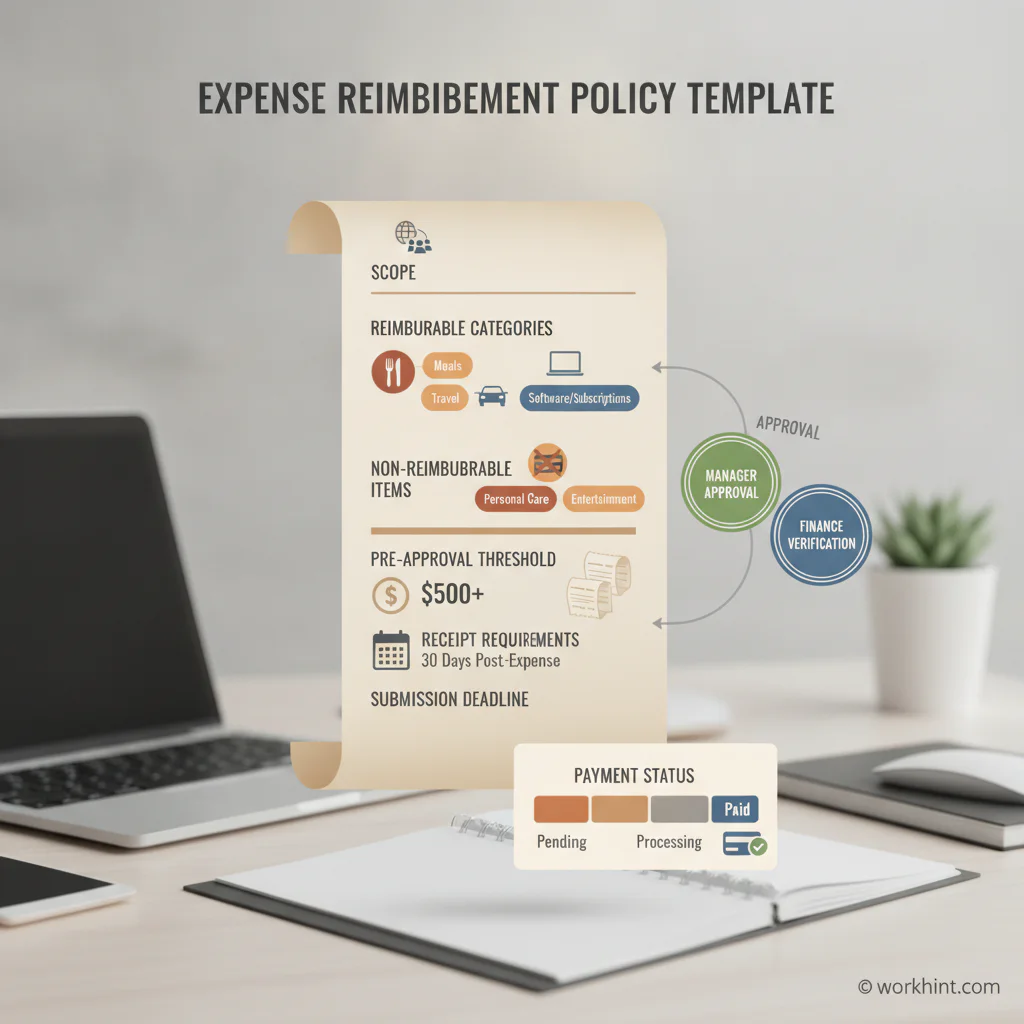
Expense Reimbursement Policy Template
Policy purpose: This policy explains how [Company Name] reimburses approved business expenses paid by eligible workers while performing authorized work for the company.
Scope: This policy applies to [employees / contractors / consultants / temporary workers] who incur approved business expenses as part of their assigned work. Expenses must be reasonable, necessary, properly documented, and connected to a legitimate business purpose.
Reimbursable expenses: The company may reimburse approved expenses in categories such as business travel, lodging, meals, mileage, parking, tolls, required software, office supplies, client meetings, training, certifications, event costs, and project-specific purchases.
Non-reimbursable expenses: The company will not reimburse personal purchases, fines, penalties, commuting costs unless specifically approved, upgrades not required for business use, missing-receipt claims without exception approval, alcohol unless allowed by policy, or expenses submitted after the deadline without approval.
Pre-approval: Expenses above [$ amount], travel bookings, client entertainment, event spending, equipment purchases, and unusual project costs require written approval before the expense is incurred.
Documentation: Each claim must include the date, vendor, amount, business purpose, receipt or invoice, project or client code when relevant, and manager approval. Mileage claims must include origin, destination, business purpose, miles driven, and applicable reimbursement rate.
Submission deadline: Expense claims should be submitted within [number] days of the expense date and no later than [number] days after month-end unless an exception is approved.
Approval and payment: Managers review expenses for business purpose, policy compliance, budget fit, and documentation. Finance processes approved claims within [number] business days after approval. Reimbursement is paid by [payroll / direct deposit / accounts payable / other method].
Exceptions: Exceptions require approval from [role or department]. Repeated policy violations may result in delayed reimbursement, denial of claims, or removal of spending privileges.
Expense categories and rules
| Category | Usually reimbursable | Documentation required | Approval note |
|---|---|---|---|
| Travel | Flights, hotels, ground transport for approved business trips | Receipt, itinerary, business purpose | Require pre-approval above policy limit |
| Meals | Business meals, travel meals, approved client meetings | Receipt, attendees, business purpose | Set daily or per-meal caps |
| Mileage | Approved use of a personal vehicle for business travel | Mileage log, route, purpose | Use the current company or statutory rate |
| Software and tools | Required tools that support assigned work | Invoice, subscription term, owner | Check for duplicate subscriptions first |
| Supplies | Necessary office, field, event, or project supplies | Receipt and project code | Require approval for equipment or bulk purchases |
| Training | Approved courses, certifications, or professional development | Invoice, course details, approval | Clarify repayment rules if applicable |
Recommended approval workflow
- Expense happens. The worker confirms the expense is allowed and keeps the receipt.
- Claim is submitted. The worker enters the amount, category, business purpose, receipt, and project code.
- Manager reviews. The manager checks business relevance, budget, and policy limits.
- Finance verifies. Finance checks documentation, coding, duplicates, tax treatment, and payment method.
- Payment is scheduled. Approved claims move to payroll or accounts payable.
- Records are retained. The company stores the claim, receipt, approval history, and payment status.
For U.S. businesses, reimbursement design often intersects with tax and accounting rules. The IRS business expense guidance explains that deductible business expenses generally need to be ordinary and necessary. That does not mean every deductible expense must be reimbursed; it means your policy should define company rules clearly and keep documentation strong.
Common mistakes
- Leaving categories vague. “Reasonable expenses” is not enough. Give examples and limits.
- Skipping pre-approval thresholds. Large expenses should not surprise finance after the money is spent.
- Ignoring contractors and field workers. External or mobile workers often create the most reimbursement complexity.
- Approving without receipts. Missing documentation creates tax, audit, and fairness issues.
- Paying too slowly. Reimbursement delays damage trust, especially for workers with lower cash cushions.
- Not reviewing spend data. Reimbursement trends can reveal budget leakage, unclear policies, or duplicated tools.
Where Workhint fits
Workhint helps organizations turn an expense reimbursement policy into a live workflow. Instead of storing the policy in a document and hoping everyone follows it, teams can build intake forms, role-based approvals, project codes, documentation requirements, exception routing, payment status tracking, and reporting around the reimbursement process.
This is useful for companies coordinating distributed workers, contractors, field staff, consultants, event teams, or multi-location operations. Workhint can connect the policy to the people, permissions, approvals, records, and handoffs that make reimbursement run consistently.
FAQ
What should an expense reimbursement policy include?
It should include scope, eligible workers, reimbursable categories, non-reimbursable items, spending limits, pre-approval rules, receipt requirements, submission deadlines, approval steps, payment timing, and exception handling.
How quickly should companies reimburse expenses?
Set a specific internal timeline, such as payment within a defined number of business days after approval. The right timeline depends on payroll and finance operations, but employees should not have to guess when repayment will happen.
Do contractors need a separate reimbursement policy?
Often, yes. Contractor reimbursement should align with the contractor agreement, project scope, tax handling, and approval rules. Do not assume employee reimbursement rules automatically apply to independent contractors.
Can a company deny reimbursement for missing receipts?
Yes, if the policy requires receipts and the rule is applied consistently. Many companies include an exception process for lost receipts, small amounts, or unusual circumstances.
Conclusion
A practical expense reimbursement policy protects both the company and the people doing the work. It tells workers what they can spend, tells managers what to approve, and gives finance the documentation needed to pay claims cleanly.
Use the template above as a starting point, then adapt the categories, limits, deadlines, and approval flow to your operating model. The best policy is not the longest one. It is the one people can understand before they spend money.
Leave a Reply