


Agency relationships break down when work depends on memory, meetings, and scattered approvals instead of a clear operating rhythm.
Learning how to manage agency relationships is not only a marketing problem. Agencies, studios, consultancies, implementation partners, and specialist vendors are part of the external workforce. They touch briefs, budgets, creative assets, customer data, deadlines, approvals, and payments. When that relationship is informal, the business feels the pain through missed context, unclear ownership, late approvals, and duplicate feedback.
A strong agency relationship is built by defining the work system around the agency: who requests work, who approves scope, how feedback is captured, what success means, when invoices are paid, and how performance is reviewed.
What’s in this article?
- Why agency relationships fail inside growing companies
- The core operating model for agency management
- A practical workflow for briefing, approvals, delivery, and payment
- A simple responsibility table for internal teams and agencies
- Common mistakes to avoid
- Where Workhint fits when agency coordination needs structure
Why agency relationship management matters
Agencies give companies flexible capacity and specialized expertise. They also add coordination complexity. A campaign may need brand review, legal review, finance approval, product context, analytics access, and executive signoff before the agency can deliver useful work. If those steps are not designed, the agency gets blamed for delays that came from the client-side operating model.
Public guidance from NI Business Info emphasizes clear communication channels, goals, contact routines, and measurable performance. Agency onboarding guides, including Automattic’s client onboarding checklist, show the same pattern from the agency side: good work starts with research, access, expectations, and a structured kickoff. The practical lesson is simple. Manage the relationship before managing the deliverables.
How to manage agency relationships
The best agency management system has five parts: scope, owners, rhythm, evidence, and payment. Scope defines what the agency is responsible for and what sits outside the agreement. Owners define who can request, approve, and change work. Rhythm defines how updates, reviews, and escalations happen. Evidence defines what proof of progress, performance, or completion is required. Payment defines how approved work becomes an invoice and how invoices move through finance.
Agencies are neither employees nor simple software vendors. They need enough context to make judgment calls, but not so much unmanaged access that accountability disappears. The goal is to set boundaries around outcomes, not dictate every step.
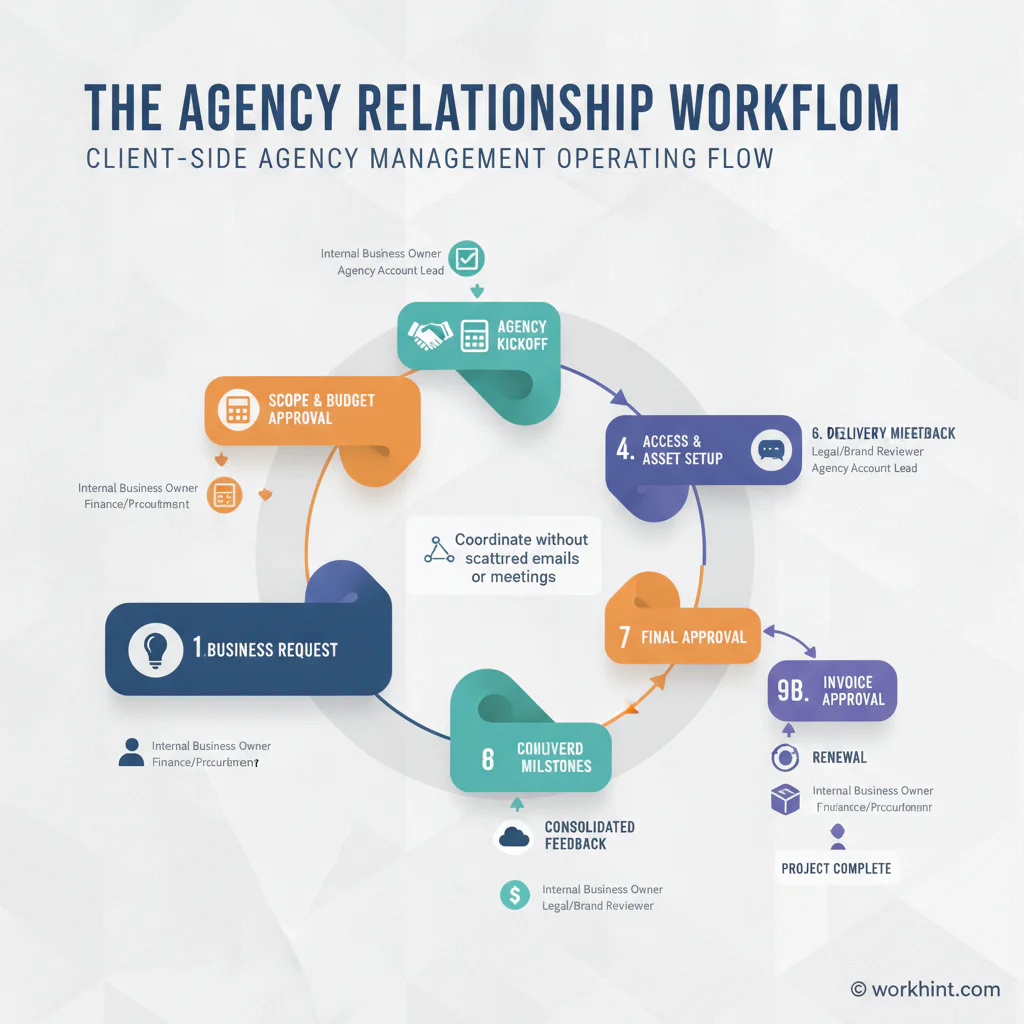
The agency relationship workflow
Use this workflow when an agency relationship has more than one stakeholder, recurring work, or meaningful budget exposure.
- Define the business outcome. Start with the commercial or operational goal, not the deliverable. A landing page, campaign, event, redesign, or content program should map to a measurable business need.
- Set the engagement model. Decide whether the agency is on a retainer, project fee, milestone model, hourly support agreement, or hybrid structure. Make sure the model matches how decisions will be made.
- Create one intake path. Use one request format with required context, deadline, budget, and approval owner.
- Run a kickoff with decision rights. Kickoff should confirm goals, audience, timeline, roles, assets, access, review windows, and what the agency can decide without waiting.
- Use structured review cycles. Feedback should be consolidated by an internal owner before it reaches the agency. Conflicting comments from multiple stakeholders slow work and weaken quality.
- Track performance against agreed evidence. Evidence may include deliverables, milestones, response times, campaign metrics, quality scores, revisions, launch dates, or budget variance.
- Close the loop. After delivery, capture what worked, what changed, what should be reused, and whether the relationship should continue.
Agency relationship responsibility table
A responsibility table prevents the most common agency problem: everyone has opinions, but no one owns the decision.
| Area | Internal owner | Agency owner | Decision needed |
|---|---|---|---|
| Brief and goals | Business lead | Account lead or strategist | What outcome matters and how success is measured |
| Scope and budget | Finance, procurement, or operations | Agency commercial lead | What is included, excluded, and billable |
| Access and assets | IT, brand, or operations | Project manager | What systems, files, and permissions are required |
| Creative or work review | Single feedback owner | Delivery lead | What changes are required before approval |
| Final approval | Named approver | Account lead | Whether the deliverable can launch, ship, or close |
| Invoice and renewal | Finance and relationship owner | Agency account lead | Whether work is accepted and payment or renewal is approved |
What to include in an agency operating rhythm
The operating rhythm should be light enough to use and strong enough to create visibility. For most agency relationships, weekly project updates and monthly performance reviews are enough. The weekly update should show work in progress, blockers, decisions needed, next milestones, and budget status.
The Armanino guide to working with a marketing agency highlights practical basics such as defining scope, assigning a relationship manager, onboarding the agency, and holding regular meetings. Those basics sound obvious, but they are exactly where agency relationships usually break.
Common agency management mistakes
- Skipping internal alignment. If leadership, finance, legal, and the business owner disagree internally, the agency becomes the place where that disagreement shows up.
- Letting every stakeholder send feedback. Agencies need consolidated direction. Unfiltered feedback creates rework and weak decisions.
- Confusing responsiveness with performance. Fast replies are useful, but agency performance should be judged by outcomes, quality, budget control, and delivery reliability.
- Approving work without acceptance criteria. If no one defines what good looks like, approval becomes subjective and late.
- Separating delivery from payment. Finance should know what milestone, approval, or deliverable makes an invoice payable.
Where Workhint fits
Workhint fits when agency management needs to become a repeatable workflow instead of a chain of emails, shared folders, and status calls. A team can use Workhint to create one intake path for agency requests, assign roles, route scope and budget approvals, collect documents, manage review cycles, track deliverables, and connect approved work to invoice and payment status.
That is useful when the company works with multiple agencies, freelancers, consultants, or implementation partners. Workhint can help separate requesters from approvers, keep permissions tied to the engagement, create reminders, and maintain a record of what was requested, approved, delivered, and paid.
FAQ
Who should own an agency relationship?
One internal relationship owner should be accountable for the agency relationship. Other teams may approve budget, legal terms, security, creative direction, or launch decisions, but the relationship owner keeps priorities, communication, and next steps clear.
How often should businesses meet with agencies?
Most recurring agency relationships need a short weekly project update and a monthly performance or planning review. High-risk launches may need more frequent check-ins, but the goal is better decision flow, not more meetings.
What metrics should be used to evaluate an agency?
Useful metrics include delivery against milestones, quality of work, budget variance, revision volume, response time, campaign or project outcomes, stakeholder satisfaction, and whether the agency proactively identifies risks.
How do you prevent scope creep with agencies?
Use a clear intake process, written scope, change request rules, approval owners, and budget visibility. When new work is requested, decide whether it replaces existing scope, creates a new milestone, or requires a separate estimate.
Is agency management the same as vendor management?
Agency management is a type of vendor management, but it usually needs more collaboration. Agencies often shape creative, operational, or strategic work, so the relationship requires clearer briefs, feedback cycles, performance reviews, and decision rights.
Conclusion
The best way to manage agency relationships is to make the work visible, owned, and reviewable. Good agencies do better work when the business gives them clear goals, usable context, decision access, and timely approvals. Businesses get better outcomes when they treat the agency as part of an external workforce system: scoped, onboarded, coordinated, measured, and paid through a repeatable process.
Leave a Reply