


Contingent workforce planning works when flexible talent is planned like capacity, not treated like last-minute help.
Contingent workforce planning is the process of forecasting, approving, onboarding, coordinating, and measuring non-permanent workers such as contractors, freelancers, consultants, agency talent, and temporary staff. It helps a business decide when flexible talent is needed, what work is assigned, who owns the relationship, how risk is controlled, and how spend is tracked.
The difference between a useful plan and a hiring wish list is operational detail: demand, budget, compliance, onboarding, approvals, and offboarding.
What’s in this article?
- Why contingent workforce planning matters for growing teams
- The core components of a practical contingent workforce plan
- A step-by-step planning workflow
- A responsibility table for HR, operations, finance, legal, and managers
- Common mistakes to avoid
- Where Workhint fits when external workforce operations need structure
Why contingent workforce planning matters
Flexible labor is no longer a side channel for emergency coverage. The U.S. Bureau of Labor Statistics reported that 11.9 million people were independent contractors on their sole or main job in July 2023, representing 7.4 percent of total employment. That excludes many freelancers, vendors, agency partners, and external specialists used outside traditional employment.
For businesses, this creates both opportunity and risk. Contractors can fill skill gaps, support project-based work, and help teams scale without permanent headcount commitments. But unmanaged contingent work can create inconsistent rates, unclear approval rights, duplicate vendors, missed security steps, delayed payments, and classification risk.
Compliance is especially important. The U.S. Department of Labor’s Fact Sheet 13 explains that worker status under the Fair Labor Standards Act depends on the economic realities of the relationship, not simply the label a company uses. This article is not legal advice, but it is a reminder that workforce plans should include review points before work starts.
Contingent workforce planning: the core components
A contingent workforce plan should answer six questions before a manager starts sourcing talent.
- Demand: What work is coming, and why is flexible talent the right model?
- Skills: What capabilities, credentials, location coverage, or availability are required?
- Budget: What is the approved rate, project budget, agency fee, or milestone cost?
- Risk: What classification, data access, tax, safety, confidentiality, or customer exposure must be reviewed?
- Operations: How will the worker be onboarded, assigned, supervised, approved, paid, and offboarded?
- Measurement: How will quality, delivery, utilization, spend, and business outcome be tracked?
Many competing guides define contingent workforce management broadly. The practical gap is planning discipline: turning strategy into a repeatable model managers can use before creating risk or spend.
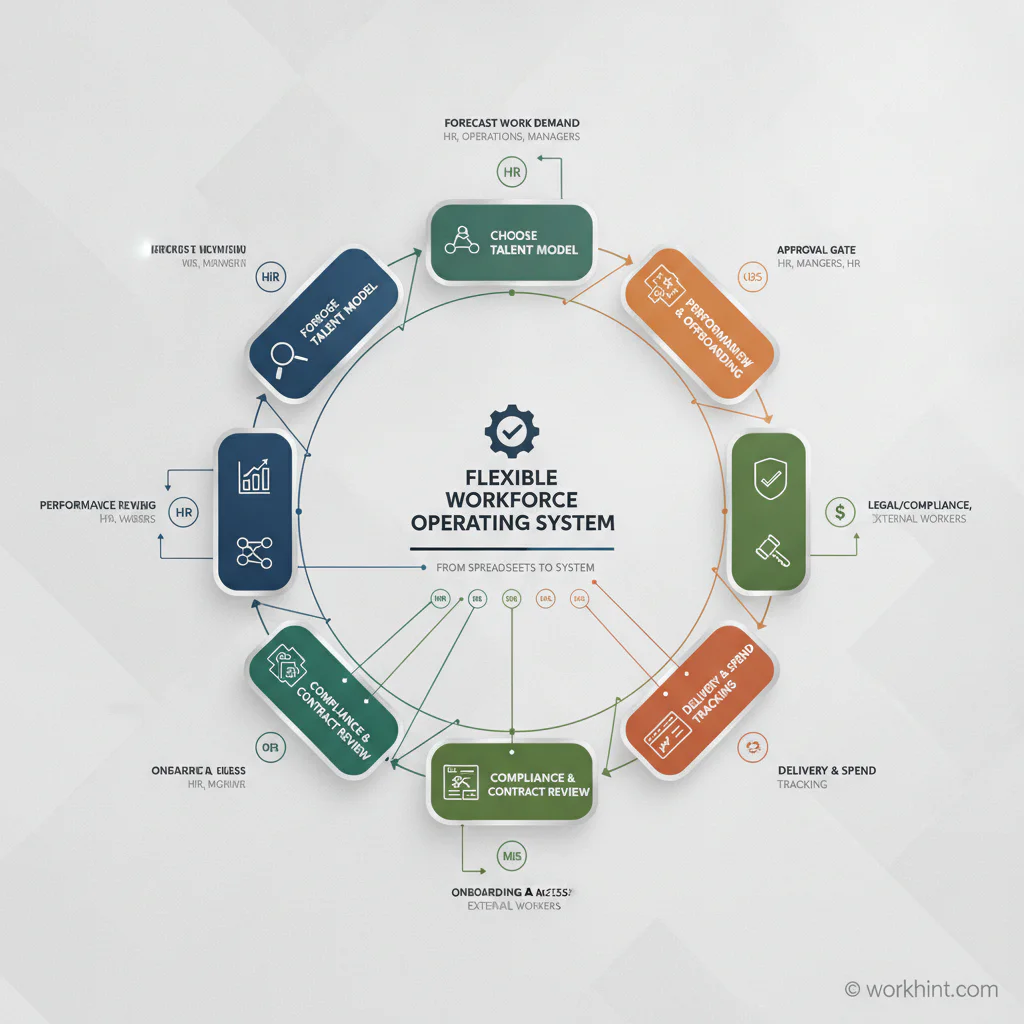
Contingent workforce planning workflow
Use this workflow when contractors, freelancers, agencies, or temporary workers are becoming a recurring part of delivery.
- Forecast work demand. Identify upcoming projects, seasonal spikes, client commitments, geographic coverage needs, and skill gaps that cannot be handled by the current team.
- Decide the right talent model. Choose between employee hire, independent contractor, freelancer, agency, staffing partner, consultant, vendor, or automation. The model should match the work, risk, duration, and level of control required.
- Create an approval gate. Require managers to submit business need, scope, expected duration, budget, data access, and classification notes before engaging external talent.
- Confirm compliance and contract requirements. Review classification, tax forms, insurance, confidentiality, intellectual property, safety, and local requirements where relevant.
- Build an onboarding path. Collect documents, assign permissions, provide context, set communication rules, and confirm who approves work.
- Track delivery and spend. Monitor milestones, timesheets, work acceptance, budget usage, invoice status, and any scope changes.
- Review performance and close out. Capture whether the work met the objective, revoke access, complete payment, store records, and decide whether the person or vendor should be reused.
Responsibility table for contingent workforce planning
Planning breaks down when every function assumes another team is handling the risk. Use clear ownership.
| Planning area | Primary owner | What they decide | Evidence to capture |
|---|---|---|---|
| Work demand | Business leader or operations | Whether flexible talent is needed | Project plan, workload forecast, service target |
| Talent model | HR, operations, or procurement | Contractor, agency, vendor, temp, or employee path | Role scope, duration, control level, sourcing route |
| Compliance review | Legal, HR, or compliance | Classification, contract, confidentiality, and local requirements | Review notes, required forms, agreement status |
| Budget approval | Finance | Rate, project cap, payment terms, cost center | Approved budget, rate card, purchase order |
| Access and onboarding | Operations, IT, or team manager | Systems, permissions, tools, training, and start date | Checklist, access log, onboarding confirmation |
| Performance and closeout | Manager or program owner | Work acceptance, reuse decision, offboarding | Milestones, quality notes, payment approval, access removal |
What metrics should a contingent workforce plan track?
The right metrics depend on the operating model, but most companies need visibility into headcount equivalent, active contractors, vendor count, total spend, average time to onboard, approval cycle time, compliance completion, budget variance, invoice aging, assignment completion, and rehire quality.
SAP’s overview of contingent workforce management connects nonpermanent labor to broader workforce planning and organizational goals. That matters because metrics should not only show what was spent. They should show whether flexible talent helped the organization deliver work faster, cover demand, or access skills it did not have internally.
Common mistakes in contingent workforce planning
- Letting managers engage talent before approval. This creates hidden spend, inconsistent terms, and compliance clean-up work.
- Using one process for every external worker. A three-day specialist project, a six-month contractor, a staffing-agency role, and a strategic vendor need different controls.
- Tracking only payment data. Spend matters, but so do scope, access, compliance, performance, and offboarding.
- Ignoring offboarding. External workers often keep unnecessary access because no one owns the closeout step.
- Separating workforce planning from operations. A plan that lives in a spreadsheet will not help managers route approvals, collect documents, or trigger payments.
Where Workhint fits
Workhint fits when contingent workforce planning needs to become a live operating system instead of a static planning document. A team can use Workhint to create intake paths for external talent requests, define roles and permissions, route budget and compliance approvals, collect onboarding documents, assign work, track milestones, manage payment status, and report on the external workforce. For broader workforce planning, workforce scheduling software can coordinate availability, capacity, roles, locations, assignments, and coverage risk.
That is useful when the business uses a mix of contractors, freelancers, vendors, agencies, and distributed teams. Workhint helps connect the planning questions to the execution workflow, so managers are not left translating policy into scattered forms, messages, spreadsheets, and finance follow-ups.
FAQ
What is contingent workforce planning?
Contingent workforce planning is the process of forecasting and managing non-permanent labor needs, including contractors, freelancers, consultants, agency workers, staffing partners, and temporary staff. It connects work demand to approvals, budgets, compliance, onboarding, assignments, payments, and performance tracking.
Who should own contingent workforce planning?
Ownership is usually shared. Operations or business leaders forecast demand, HR and legal review worker model and compliance risk, finance approves budget, procurement may manage vendors, and managers own delivery. A single program owner should coordinate the process.
How is contingent workforce planning different from workforce planning?
Traditional workforce planning often focuses on employee headcount. Contingent workforce planning adds external capacity, contract duration, vendor routes, classification review, access controls, invoice workflows, and offboarding requirements.
What should be included in a contingent workforce plan?
Include demand forecast, talent model, approval workflow, compliance review, budget, sourcing channel, onboarding steps, systems access, manager responsibilities, performance metrics, payment process, and offboarding checklist.
How often should a contingent workforce plan be reviewed?
Review active contingent workforce data monthly if external workers are central to delivery. Review the broader plan quarterly or before major hiring, seasonal, expansion, or client-delivery cycles.
Conclusion
Contingent workforce planning is not just deciding whether to use contractors. It is designing the operating model around flexible talent. The best plans make demand visible, approvals clear, risk review timely, onboarding consistent, work measurable, and payment connected to accepted delivery. When that system is in place, external talent becomes a managed capacity strategy instead of a source of hidden work.
Leave a Reply