


A mobile notary business can start lean if you sell convenience first and build the operation around verified local providers.
If you are researching how to start a mobile notary business, the opportunity is simple: customers need important documents notarized, but many do not want to visit a bank or work around business hours.
The mistake is treating this only as a solo side hustle. A stronger model is to launch a branded platform, validate demand in one market, and build a private network of commissioned notaries or signing agents.
That keeps startup costs low. You do not need an office, employees, or a large back-office system. You need a compliant offer, customer requests, provider assignment, and enough local demand to prove the model.
What’s in this article?
- Why mobile notary services are attractive
- What you need before launch
- How to price mobile notary work
- Where first customers come from
- How Workhint can power the business platform
- A 7-day launch plan, checklist, and FAQ
Why this business works
Mobile notary services work because the customer is usually buying urgency, convenience, and trust. People need notarization for real estate documents, estate forms, business agreements, school forms, medical authorizations, powers of attorney, and other time-sensitive paperwork.
The business can also expand beyond one operator. In many markets, independent notaries already exist, but they lack a reliable stream of local requests. A branded platform can bring in customers, screen requests, match appointments to available providers, collect payment, and track service quality.
Start with a narrow offer: mobile notarization by appointment in one service area. Add loan signing, after-hours appointments, business accounts, or remote online notarization only when requirements, provider capacity, and demand are clear.
What you need to launch
Requirements vary by state, so the first step is checking your Secretary of State or state notary regulator. Most founders need a notary commission if they personally perform notarizations. If you build a provider network, each provider must be properly commissioned where they operate.
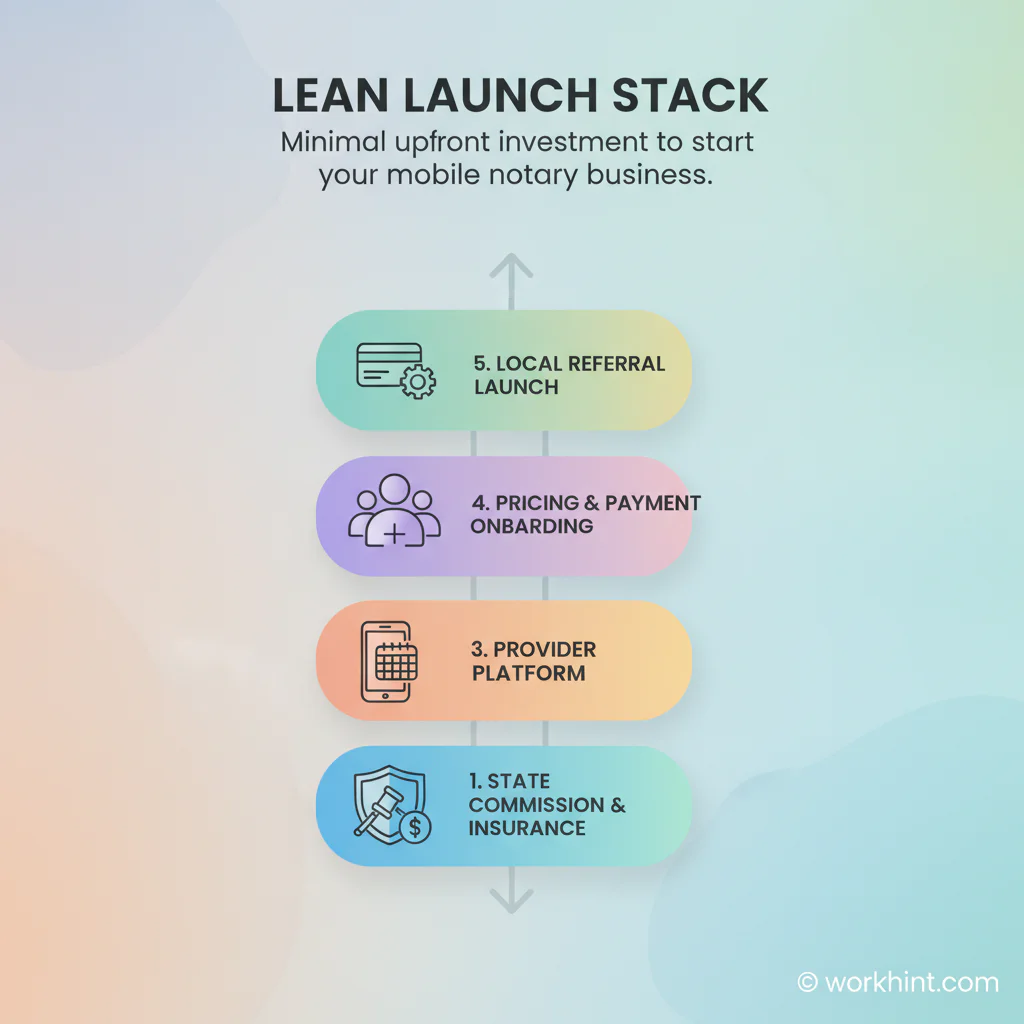
The lean version starts with the platform, process, and provider network. Buy only what is needed to validate demand: registration, insurance, provider onboarding, customer requests, scheduling, payment, and local marketing.
| Launch item | Lean budget | Why it matters |
|---|---|---|
| Business registration and local permits | $50-$300 | Creates a basic legal structure before selling services. |
| Notary commission, seal, journal, bond, and state fees | $100-$500 | Varies by state and applies to anyone performing notarizations. |
| Errors and omissions insurance | $50-$300+ | Protects against professional mistakes and builds customer confidence. |
| Branded customer platform and intake flow | $100-$500 | Lets customers request appointments, upload details, approve quotes, and pay. |
| Provider recruiting and onboarding | $100-$400 | Builds a small private network of commissioned notaries or signing agents. |
| Local marketing | $150-$700 | Funds Google profile setup, landing pages, directories, referral material, and outreach. |
A loan signing path may require extra training, certification, background checks, printer capacity, and document-handling discipline. Treat that as an expansion path unless your first target market is real estate closings.
How to price it
Mobile notary pricing usually combines state-allowed notarial fees with travel, convenience, urgency, and appointment complexity. Always check your state’s maximum notarial fee rules before publishing prices.
| Offer | Example price | Best use |
|---|---|---|
| Standard mobile appointment | $40-$125 plus permitted notarial fees | General documents within a defined local service area. |
| After-hours or urgent appointment | $75-$175 plus permitted fees | Evening, weekend, hospital, or same-day requests. |
| Business account visit | $100-$250 per visit or monthly package | Law firms, clinics, dealerships, schools, and property managers. |
| Loan signing appointment | $75-$200 per signing | Real estate closing work when provider qualifications are in place. |
The goal is not to be the cheapest notary. The goal is easy booking, clear availability, fast routing, and reliable professional visits.
How to get first customers
Start with high-intent local demand. Create a Google Business Profile, a simple service page, and directory listings where people search for notaries. Make the offer specific: mobile notary appointments in your city, same-day availability when possible, and clear service-area rules.
Then build referral channels. Contact estate planning attorneys, real estate agents, title offices, hospitals, senior care coordinators, auto dealerships, tax preparers, and small business accountants. These groups do not need a generic pitch. They need a reliable place to send notarization requests without creating extra admin work.
Track every inquiry. If people request areas, hours, or document types you cannot serve yet, use that demand data before adding providers or service windows.

How Workhint helps launch it
Workhint can become the branded operating system for the mobile notary business before you build custom software or hire administrative staff.
A customer visits your branded portal, chooses the appointment type, enters the address, describes the document, confirms signer requirements, and submits the request. The system routes the request to your operations dashboard, where you review the job, calculate the quote, and match it to a commissioned notary in the right service area.
The provider receives the assignment, appointment details, checklists, document-handling instructions, and completion steps. The customer receives confirmations, quote approvals, payment links, appointment updates, and a review request. Workhint can also track provider onboarding, credentials, availability, invoices, online payments, contractor payouts, and reporting.
That matters because the business is not just notarization. The business is trust, routing, scheduling, payment, compliance records, and consistent service delivery. Workhint gives you the platform foundation so you can validate demand and recruit providers before investing in a larger team.
First 7-day launch plan
- Day 1: Pick one city, one core offer, and one customer type such as families, attorneys, title offices, or local businesses.
- Day 2: Configure the branded platform basics: request form, service area, appointment types, customer dashboard, and internal review queue.
- Day 3: Build pricing, quote approval, scheduling, payment, provider payout, and completion checklist flows.
- Day 4: Recruit three to five commissioned notaries or signing agents who meet your requirements and service standards.
- Day 5: Publish the local service page, Google profile, and directory listings, then contact referral partners.
- Day 6: Route every inquiry through the platform, even if you handle the first appointments manually.
- Day 7: Review demand, provider coverage, missed requests, pricing, and customer feedback before expanding.
Final launch checklist
- Choose a local service area and first customer segment.
- Confirm state notary, bond, journal, seal, insurance, and business registration requirements.
- Create service packages and travel fee rules.
- Set up a branded Workhint customer portal and request form.
- Recruit and onboard independent commissioned notaries or signing agents.
- Create quote approval, scheduling, payment, completion, and payout workflows.
- Launch a local service page and Google Business Profile.
- Contact attorneys, title offices, real estate agents, clinics, senior care providers, and business service firms.
- Validate demand before hiring employees, leasing space, or buying expensive equipment.
FAQ
How much does it cost to start a mobile notary business?
A lean launch can often start with a few hundred dollars for business setup, notary supplies, insurance, a branded platform, and local marketing. Costs rise if you add loan signing training, a printer, paid directories, or broader advertising.
Do I need a license to run a mobile notary business?
You need to follow your state’s notary commission rules if you perform notarizations. Business registration, local permits, surety bonds, journals, seals, and insurance requirements vary by location.
Can I hire independent notaries instead of employees?
You can build a provider network with independent commissioned notaries, but you need clear agreements, credential checks, service standards, payout rules, and compliance controls. Classification and notary rules vary, so review local legal requirements.
How do mobile notaries get clients?
Strong first channels include Google Business Profile, local SEO, notary directories, attorneys, real estate agents, title companies, hospitals, senior care providers, and business service partners.
How much should I charge for mobile notary services?
Pricing should include state-permitted notarial fees plus travel, urgency, appointment time, and complexity. Publish clear travel zones and after-hours premiums so customers understand the total before booking.
Is loan signing required?
No. General mobile notary work can be the first offer. Loan signing can be added later if you or your providers meet the training, certification, background check, printer, and document-handling expectations of that market.
Conclusion
A mobile notary business is attractive because it can start with a focused local offer, modest upfront cost, and real customer urgency. The fastest path is to create a trusted branded platform, recruit reliable independent providers, route every request through a repeatable operating system, and invest only after demand is proven.
Leave a Reply