


A medical courier service can start lean when you sell reliable local delivery before buying a fleet.
How to start a medical courier business is a timely question because healthcare providers need dependable movement of lab specimens, prescriptions, medical supplies, records, devices, and time-sensitive materials. The opportunity is not just driving. It is building a trusted delivery operation that clinics, labs, pharmacies, and home health teams can rely on.
The lean version does not begin with a warehouse, dispatch office, or fleet of vans. It begins with one narrow route type, a branded customer platform, clear compliance rules, trained independent drivers or courier partners, and proof that local healthcare customers will pay for dependable delivery.
What’s in this article?
- Why medical courier services are attractive
- What you need to launch without overinvesting
- How to price routes, rush jobs, and recurring accounts
- How to find the first healthcare customers
- How Workhint helps launch the operating platform
- A 7-day launch plan, checklist, and FAQ
Why this business works
Medical courier demand exists because healthcare work is fragmented across facilities. Labs need specimens picked up. Pharmacies need local delivery. Clinics need supplies moved between offices. Home health providers need documents, equipment, or testing kits handled reliably.
Recent search results show strong current interest in medical courier startup costs, 2026 courier business setup, certifications, insurance, healthcare delivery pricing, route software, and how to get medical courier contracts. Most competing guides cover business registration, vehicles, insurance, regulations, and route planning. The gap is the operating model: how to validate demand with a branded platform, a small courier network, and repeatable dispatch workflows before taking on expensive fixed costs.
The first version should be specific. Examples include clinic-to-lab specimen pickup, pharmacy-to-patient delivery, dental lab transport, medical supply runs, or scheduled home health kit drop-offs. A focused service is easier to price, insure, train for, and sell.
What you need to launch
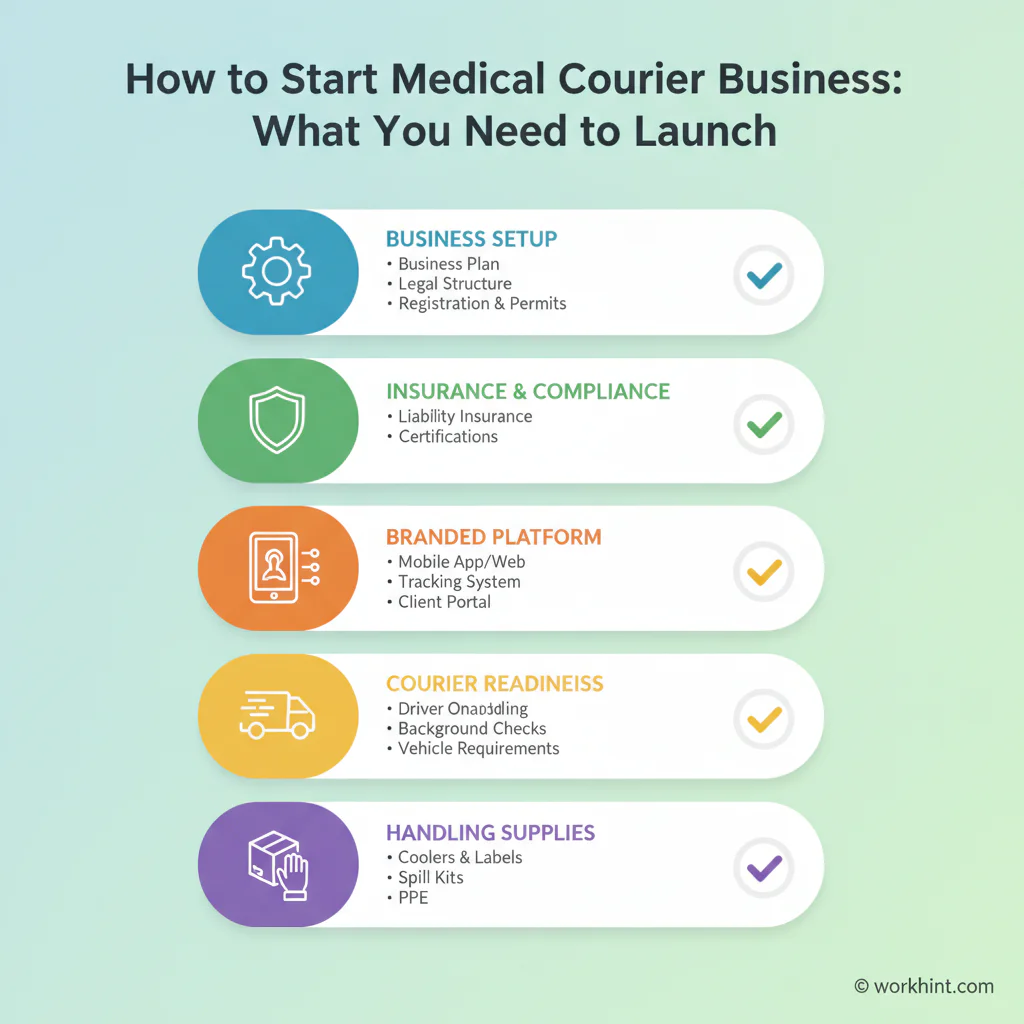
Start with the minimum setup needed to deliver safely and professionally. You need a registered business, insurance, driver screening, clear handling procedures, customer intake, dispatch rules, delivery proof, issue escalation, invoicing, and payout processes. Requirements vary by state and by what you transport, so verify local rules before carrying specimens, medication, hazardous materials, or protected health information.
A vehicle may be necessary, but a fleet is not. Many founders can validate demand with one owned vehicle, one rented backup option, or a small network of qualified independent couriers who already have reliable transportation. Invest in specialized equipment only when the service type requires it.
| Launch item | Lean first version | Typical early budget |
|---|---|---|
| Business setup | LLC or local registration, EIN, bank account, basic contracts | $150 to $900 |
| Insurance and compliance | Commercial auto review, general liability, cargo coverage, HIPAA-aware procedures where relevant | $800 to $3,500+ |
| Branded platform | Customer request form, dispatch board, delivery proof, invoicing, courier payouts | $0 to $700 to configure |
| Courier readiness | Driver screening, agreements, training, ID badges, route standards | $200 to $1,200 |
| Handling supplies | Insulated bags, spill kit, labels, temperature log process, phone mounts | $200 to $1,500 |
| Customer acquisition | Local outreach, landing page, healthcare directories, follow-up calls | $100 to $1,000 |
Do not buy multiple vehicles before you have repeat accounts. Prove that a route, customer segment, and service level can generate predictable work. Then add capacity around booked demand.
How to price it
Medical courier pricing usually combines distance, urgency, handling requirements, route frequency, waiting time, and service-level expectations. Simple pricing helps early buyers understand the offer and helps you avoid losing money on jobs that take longer than expected.
| Pricing model | Example customer price | Best use |
|---|---|---|
| Scheduled local pickup | $25 to $60 per stop plus mileage if needed | Clinic-to-lab and office-to-office routes |
| Rush delivery | $60 to $150+ depending on distance and urgency | Time-sensitive specimens, records, or supplies |
| Recurring route contract | $400 to $2,500+ per month | Predictable lab, pharmacy, or clinic routes |
| Special handling add-on | $10 to $75 per job | Temperature logs, chain-of-custody steps, wait time, extra documentation |
Keep the first offer narrow: one delivery radius, one service category, and one response-time promise. Track job time, mileage, failed pickup reasons, customer response time, courier acceptance, and margin before expanding.
How to get first customers
Your first customers are usually local operators with repeated delivery friction: independent labs, specialty clinics, dental offices, pharmacies, mobile healthcare providers, home health agencies, urgent care groups, veterinary clinics, and medical equipment suppliers.
Start with direct outreach. Build a list of nearby healthcare offices, call operations managers, ask how they currently handle pickups, and offer a simple pilot route. The strongest pitch is operational: fewer missed pickups, clearer delivery proof, faster issue resolution, and a cleaner customer portal than texting drivers manually.
Do not lead with scale. Lead with reliability in one local market. A small medical courier company can win by being easier to reach, easier to schedule, and easier to audit than informal courier arrangements.
How Workhint helps launch a medical courier platform
Workhint helps you launch the medical courier business as a branded operating platform before you build custom dispatch software or combine forms, spreadsheets, payment links, driver texts, and manual invoices.
A clinic can submit a pickup request through your branded portal, choose the delivery type, add handling notes, select urgency, upload documents when appropriate, and receive confirmation. Inside the operations dashboard, you can match the job to an approved independent courier, confirm route timing, collect delivery proof, record exceptions, send customer updates, generate invoices, and calculate courier payouts.
For couriers, Workhint can handle invitations, onboarding documents, training acknowledgments, availability, route assignments, mobile job checklists, delivery confirmation, incident reporting, and payout status. For customers, it creates a professional experience from the first request. That lets you validate demand, sell recurring routes, and expand provider capacity without building the operational foundation from scratch.
First 7-day launch plan
- Day 1: Choose one niche, such as clinic-to-lab pickups or pharmacy delivery, and define your launch radius.
- Day 2: Set up the branded Workhint platform basics: request form, customer dashboard, courier onboarding, and dispatch view.
- Day 3: Configure pricing, route assignment, delivery proof, issue escalation, invoicing, and courier payout flows.
- Day 4: Verify insurance, local requirements, handling procedures, and courier standards before accepting sensitive work.
- Day 5: Recruit one to three qualified independent couriers or backup providers with clean records and reliable availability.
- Day 6: Contact local clinics, labs, pharmacies, dental offices, and home health providers with one pilot offer.
- Day 7: Review demand, route economics, compliance gaps, and courier readiness before buying vehicles or expanding services.
Final launch checklist
- Choose one medical courier niche and one launch geography
- Register the business and confirm local requirements
- Review commercial auto, liability, cargo, and healthcare-related insurance needs
- Create handling, pickup, delivery proof, incident, and privacy procedures
- Configure a branded platform for customer requests, dispatch, tracking, invoicing, and payouts
- Recruit and onboard a small independent courier network
- Create one pilot offer for clinics, labs, pharmacies, or home health providers
- Validate recurring demand before buying additional vehicles or hiring employees
FAQ
How much does it cost to start a medical courier business?
A lean launch can often start with several thousand dollars if you already have reliable transportation, but costs rise with commercial insurance, specialized handling supplies, compliance needs, and vehicles. Avoid fleet purchases until demand is proven.
Do I need a license to start a medical courier business?
Requirements depend on your location and what you transport. At minimum, expect business registration and proper insurance. Some services may require specific handling, privacy, training, temperature control, or hazardous-material procedures.
Can I use independent couriers instead of employees?
You can build a courier network with independent providers, but classification rules matter. Use clear agreements, define service standards, avoid controlling work like an employer, and get local legal or tax guidance if needed.
What types of customers hire medical couriers?
Common customers include labs, clinics, pharmacies, dental offices, home health agencies, veterinary practices, medical supply companies, and healthcare groups that need reliable local transport.
How do medical courier companies get contracts?
Start with local outreach, referral partnerships, healthcare directories, operations managers, and pilot routes. Recurring contracts usually come from proving reliability, documentation, responsiveness, and clean communication.
What equipment do medical couriers need?
Basic needs may include a reliable vehicle, phone, insulated bags, labels, spill kit, route app, delivery confirmation process, and any required handling supplies for the items being transported.
Is a medical courier business profitable?
It can be profitable when route density, pricing, insurance, driver payouts, and customer retention are managed carefully. Recurring routes usually create stronger economics than one-off jobs alone.
Conclusion
A medical courier business is worth starting when you treat it as an operational trust business, not just a delivery side hustle. Validate one local healthcare route, build a small courier network, run every request through a branded platform, and invest in vehicles or staff only after recurring demand proves the model.
Leave a Reply