


Bottlenecks are easiest to fix when they are treated as system constraints, not individual productivity problems.
Operational bottlenecks are points in a workflow where work slows down, piles up, waits for a decision, or cannot move because capacity, information, authority, or tooling is constrained. They are common in approvals, intake queues, handoffs, reviews, scheduling, payments, customer delivery, and cross-functional work.
The hard part is finding the real constraint, proving it with evidence, and changing the system so the same delay does not reappear elsewhere.
What’s in this article?
- Why operational bottlenecks matter
- How to identify the true constraint
- A practical bottleneck analysis workflow
- A table of bottleneck signals, causes, and fixes
- Common mistakes that create hidden delays
- Where Workhint fits when bottleneck fixes need to become operating systems
Why operational bottlenecks matter
Operational bottlenecks make work slower, less predictable, and harder to manage. A team can hire strong people, buy better tools, and still miss targets if work waits too long between steps or gets stuck behind one overused role.
Current search results for bottleneck analysis, process bottlenecks, workflow bottlenecks, and how to identify bottlenecks show strong operational intent. Competing articles explain definitions, examples, and improvement methods. The practical gap is system design: who owns the constraint, what data proves it, what queue controls are needed, and how the fix will be measured.
The American Society for Quality describes the theory of constraints as a continuous improvement approach focused on the weakest link in a process. The first step is identifying the constraint. For operators, that means looking beyond symptoms such as missed deadlines and finding the part of the system that actually limits throughput.
Operational bottlenecks: how to identify the real constraint
Start with the outcome the workflow is supposed to produce: approved vendor, completed onboarding, paid invoice, resolved support issue, shipped campaign, closed implementation, or scheduled field visit. Then trace the path from request to completion.
Look for five signals. First, work piles up in one step. Second, cycle time increases even when demand is stable. Third, people wait for the same role, approval, document, or system. Fourth, urgent exceptions keep bypassing the normal process. Fifth, managers cannot explain status without asking several people for updates.
Lean practice often uses process mapping to make these delays visible. The Lean Enterprise Institute describes value stream mapping as diagramming the material and information flow needed to bring a product from order to delivery. Service and operations teams can use the same idea: map every step, queue, handoff, decision, rework loop, system, and waiting period that affects the customer or internal requester.
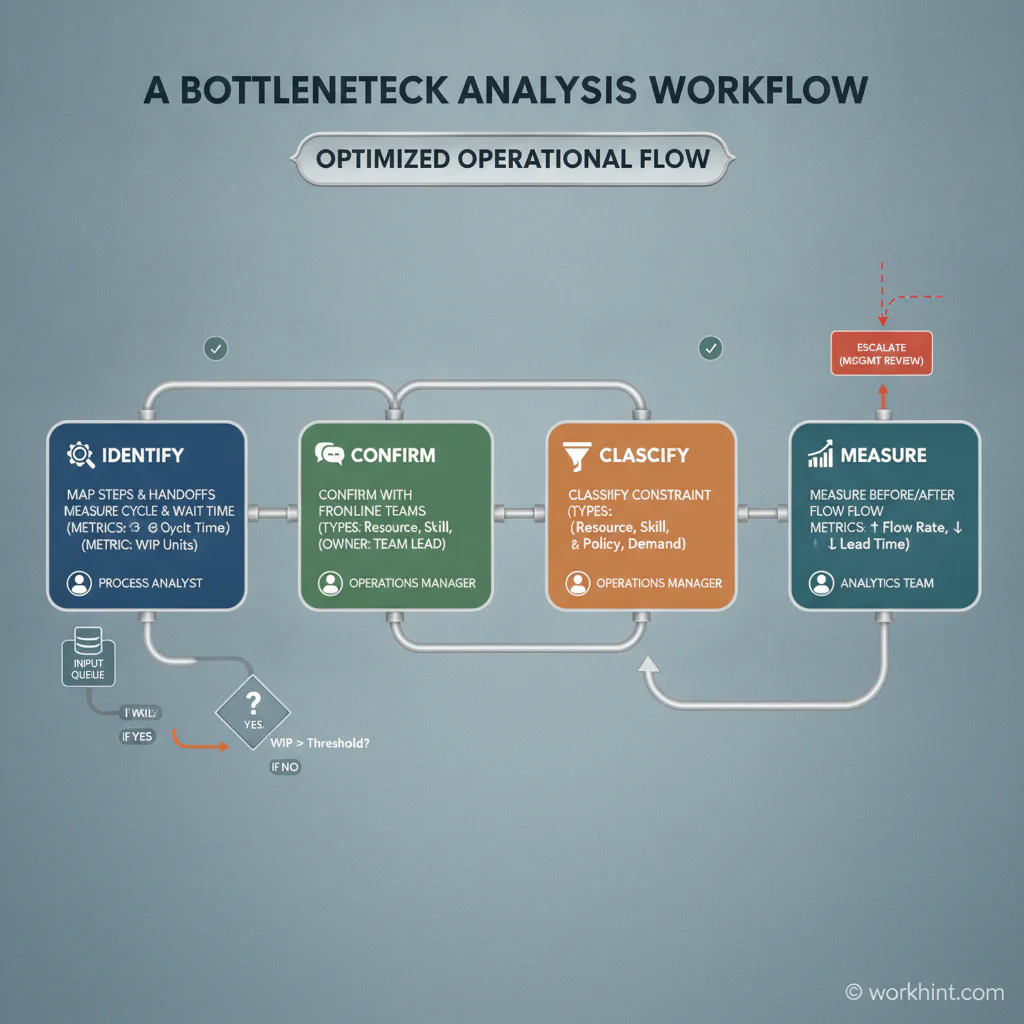
A bottleneck analysis workflow
Use this workflow before changing staffing, adding automation, or buying another tool.
- Name the workflow and outcome. Pick one process with a clear output. Do not analyze the whole company at once.
- Map the current path. List each step, owner, input, output, system, approval, handoff, and exception path.
- Measure cycle time and wait time. Separate time spent doing work from time spent waiting for review, information, capacity, or access.
- Find work-in-progress buildup. Identify where requests, tasks, documents, tickets, or decisions accumulate.
- Confirm the constraint with people doing the work. Ask what they wait for, what they redo, which rules are unclear, and where exceptions happen.
- Classify the bottleneck. Decide whether the constraint is capacity, decision rights, missing information, dependency, tool friction, policy ambiguity, quality rework, or demand volatility.
- Choose the smallest system change. Fix the constraint with clearer ownership, queue rules, better intake, role redesign, automation, escalation paths, or capacity changes.
- Measure the before and after. Track cycle time, queue age, throughput, rework, handoff delay, escalation volume, and SLA misses.
Bottleneck signals and practical fixes
The right fix depends on the type of constraint. More people is not always the answer.
| Signal | Likely constraint | System fix | Metric to watch |
|---|---|---|---|
| Requests wait for one person | Decision authority or specialist capacity | Define approval thresholds, backups, and escalation rules | Approval cycle time |
| Work arrives incomplete | Weak intake | Require fields, documents, and routing rules before submission | Rework rate |
| Too many tasks are open | Uncontrolled work in progress | Add queue limits, priority rules, and aging reviews | WIP count and queue age |
| Teams redo the same work | Quality or handoff gap | Add acceptance criteria, checklists, and clearer ownership | First-pass completion rate |
| Status is unclear | Visibility gap | Create shared workflow states and operational dashboards | Stale work items |
| Automation fails silently | Integration or exception handling gap | Add failure queues, owner alerts, and manual fallback paths | Failed handoffs |
Use flow controls before adding more capacity
Many bottlenecks are caused by too much work entering the system at once. Work-in-progress limits can make the constraint visible and force teams to finish before starting more. Atlassian’s guide to Kanban WIP limits explains that limiting active work helps reveal bottlenecks, reduce multitasking, and improve flow.
For operations teams, WIP limits do not have to be complicated. A legal review queue might limit open contract reviews by risk tier. A customer implementation team might cap active onboardings per lead. A finance team might set invoice exception limits by age and dollar amount. The point is to prevent invisible overload from becoming the normal operating model.
Common bottleneck mistakes
- Fixing the loudest symptom. A delayed approval may be caused by poor intake, unclear thresholds, or missing authority, not by the approver being slow.
- Optimizing one step in isolation. Speeding up one team can overload the next queue if the full workflow is not reviewed.
- Automating a broken path. Automation can move incomplete requests faster into the same delay.
- Ignoring exception work. Repeated exceptions are usually part of the real process and need owners, rules, and measurement.
- Tracking activity instead of flow. Completed tasks matter, but cycle time, queue age, rework, and blocked work usually reveal bottlenecks faster.
Where Workhint fits
Workhint fits when bottleneck analysis needs to become a live work system, not a one-time workshop. A team can use Workhint to turn the workflow into structured intake, roles, permissions, assignments, approvals, escalation paths, dashboards, automations, documents, and reporting.
That matters because most bottlenecks return when the fix is only written in a slide deck. If the new rule says high-risk requests need legal review, the operating system should route those requests, show queue age, assign the right owner, record the decision, and escalate when the work stalls. Workhint helps connect the process design to the daily execution layer where bottlenecks actually appear.
FAQ
What is an operational bottleneck?
An operational bottleneck is any constraint that slows a workflow, reduces throughput, increases wait time, or prevents work from moving predictably from request to completion.
How do you identify operational bottlenecks?
Map the workflow, measure cycle time and wait time, look for work piling up, review handoffs and approvals, interview the people doing the work, and confirm which constraint limits the entire process.
What metrics reveal bottlenecks?
Useful metrics include cycle time, queue age, work in progress, throughput, blocked work, rework rate, approval time, escalation volume, SLA misses, and first-pass completion rate.
Should bottlenecks be fixed with more staffing?
Sometimes, but staffing should not be the default answer. Many bottlenecks come from weak intake, unclear ownership, missing decision rights, poor visibility, rework, or uncontrolled work in progress.
How often should teams review bottlenecks?
Review high-volume operational workflows monthly and after major demand changes. For critical queues such as customer escalations, compliance approvals, or payments, review aging and blocked work weekly.
Conclusion
Operational bottlenecks are not just slow steps. They are signals that the work system needs clearer intake, ownership, capacity controls, decision rules, handoffs, visibility, or measurement. The best teams identify the real constraint, make one targeted system change, and measure whether flow improves. When that discipline becomes part of operating rhythm, bottlenecks stop being recurring surprises and become manageable signals for continuous improvement.
Leave a Reply