


Internal requests scale only when every ask has a front door, owner, priority, status, and measurable path to completion.
Internal request management is the operating system a company uses to capture, route, approve, fulfill, and measure requests from employees and teams. It covers IT access, finance questions, legal reviews, procurement requests, HR support, data pulls, facilities issues, marketing asks, operations changes, and any other internal work that arrives from many directions.
The problem is rarely that people ask for help. The problem is that requests arrive through Slack, email, meetings, spreadsheets, side conversations, and personal favors. Work disappears, priorities become political, and teams cannot tell whether they are under-resourced or simply disorganized.
What’s in this article?
- What internal request management means in practical business terms
- Why informal request handling breaks as a company grows
- A step-by-step request management workflow
- A table of request fields, owners, and operating rules
- Common mistakes that make request systems fail
- Where Workhint fits when requests need to become live operating workflows
Why internal request management matters
Internal requests are a hidden execution layer. They decide who gets access, which spend gets approved, what work enters a queue, when exceptions are allowed, and how quickly blockers are removed. When that layer is unmanaged, the loudest request often wins instead of the most important one.
Service management frameworks treat request handling as a repeatable practice, not a pile of one-off messages. PeopleCert’s ITIL 4 service request management module describes the goal as handling predefined, user-initiated service requests in an effective and user-friendly way. Atlassian’s service request management guidance emphasizes starting with common requests and documenting requirements before adding them to a catalog.
That logic applies beyond IT. Finance needs clean reimbursement requests. Legal needs complete contract review packets. Operations needs field issue reports with enough context to act. HR needs employee questions routed to the right policy owner.
Internal request management: the core system
A strong internal request system has five parts: intake, classification, ownership, workflow, and measurement. Intake captures the request. Classification decides what kind of work it is. Ownership assigns accountability. Workflow defines the steps, approvals, and handoffs. Measurement shows volume, aging, completion time, rework, and service quality.
The system should be simple enough that employees use it and structured enough that operations can improve it. The test is whether a request can be understood, prioritized, assigned, tracked, and closed without private detective work.
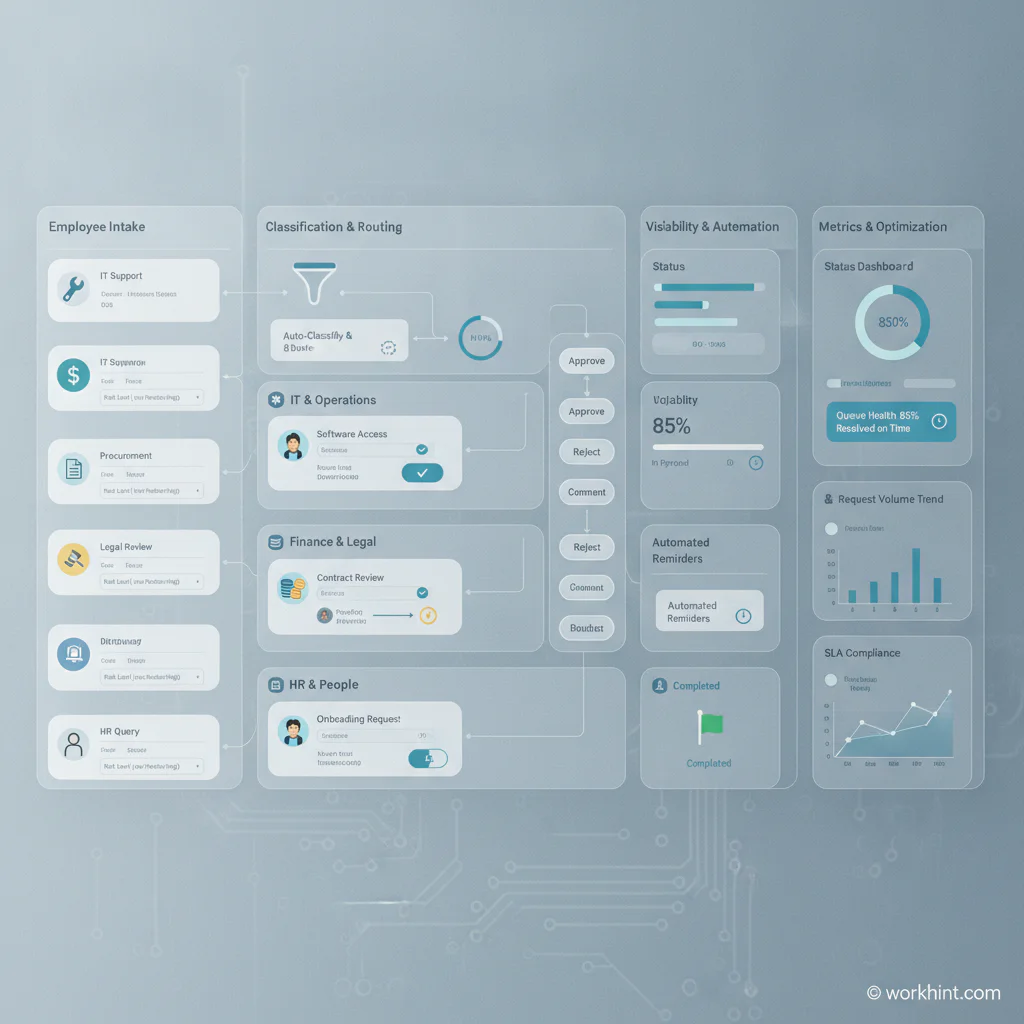
A practical request management workflow
- Define request categories. Start with recurring requests that create volume or confusion: access, purchases, contract reviews, reporting, onboarding, policy questions, exceptions, and support issues.
- Create one front door per audience. Employees should know where to go: a portal, form, or embedded intake path inside the tools they already use.
- Ask only for required information. Every field should help route, approve, fulfill, or measure the request. Extra questions reduce adoption and create bad data.
- Route by type, risk, and owner. Access requests, vendor exceptions, legal reviews, and field operations issues should not land in the same generic queue.
- Set priority rules. Define what counts as urgent, high impact, blocked work, compliance-sensitive, or standard service. Priority should be based on business impact, not who asked loudest.
- Attach approvals only where needed. Low-risk repeatable requests should move fast. High-risk, high-cost, or policy-sensitive requests need the right approval step.
- Show visible status. Requesters should see whether the request is received, waiting for information, under review, approved, in progress, blocked, complete, or declined.
- Measure the queue. Track request volume, age, cycle time, SLA misses, backlog, reopens, approval delay, handoff delay, and categories that keep growing.
The request system design table
| System element | Decision to make | Operating rule |
|---|---|---|
| Request type | What kind of work is being requested? | Use categories that map to real owner teams, not vague labels. |
| Required fields | What must be known before work can start? | Collect the minimum data needed for routing, approval, and fulfillment. |
| Owner | Who is accountable for moving the request forward? | Assign one primary owner and a backup for time-sensitive queues. |
| Priority | How important is this request compared with other work? | Use impact, urgency, risk, and due date instead of requester seniority. |
| Approval | Does the request need permission before fulfillment? | Require approvals only when cost, access, compliance, or business risk justifies it. |
| Status | What should the requester and owner see? | Use simple statuses that explain what is happening and what is blocked. |
| Metrics | How will the team know whether the system works? | Track cycle time, queue age, SLA misses, reopen rate, and request volume by category. |
How to keep the system usable
Internal request management works when it is designed around real behavior. If employees live in Slack, email, Teams, or a field app, the request path should be easy to reach from there. Atlassian’s request management guidebook makes this point clearly: the process should reflect how teams communicate.
Usability also depends on trust. Requesters need visible status. Owners need a queue that reflects real priorities. Leaders need metrics that represent operational load. A request system that becomes a dumping ground will push people back into side channels.
Common request management mistakes
- Starting with software instead of process. A tool cannot fix undefined categories, missing owners, unclear approvals, or political prioritization.
- Making every request use the same workflow. Different work needs different routing, fields, and approval depth.
- Asking too many questions. Long forms create poor adoption. Capture what is needed to start, then collect specialist details later if required.
- Skipping requester visibility. If employees cannot see status, they will chase owners manually and recreate the noise the system was meant to reduce.
- Ignoring queue health. Ivanti’s service request management guidance stresses centralizing requests so admins do not search across channels. Centralization only helps if teams also review aging, backlog, and service levels.
- Automating bad routing. Automation should follow clear operating rules. Otherwise it just moves requests to the wrong place faster.
Where Workhint fits
Workhint fits when internal request management needs to become a live work system instead of a static form. A team can use Workhint to design intake, define request types, assign roles and permissions, route work, trigger approvals, show statuses, manage documents, automate reminders, and report on queue health.
That matters because internal requests rarely stay inside one department. A vendor request might need operations, finance, legal, security, and the business owner. A field issue might need dispatch, customer support, payroll, and a regional manager. Workhint helps connect those steps from submission through completion.
FAQ
What is internal request management?
Internal request management is the process a company uses to receive, classify, route, approve, fulfill, and measure requests from employees and internal teams.
What should an internal request system include?
It should include request categories, intake fields, priority rules, owners, approval paths, statuses, service targets, reporting, and a clear way for requesters to see progress.
How is request management different from project intake?
Project intake evaluates larger work before it enters planning. Request management handles recurring operational asks, service needs, approvals, access, exceptions, support, and cross-team requests.
What metrics should operations teams track?
Track request volume, backlog, queue age, cycle time, first response time, approval delay, SLA misses, reopen rate, handoff delay, and request categories by owner team.
When should a request be automated?
Automate repeatable requests after the intake fields, owner rules, approval criteria, exceptions, and completion requirements are clear. Do not automate unclear work.
Conclusion
Internal request management is not just ticketing. It is how a company decides what work enters the system, who owns it, how it moves, when it needs approval, and whether it is getting better over time. Start with the requests that happen most often, define the minimum information needed, route work to clear owners, make status visible, and review the metrics. Then internal work becomes easier to scale, easier to measure, and much harder to lose.
Leave a Reply