


Contractor offboarding protects the work, the relationship, and the business record when an external engagement ends.
A contractor offboarding checklist is the operating sequence a company uses when an independent contractor, freelancer, consultant, agency worker, or external specialist finishes an engagement. It should close the work, protect company systems, settle payment, preserve records, and avoid treating the contractor like an employee after the relationship ends.
Offboarding often gets less attention than onboarding because the urgent work feels finished. That is exactly when risk appears. A contractor may still have access to shared drives, customer data, project tools, Slack channels, source files, buildings, payment systems, or confidential documents. A final invoice may be blocked because no one confirmed acceptance of the deliverables. A manager may assume IT removed access while IT assumes the manager never filed the request.
What’s in this article?
- Why contractor offboarding needs its own workflow.
- A practical contractor offboarding checklist for business, IT, finance, and legal teams.
- How to handle final deliverables, access, assets, invoices, records, and communication.
- Common mistakes that create security, payment, or misclassification risk.
- Where Workhint fits when contractor offboarding needs to become a repeatable system.
Why contractor offboarding matters
Contractors are not employees, so their offboarding should not simply copy an employee exit process. The U.S. Department of Labor explains misclassification as treating a worker as an independent contractor when the worker is actually an employee under the Fair Labor Standards Act. The IRS also tells businesses to look at the whole relationship, including control and independence, when determining whether a worker is an employee or independent contractor.
That does not mean companies should be hands-off at the end of a project. It means the process should focus on business controls: acceptance of deliverables, return of property, removal of project access, final payment, record retention, and relationship closeout. The company should not keep assigning work, supervising daily behavior, or extending access indefinitely because no one owns the exit.
Government offboarding checklists show the same operational pattern in a stricter environment. The FAA contractor off-boarding checklist, for example, covers surrender of property, termination of facility and system access, and cancellation of credentials. The business version may be lighter, but the control logic is the same: once access is no longer needed, remove it and document that removal.
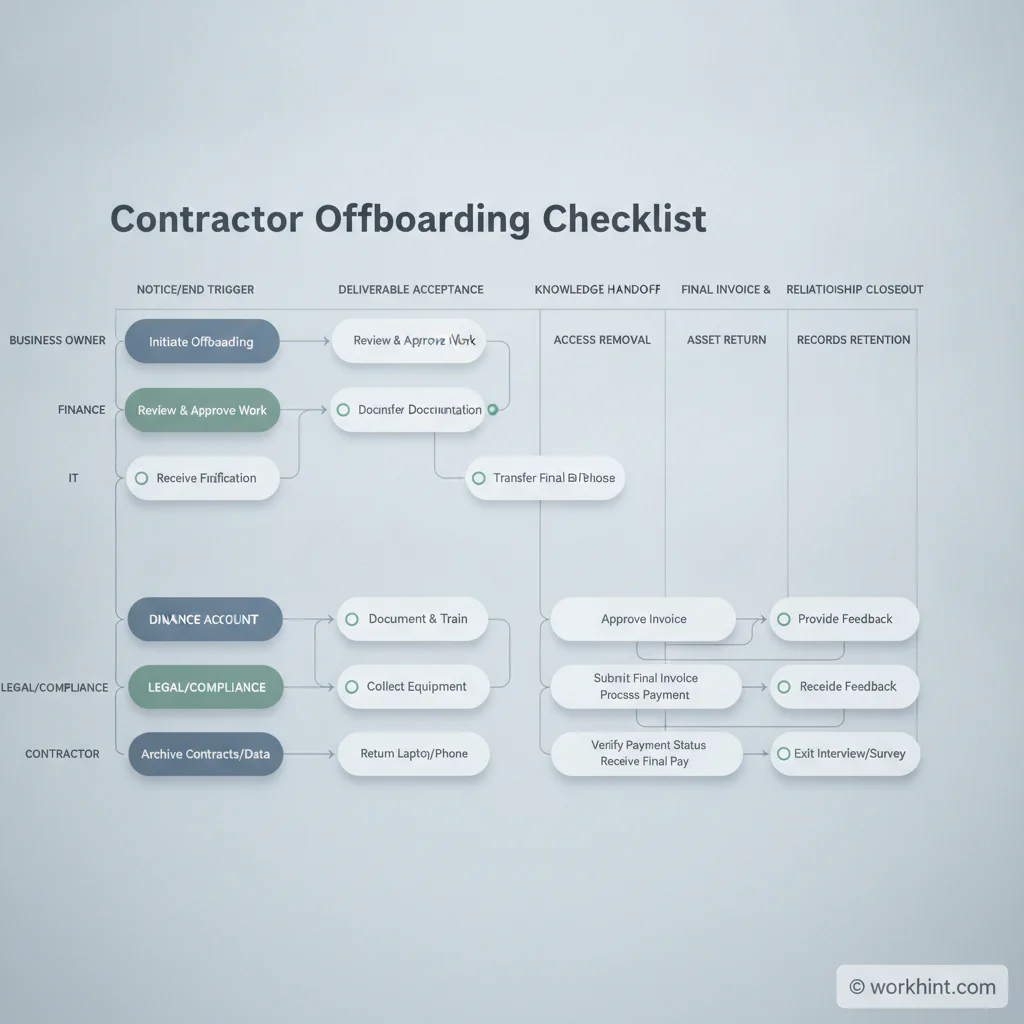
Contractor offboarding checklist
The checklist below works for freelancers, independent contractors, consultants, field contractors, and agency-supplied workers. Adjust it based on the contractor’s access level, geography, contract terms, and risk profile.
| Step | Owner | What to confirm | Output |
|---|---|---|---|
| End trigger | Business sponsor | Contract end date, project completion, termination notice, or non-renewal decision. | Confirmed offboarding date |
| Deliverable acceptance | Project owner | Final files, milestones, handoff notes, open defects, and acceptance criteria. | Accepted deliverables record |
| Knowledge transfer | Project owner | Where files live, decisions made, dependencies, credentials not owned by the contractor, and next steps. | Handoff document |
| Access removal | IT or system owner | Email, chat, project tools, repositories, databases, portals, VPN, devices, and shared folders. | Access removal log |
| Asset recovery | Operations or IT | Laptop, badge, keys, test devices, uniforms, documents, equipment, or customer materials. | Returned asset record |
| Invoice review | Finance | Final invoice, approved hours or milestones, expenses, tax form status, currency, and payment terms. | Approved final payment |
| Record retention | Legal, HR, or finance | Agreement, SOW, tax forms, classification record, invoices, approvals, and offboarding evidence. | Complete contractor file |
How to run the offboarding workflow
1. Start with the contract and scope
Review the contractor agreement, statement of work, purchase order, or agency agreement before sending the final message. Confirm notice requirements, final deliverables, intellectual property terms, confidentiality obligations, payment terms, and whether the contractor has any equipment or system access. If the engagement is ending early, involve legal or procurement before taking action.
2. Accept the work before approving final payment
Final payment should not depend on memory or scattered chat messages. Create a simple acceptance record that lists the deliverables, the approver, the date, and any unresolved exceptions. For hourly contractors, confirm that hours were submitted under the agreed process. For milestone contractors, confirm that the milestone was completed and accepted.
3. Remove access based on need, not convenience
Access should end when the contractor no longer needs it. That includes obvious tools like email and project management accounts, but also shared folders, source code repositories, customer systems, analytics tools, AI workspaces, calendars, password vaults, and communication channels. NIST access control guidance emphasizes account management controls such as disabling accounts when they are no longer needed or authorized. For contractors, this should be tied to the offboarding date.
4. Capture the handoff while context is fresh
A useful handoff is short and specific. Ask for final file locations, open decisions, unfinished items, recurring tasks, vendor or customer contacts, technical dependencies, and any risks the next owner should know. The goal is continuity, not a performance review. Keep the request focused on the work product and the agreed scope.
5. Close finance cleanly
Finance needs more than a final invoice. It needs proof that the work was accepted, the billing terms match the agreement, the contractor’s tax or payment details are complete, and any expenses were approved under policy. If payment is cross-border, confirm currency, fees, and documentation before the contractor has already disengaged.
Common contractor offboarding mistakes
- Leaving access open because another project might start later. Reopen access when new work is approved instead of leaving old access active.
- Approving payment without acceptance. A clean final payment record should connect invoice, scope, deliverable, and approver.
- Using an employee exit checklist without changes. Contractors need access and asset controls, but not employee benefits, payroll, or exit interview assumptions.
- Forgetting agency or vendor-supplied workers. The agency may manage employment, but your company still owns access, data, deliverables, and internal approvals.
- Losing documentation after the contractor leaves. Store the final agreement, SOW, invoices, approvals, handoff, and access removal evidence in one contractor record.
Where Workhint fits
Workhint helps turn contractor offboarding from a manager’s memory into a controlled workflow. A company can create an offboarding intake, assign owners across business, IT, finance, legal, and operations, collect final documents, route deliverable approval, trigger access removal tasks, track asset return, connect final invoice approval, and keep the contractor record tied to the engagement. For ongoing contractor operations, contractor management software can connect onboarding, assignments, access, records, performance, and offboarding in one operating system.
That matters most when external work spans many teams. Without a system, each manager invents a different exit process. With a Workhint workflow, contractor offboarding follows the same operating path while still adapting by contractor type, project, risk level, location, and payment method.
FAQ
What should a contractor offboarding checklist include?
It should include the contract end trigger, deliverable acceptance, knowledge transfer, access removal, asset recovery, final invoice review, payment approval, stakeholder communication, and record retention.
Is contractor offboarding the same as employee offboarding?
No. Contractor offboarding should focus on closing the commercial engagement, removing access, recovering assets, settling invoices, and preserving records. Employee-specific steps such as benefits, payroll termination, and employment exit processes usually do not apply.
Who owns contractor offboarding?
The business sponsor should own the overall closeout, but IT, finance, legal, procurement, and operations may each own required tasks. The best process has one accountable owner and clear task-level owners.
When should contractor access be removed?
Access should be removed when the contractor no longer needs it for approved work. For most engagements, that means on the confirmed offboarding date or immediately after final deliverable transfer.
Conclusion
Contractor offboarding is not just an administrative goodbye. It is the final control point in the external workforce lifecycle. When the checklist is clear, companies protect data, preserve work continuity, pay contractors correctly, and keep a usable business record. The best process is simple: confirm the end, accept the work, remove access, recover assets, approve payment, and store the evidence.
Leave a Reply