


A usable change plan turns uncertainty into owners, messages, timelines, training, risks, and adoption checks.
A change management plan template gives teams a repeatable way to move from an old way of working to a new one without relying on scattered meetings, vague announcements, or manager memory. Use it when your company is rolling out software, changing a process, reorganizing ownership, updating a policy, merging teams, or introducing a new operating model.
This resource is not legal, HR, or compliance advice. It is an operational planning template for business teams. For regulated changes, pair it with the right internal counsel, HR, security, or compliance review.
What’s included
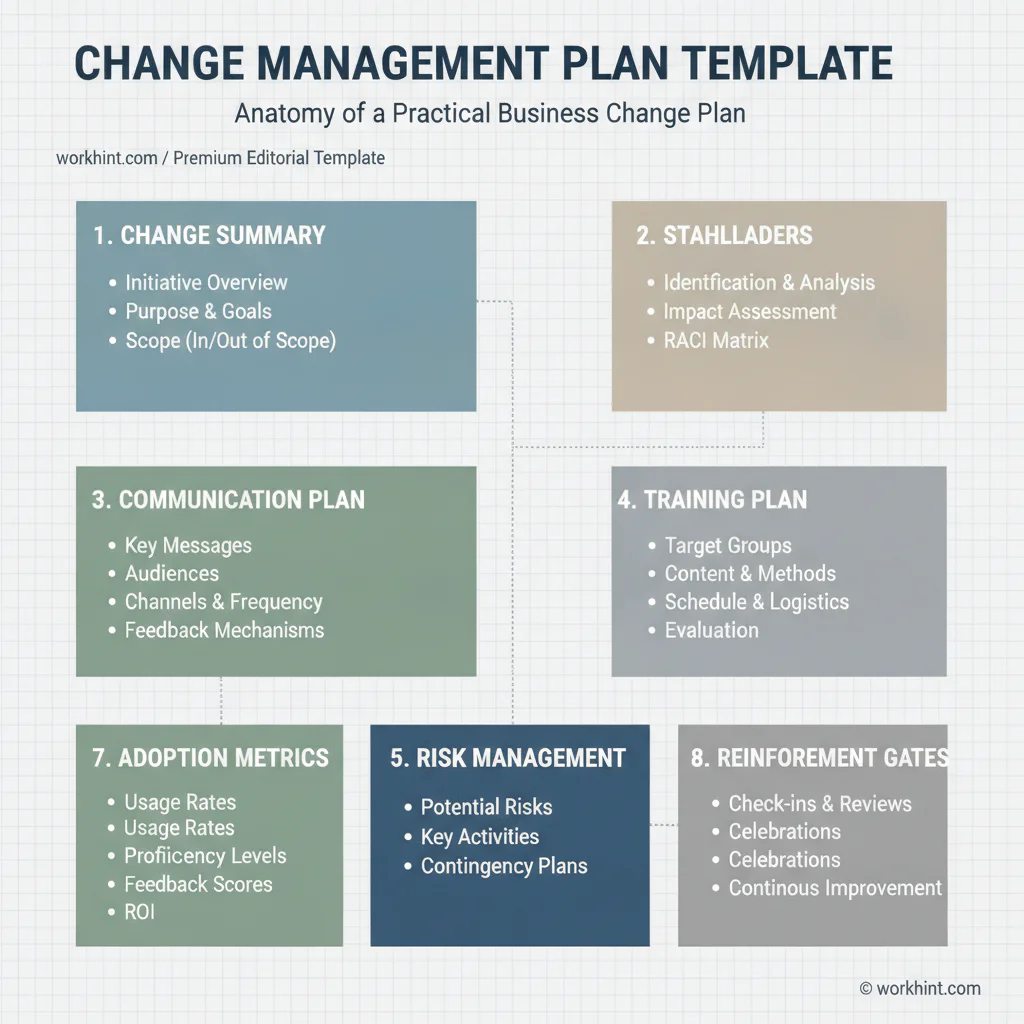
This template covers the sections most teams need before they launch a meaningful change:
- Change summary and business reason
- Impacted teams, stakeholders, and decision owners
- Communication plan by audience
- Training and enablement needs
- Risk, resistance, and dependency tracking
- Implementation timeline and rollout gates
- Adoption metrics, feedback loops, and reinforcement steps
The structure aligns with common change planning guidance from sources such as Prosci’s change management plan template, the University of Waterloo change management resource centre, the GSA M3 Playbook Change Management Plan Template, and the UC Berkeley Change Management Toolkit.
How to use this change management plan template
Start with one specific change. Do not use the same plan to cover a software migration, reporting restructure, approval redesign, and policy rollout at once. If several changes are connected, create one parent plan and separate implementation tracks underneath it.
Assign one accountable change owner before filling in details. That person does not need to do every task, but they must keep the plan current, escalate blocked decisions, and confirm that adoption is happening after launch. Then review the template with the teams most affected by the change. The best plan is not the neatest document; it is the one that exposes what people need to know, do, approve, learn, stop doing, or measure differently.
Change management plan template
| Section | What to capture | Owner | Evidence of completion |
|---|---|---|---|
| Change summary | What is changing, why now, what stays the same, and what outcome the business expects. | Change owner | Approved one-page summary |
| Current state | The process, tool, team structure, or policy being replaced or improved. | Process owner | Mapped current workflow |
| Future state | The new workflow, roles, tools, handoffs, rules, and success criteria. | Process owner | Signed-off future-state map |
| Stakeholders | Who is affected, who decides, who approves, who supports, and who may resist. | Change owner | Stakeholder list with roles |
| Communication | Audience, message, sender, channel, date, and feedback path. | Comms lead | Message calendar |
| Training | What people need to learn, by when, and how readiness will be checked. | Enablement lead | Training completion report |
| Risks | Adoption risks, operational risks, compliance risks, dependencies, and mitigation plans. | Change owner | Risk log with next actions |
| Rollout timeline | Pilot, launch, transition period, cutover, support window, and review dates. | Project lead | Milestone plan |
| Adoption metrics | Usage, completion, cycle time, error rate, satisfaction, support requests, or business KPIs. | Analytics owner | Baseline and post-launch dashboard |
Example application
Imagine an operations team replacing spreadsheet-based vendor requests with a standardized intake and approval workflow. The change summary explains why the spreadsheet is being retired: duplicate requests, unclear approval ownership, delayed vendor onboarding, and missing status visibility.
The stakeholder section lists requesters, department approvers, finance, legal, procurement, IT, and vendors. The communication plan separates messages by audience. Requesters need to know where to submit new requests. Approvers need decision criteria and response-time expectations. Finance needs budget fields. Legal needs contract review triggers. Vendors need document submission instructions.
The training plan includes a 20-minute walkthrough for requesters, a decision checklist for approvers, and a support channel for the first two weeks. Adoption metrics include percentage of requests submitted through the new workflow, median approval time, number of incomplete vendor packets, and manual follow-up volume.
Common mistakes
- Treating communication as one announcement. Most changes need staged messages: why it is happening, what will change, what people must do, when the old process stops, and where to get help.
- Skipping the current state. If you do not understand how work happens today, you will miss hidden dependencies, informal approvals, and exceptions that matter.
- Confusing launch with adoption. A rollout is not successful because the new tool or process went live. It is successful when the intended people actually use it correctly.
- No decision owner. Change stalls when every unresolved question becomes a meeting instead of a decision routed to a named owner.
- No reinforcement period. Teams often need reminders, manager coaching, quick fixes, and exception handling after the first launch date.
Where Workhint fits
A template is useful for planning, but most change work fails in the handoff between the document and daily execution. Workhint helps teams turn a change management plan into a live work system: intake forms, roles, permissions, task routing, approval gates, training steps, reminders, dashboards, documents, and status reporting can all be connected to the same operating workflow.
For example, the stakeholder map can become role-based access. The communication plan can become scheduled tasks and audience-specific updates. The training plan can become required completion steps. The risk log can become an escalation workflow. The adoption metrics can become a dashboard the change owner checks after launch. That keeps the template from becoming a static file that everyone forgets once the rollout begins.
FAQ
What is a change management plan?
A change management plan is a structured document that explains how an organization will prepare for, communicate, implement, support, and measure a business change. It focuses on people, process, adoption, and risk, not just project tasks.
What should a change management plan include?
At minimum, include the business reason, current state, future state, impacted stakeholders, communication plan, training plan, risks, timeline, owners, and adoption metrics.
Who owns the change management plan?
One accountable change owner should own the plan. Depending on the change, that owner may sit in operations, HR, product, IT, finance, compliance, or the business function being changed.
How is a change management plan different from a project plan?
A project plan tracks tasks, dates, deliverables, and dependencies. A change management plan tracks how people will understand, accept, learn, use, and sustain the new way of working. Most meaningful initiatives need both.
When should a business use this template?
Use it before launching changes that affect how people work: new software, reorganized teams, process redesigns, new approval rules, policy changes, vendor workflows, customer operations, or compliance procedures.
Conclusion
A strong change management plan makes the work visible before the disruption begins. It gives teams a shared view of what is changing, why it matters, who owns each decision, how people will be trained, what risks need attention, and how adoption will be measured. Copy the template, adapt it to the specific change, and review it after launch so the next rollout starts with better evidence.
Leave a Reply