


Vendor performance is easier to manage when every review connects evidence, owners, issues, approvals, and renewal decisions.
Vendor performance management is the operating discipline of tracking whether outside suppliers, agencies, contractors, and service partners are delivering what the business actually needs. It is not just a quarterly procurement scorecard. Done well, it helps teams spot risk early, protect budgets, improve delivery, and decide which vendors should grow, fix issues, or exit.
What’s in this article?
- Why vendor performance management matters after approval.
- The KPIs and evidence worth tracking.
- A practical workflow for vendor reviews, escalation, and renewal decisions.
- A simple vendor scorecard structure teams can adapt.
- Where Workhint fits when vendor performance needs to become a live operating system.
Why vendor performance management matters
Most vendor problems do not appear all at once. They build quietly: missed response times, late deliverables, unresolved quality issues, surprise fees, unclear owners, expired documents, or complaints that live in email but never reach a review. By the time the renewal date arrives, the team relies on memory instead of evidence.
Public procurement programs show why structured vendor performance records matter. The Texas Comptroller describes its Vendor Performance Tracking System as a way for procurement teams to evaluate vendor performance and reduce risk in future awards. Private companies need the same operating logic, even if their process is lighter: define expectations, collect evidence, review consistently, and use the record when making sourcing, renewal, and payment decisions.
This matters even more for external workforces. A vendor may handle customer support, logistics, field service, recruiting, creative production, IT support, payroll, compliance checks, or subcontracted delivery. Poor performance can affect customers, workers, cash flow, security, and operations at the same time.
What to track in vendor performance
Start with the contract and the work model. A low-risk office supplier does not need the same review as a staffing agency, agency partner, or vendor with access to customer data. Use risk tiers so the process is proportional.
| Performance area | What to measure | Useful evidence |
|---|---|---|
| Delivery | On-time work, missed milestones, backlog, cycle time | Accepted deliverables, work orders, project records |
| Quality | Error rate, rework, defects, customer complaints | QA notes, issue logs, revision history, client feedback |
| Responsiveness | Response time, escalation handling, update cadence | Support threads, status updates, SLA records |
| Cost control | Budget variance, invoice accuracy, change orders | Approved invoices, purchase orders, budget reports |
| Compliance and risk | Expired documents, data access, policy exceptions | Certificates, access logs, security reviews, audit notes |
A vendor scorecard helps turn those signals into a consistent review. Ramp’s guide to vendor scorecards describes the common pattern: compare vendors across areas such as quality, delivery, cost, compliance, and responsiveness. The useful version is not a spreadsheet nobody trusts. It is a shared record tied to actual work evidence.
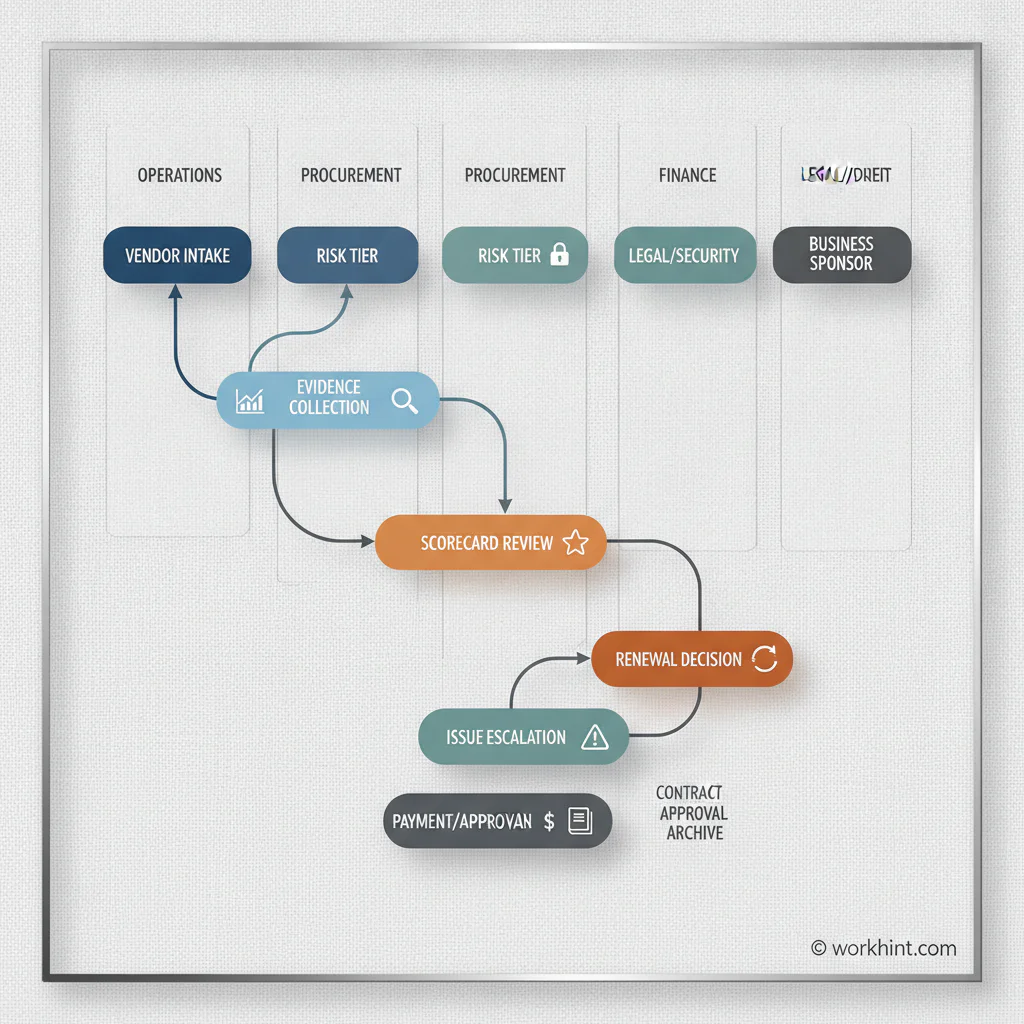
A practical vendor performance workflow
Use this workflow when vendor performance needs to be visible across operations, procurement, finance, legal, security, and business owners.
- Set the baseline before work starts. Define the vendor’s scope, success metrics, owner, review cadence, payment terms, required documents, access limits, and escalation path.
- Assign a risk tier. Tier vendors by spend, business criticality, customer impact, data access, compliance exposure, and operational dependency.
- Collect evidence during delivery. Capture accepted deliverables, missed deadlines, issue reports, invoices, approvals, communication records, and exceptions as the work happens.
- Review on a fixed cadence. Monthly reviews may fit critical vendors; quarterly reviews may work for standard vendors. Low-risk vendors can be reviewed at renewal or after incidents.
- Score only what the team will use. A five-category scorecard is usually enough: delivery, quality, responsiveness, cost, and risk/compliance.
- Route issues to owners. Every performance issue should have an owner, next step, due date, and severity level. Do not let the review become a complaint archive.
- Connect performance to decisions. Use the record for renewal, expansion, reduction, replacement, payment hold, contract changes, or additional controls.
For vendors with system access, customer data, subcontractors, or critical operational roles, performance tracking should include risk monitoring. NIST’s cybersecurity supply chain risk management work and CISA’s supply chain risk management guidance both reinforce the same practical point: third-party relationships need ongoing visibility, not one-time approval.
Common mistakes to avoid
- Tracking too many KPIs. If nobody acts on a metric, remove it.
- Reviewing vendors only at renewal. By then, leverage is lower and memory is unreliable.
- Letting every department keep its own version. Procurement, finance, operations, and the business owner need one shared record.
- Scoring without evidence. Performance reviews should cite work records, issue logs, approvals, invoices, and stakeholder feedback.
- Ignoring vendor tiering. A heavy process for every vendor slows the business; a light process for critical vendors creates risk.
Where Workhint fits
Workhint fits when vendor performance management needs to move from scattered spreadsheets and inboxes into a repeatable workflow. A business can use Workhint to structure vendor intake, assign risk tiers, define roles and permissions, collect documents, route approvals, track deliverables, log issues, connect accepted work to invoice readiness, and keep review evidence in one place.
The value is not that Workhint replaces judgment. The value is that the operating system is visible. Operations can see delivery status, finance can see approved work before payment, legal or security can see open risk items, and the business owner can make renewal decisions from a real record instead of a last-minute opinion.
FAQ
What is vendor performance management?
Vendor performance management is the process of measuring, reviewing, and improving how outside vendors deliver against agreed expectations, including quality, delivery, cost, responsiveness, compliance, and risk.
What KPIs should a vendor scorecard include?
A practical vendor scorecard usually includes delivery performance, quality, responsiveness, cost control, compliance, issue resolution, and stakeholder satisfaction. Add category-specific metrics only when they affect decisions.
How often should vendors be reviewed?
Critical vendors should usually be reviewed monthly or quarterly. Standard vendors may be reviewed quarterly or twice a year. Low-risk vendors can be reviewed at renewal, after incidents, or when spend grows.
Who should own vendor performance reviews?
Ownership should be shared but explicit. The business sponsor owns outcomes, procurement owns vendor governance, finance owns invoice and spend controls, legal or security owns risk requirements, and operations owns the day-to-day workflow.
Conclusion
The practical answer to how to track vendor performance is to build a workflow, not just a scorecard. Define expectations, tier vendors by risk, collect evidence during work, review on a cadence, route issues to owners, and connect the record to payment, renewal, and sourcing decisions. That turns vendor performance management into an operating habit instead of a scramble before renewal.
Leave a Reply