


Use this RFP template to define the work, compare vendors fairly, and turn proposals into a clear decision.
A request for proposal template gives a business a repeatable way to ask vendors for comparable proposals. Instead of sending a loose email, every vendor receives the same scope, requirements, deadlines, pricing instructions, and evaluation criteria. That makes the buying process cleaner for the team and clearer for the vendors responding.
This template is designed for business teams selecting software, service providers, agencies, contractors, implementation partners, consultants, or operational vendors. It is not legal advice, and regulated or high-value purchases should still be reviewed by procurement, finance, legal, security, or counsel before release.
What’s included in this request for proposal template
- An RFP structure you can copy into a document.
- A checklist for preparing the RFP before vendors see it.
- A scoring matrix for comparing responses consistently.
- Common mistakes that create weak proposals or messy decisions.
- A workflow for turning the RFP into approvals, ownership, and vendor onboarding.
How to use this RFP template
Start by confirming that an RFP is the right tool. Use an RFI when you are still learning the market, an RFQ when the requirement is clear and price is the main variable, and an RFP when the work is complex enough that vendors need to explain approach, scope, timeline, staffing, pricing, risk, and tradeoffs. The USAC sample documents describe RFPs as formal bidding documents that define a project and desired services in detail, which is the right mindset for most business RFPs.
Before writing, collect the business problem, current process, budget range, must-have requirements, decision timeline, stakeholders, and approval rules. Procurement guidance from CIPS emphasizes using supplier data and criteria before narrowing potential suppliers. If the criteria come after proposals arrive, the process becomes easier to bias toward the most familiar vendor or the best sales presentation.
Request for proposal template
1. RFP overview
Include the company name, issuing team, RFP owner, release date, response deadline, expected decision date, and contact instructions. State whether vendor questions are allowed, where questions should be sent, and whether answers will be shared with all bidders.
2. Business problem and desired outcome
Explain the business problem in plain language. Avoid starting with a preferred solution. A strong RFP describes the outcome the business needs, such as faster onboarding, cleaner vendor approvals, better reporting, reduced manual work, higher service reliability, or a more consistent customer experience.
3. Scope of work
Define what is included, what is out of scope, and what the vendor must deliver. For services, include phases, deliverables, meetings, handoffs, review cycles, and acceptance criteria. For software, include use cases, user groups, required integrations, data needs, implementation support, security expectations, and reporting requirements.
4. Requirements
Separate requirements into must-have, preferred, and optional. Must-have requirements should be few and defensible. If everything is marked critical, vendors cannot tell what matters, and evaluators cannot make tradeoffs.
5. Vendor response format
Tell vendors exactly how to respond. Ask for company background, proposed approach, team structure, timeline, assumptions, dependencies, risks, implementation plan, support model, references, pricing, and contract exceptions. Consistent response formats make proposal review faster and more objective.
6. Timeline and milestones
List the RFP release date, vendor question deadline, response deadline, finalist interviews, decision date, contract target date, and expected project start. If the timeline is uncertain, say so. Vendors can plan better when they know which dates are firm.
7. Pricing instructions
Ask vendors to separate one-time fees, recurring fees, usage-based costs, implementation costs, support costs, travel, taxes, discounts, renewal assumptions, and optional add-ons. This prevents teams from comparing a low first-year number against a more complete total cost estimate.
8. Evaluation criteria
Share the criteria and weights before responses arrive. A public-sector example from Results for America highlights the value of structured procurement checklists and templates when teams need consistent review. The same principle applies in private companies: the decision should be tied to defined criteria, not memory or preference.
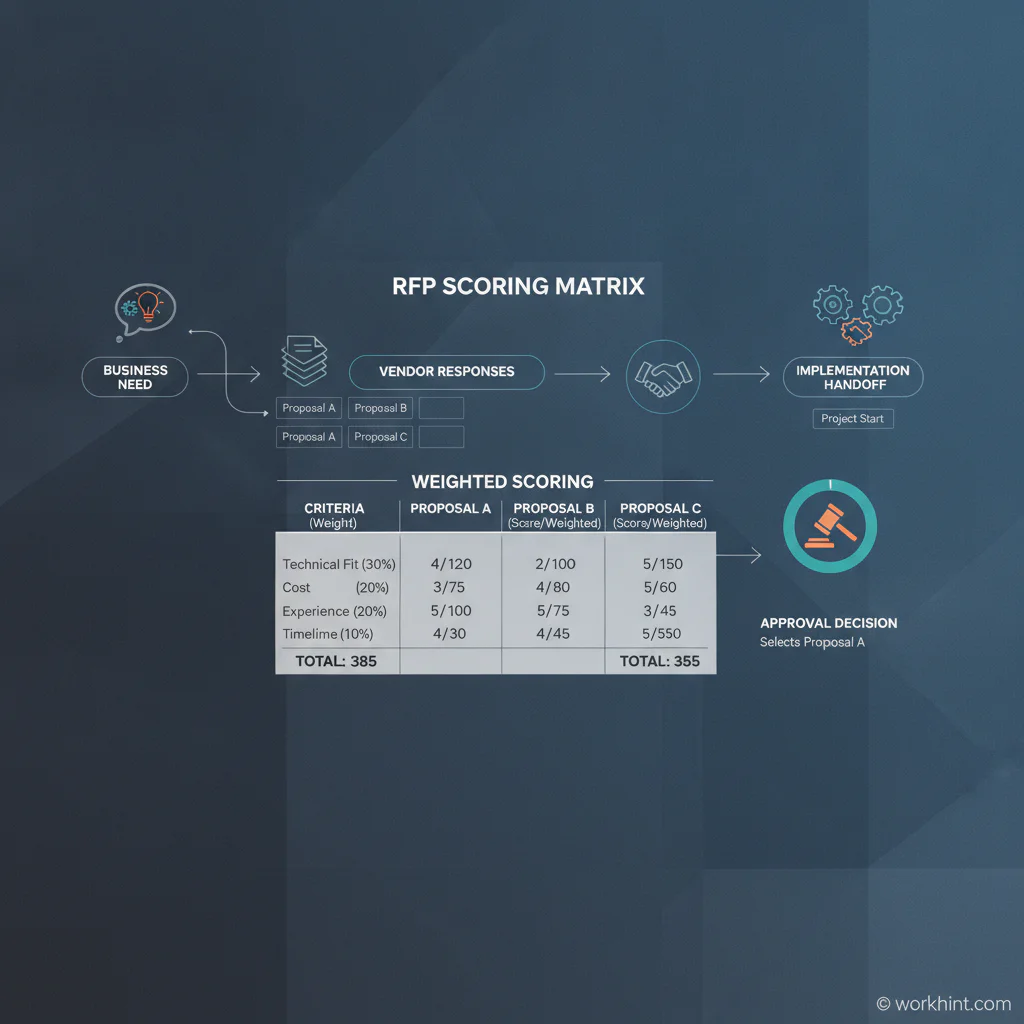
RFP scoring matrix
| Criteria | Suggested weight | What to evaluate |
|---|---|---|
| Fit to business need | 25% | How directly the proposal solves the stated problem and required use cases. |
| Delivery approach | 20% | Implementation plan, staffing, milestones, dependencies, and risk handling. |
| Experience and references | 15% | Relevant customer examples, domain experience, and proof of successful delivery. |
| Security, compliance, and risk | 15% | Data handling, access controls, legal requirements, continuity, and vendor risk. |
| Total cost | 15% | Complete cost over the decision horizon, not just first-year price. |
| Support and operating model | 10% | How the vendor will support users, changes, reporting, and issue resolution. |
Use a 1 to 5 score for each criterion, multiply by weight, then discuss exceptions. A vendor with the highest score is not always the automatic winner, but the scoring record forces the team to explain why it is choosing a different option.
Example RFP checklist before release
- The business owner has approved the problem statement and desired outcome.
- Finance has reviewed the budget range and pricing instructions.
- Legal has reviewed contract, confidentiality, and liability language where needed.
- Security or IT has reviewed data, access, integration, and compliance requirements.
- The evaluation criteria and weights are documented before vendor responses arrive.
- The response deadline gives vendors enough time to submit useful proposals.
- The decision owner and approval path are clear.
Common RFP mistakes
The first mistake is writing the RFP around a solution the team already wants. That turns the process into confirmation rather than evaluation. The second is asking for too much generic information. Long vendor questionnaires create work, but not always insight. Every question should support a decision.
The third mistake is hiding the evaluation criteria. Vendors give better responses when they know what matters. The fourth is failing to define the handoff after selection. A winning proposal still has to become a contract, project plan, onboarding workflow, access setup, payment path, reporting cadence, and renewal record.
Where Workhint fits
Workhint helps teams turn the RFP template into a live buying and vendor-selection workflow. A business can use Workhint to structure the intake request, assign the RFP owner, route finance/legal/security approvals, collect vendor responses, manage evaluation tasks, track scoring, record decisions, and convert the winning proposal into onboarding, implementation milestones, document collection, and payment readiness.
That matters when RFPs involve multiple departments or outside partners. The document starts the process, but the operating system around the document keeps the work from disappearing into email threads, spreadsheets, and scattered files.
FAQ
What should an RFP template include?
An RFP template should include the business problem, scope of work, requirements, response format, timeline, pricing instructions, evaluation criteria, submission rules, and contact process.
What is the difference between an RFP, RFI, and RFQ?
An RFI is used for market research, an RFQ is used when requirements are clear and price is the main comparison point, and an RFP is used when vendors need to propose an approach for a more complex need. Indeed’s RFP guide frames an RFP as a way for organizations to invite third-party services to bid on a project.
Should you share scoring criteria with vendors?
Yes. Sharing criteria helps vendors respond to the actual decision and helps the buying team stay consistent. You do not need to share every internal discussion, but the main evaluation categories should be clear.
Who should own an RFP?
The business owner should own the outcome. Procurement, operations, finance, legal, security, IT, and executives may own review steps depending on the size, risk, and type of purchase.
Conclusion
A request for proposal template is useful because it makes complex buying decisions more structured. Define the business problem, give vendors a consistent response format, publish evaluation criteria, score proposals against the same model, and keep the decision record connected to implementation. The result is not just a cleaner document. It is a better way to choose vendors and move from selection to execution.
Leave a Reply