


Direct sourcing works only when the talent pool is connected to real workflow, compliance, and payment controls.
Direct sourcing in contingent workforce management means using your own brand, relationships, and talent community to find temporary workers, freelancers, contractors, or consultants more directly instead of sending every request to staffing suppliers first. The goal is not to eliminate suppliers. The goal is to create a faster, better-governed path for repeatable external work.
A direct sourcing program usually combines a branded talent pool, curation, intake, classification review, onboarding, assignment management, and payment operations. MBO Partners describes direct sourcing strategy as a way for companies to use a talent network of vetted independents to match skills with project opportunities. That sounds simple, but the operating details matter.
What’s in this article?
- What direct sourcing means for contingent workforce teams.
- When direct sourcing is a good fit and when staffing suppliers still matter.
- A practical workflow for building a contractor talent pool.
- Governance checks that prevent the program from becoming risky shadow hiring.
- Where Workhint fits when direct sourcing needs to become a live work system.
Why direct sourcing matters
Companies often turn to direct sourcing after seeing the same external roles requested again and again: designers, developers, customer support specialists, field technicians, operations coordinators, implementation consultants, seasonal staff, or project experts. If each request starts from zero, the business pays for sourcing repeatedly and loses time rebuilding context.
Direct sourcing turns that repeat demand into a reusable channel. ICON Consultants frames direct sourcing in contingent workforce strategy as a way to build or access talent communities while still preserving supplier relationships. That distinction matters. Direct sourcing should be one lane in the workforce model, not a free-for-all.
It is also compliance-sensitive. The U.S. Department of Labor’s independent contractor classification guidance reminds businesses that worker status depends on the actual relationship, not just the label used in a contract. This article is not legal advice. For classification, tax, employment, or cross-border questions, use qualified counsel and official guidance.
When direct sourcing is a good fit
Direct sourcing works best when the business has repeatable demand, recognizable roles, a reason contractors would want to work with the company, and enough operational discipline to manage the lifecycle after the person is found.
| Good fit | Weak fit | What to decide |
|---|---|---|
| Recurring project roles with similar skills | One-off urgent roles with no repeat demand | Will a talent pool be reused often enough? |
| Known contractor communities or alumni networks | No brand awareness with the target talent | Can the company attract and re-engage people directly? |
| Clear intake, classification, and approval rules | Ad hoc manager-to-contractor arrangements | Who reviews risk before work starts? |
| Repeatable onboarding and payment process | Manual documents and invoice chasing | Can operations support the experience at scale? |
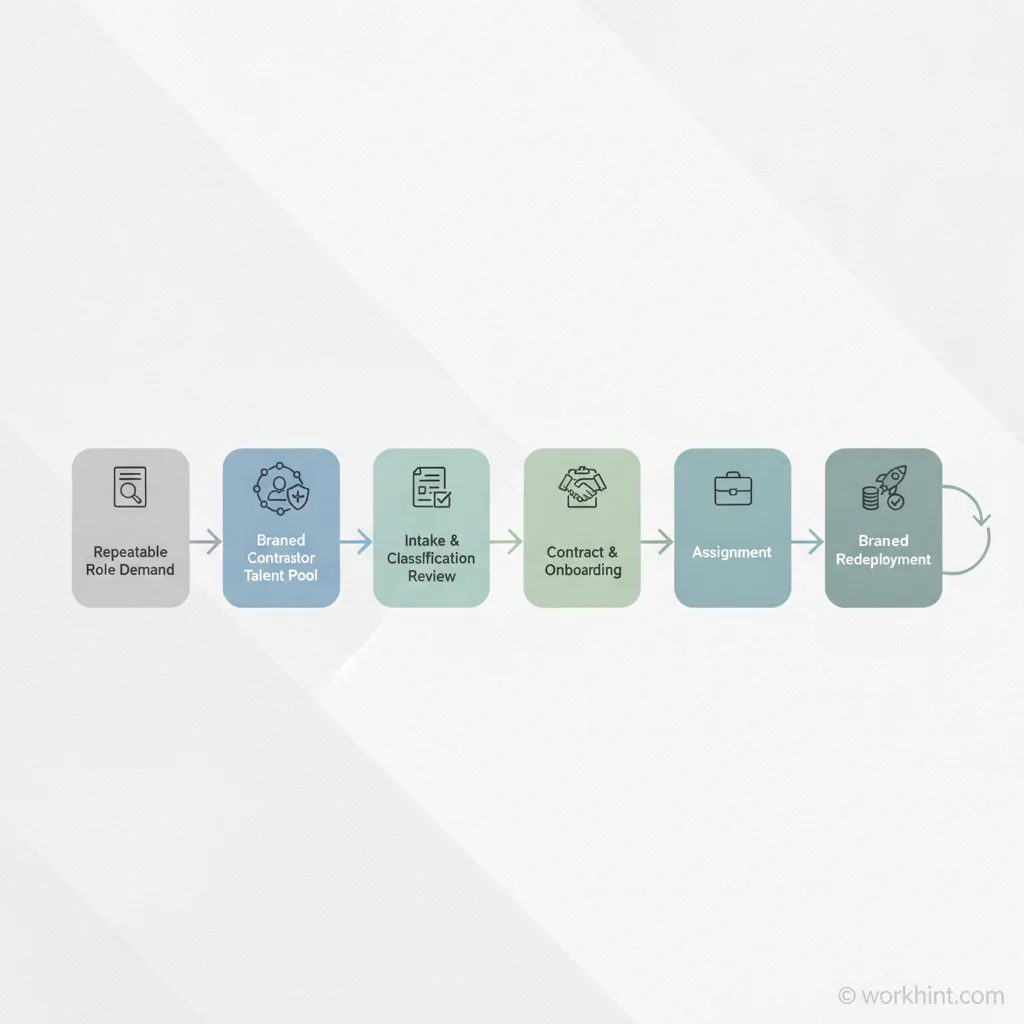
Direct sourcing operating workflow
Start with the work pattern, not the software. A useful direct sourcing workflow has seven steps.
- Identify repeatable demand. Review contractor spend, agency requests, project backlogs, and manager needs. Direct sourcing is strongest where roles recur across teams or seasons.
- Define the talent pool. Decide who belongs in the pool: past contractors, applicants, referrals, alumni, marketplace specialists, partner workers, or pre-vetted freelancers.
- Create intake rules. Managers should request external work through a structured form with role, scope, location, budget, timeline, system access, and payment model.
- Route classification and risk checks. Before engagement, review worker type, contract path, data access, insurance needs, tax forms, and country or state considerations.
- Onboard before assignment. Collect agreements, documents, access approvals, security acknowledgments, payment details, and kickoff information before the contractor starts.
- Manage the work. Assign deliverables, due dates, approvers, change requests, acceptance criteria, and escalation paths. The pool is only useful if the work is clear.
- Close, pay, and redeploy. Approve completed work, release payment, revoke access if needed, record performance notes, and decide whether the contractor should remain available for future work.
Governance rules to set early
The most common mistake is treating direct sourcing as a recruiting shortcut. It is really an operating model. Set these rules before scaling:
- Who can request a direct contractor? Limit requests to approved managers or require budget-owner approval.
- Which roles are eligible? Keep the first pool focused. Broad talent pools become hard to curate.
- What must happen before work starts? Classification, contract, tax, security, access, and payment setup should not happen after the first task.
- When should suppliers still be used? Staffing partners may still own surge hiring, specialized sourcing, employer-of-record needs, or regulated roles.
- How will performance be reviewed? Track completion, quality, responsiveness, rate fit, rehire eligibility, and manager satisfaction.
Common mistakes
- Building a database instead of a workflow. A list of names is not direct sourcing. The value comes from matching, onboarding, assignment, approval, payment, and redeployment.
- Skipping classification review. Direct access to contractors can increase risk if managers treat external workers like employees.
- Overpromising savings. Lower agency dependency can reduce cost, but curation, compliance, tools, and payment operations still need owners.
- Ignoring the contractor experience. Talented contractors will not return if every engagement requires repeated paperwork, unclear scope, slow approvals, or late payment.
- Creating conflict with suppliers. Define which work belongs in the direct pool and which work remains supplier-led.
Where Workhint fits
Workhint fits when direct sourcing needs to move from a talent idea into a controlled operating system. A company can use Workhint to structure contractor intake, route approvals, collect documents, assign role-based access, coordinate deliverables, track acceptance, connect payment status, and maintain a reusable record of who worked on what.
That is especially useful when direct sourcing spans operations, finance, legal, procurement, hiring managers, and external workers. Workhint is not the source of legal advice or a replacement for every VMS, MSP, or payrolling partner. It helps the business design and run the workflow around the external talent pool so work, approvals, records, and payments do not scatter across email and spreadsheets.
FAQ
What is direct sourcing in contingent workforce management?
Direct sourcing is a model where a company uses its own brand, network, and talent pool to find and engage temporary workers, freelancers, contractors, or consultants more directly instead of relying only on staffing suppliers.
Is direct sourcing the same as a freelance marketplace?
No. A marketplace helps find external talent. Direct sourcing is a program model that includes talent pooling, intake, curation, compliance review, onboarding, work assignment, payment, and re-engagement.
Does direct sourcing replace staffing agencies?
Usually not. It works best as one channel inside a broader workforce strategy. Staffing agencies may still be better for urgent roles, specialized searches, high-volume surge needs, or employer-of-record support.
Who should own a direct sourcing program?
Ownership is usually cross-functional. Talent, procurement, legal, finance, operations, and business leaders all touch different parts of the lifecycle. One program owner should coordinate the rules.
What should be measured?
Track time to fill, percentage of repeat roles filled from the pool, contractor re-engagement rate, approval cycle time, compliance exceptions, work acceptance rate, payment timing, and manager satisfaction.
Conclusion
Direct sourcing in contingent workforce management is valuable when it turns repeat external work into a managed channel. Start with the roles that repeat, define the rules before managers use the pool, keep suppliers in the model where they add value, and connect sourcing to onboarding, assignments, approvals, payments, and records. The strongest programs do not just find contractors faster. They make external work easier to run.
Leave a Reply