


You can sell qualified leads before you build a large agency, hire a sales team, or buy a stack of expensive tools.
If you are searching for how to start a lead generation agency, the opportunity is simple: companies need more qualified conversations, but many do not have the time, data, process, or outbound discipline to create them consistently.
The mistake is thinking you need to start like a traditional agency. You do not need employees, an office, or a large internal sales team on day one. You need a clear niche, a measurable offer, a branded customer platform, and a reliable network of independent researchers, copywriters, list builders, appointment setters, and campaign operators who can fulfill work as demand appears.
What’s in this article?
- Why a lead generation agency can work as a low-overhead startup
- What you need before taking your first client
- How to price lead generation services
- How to find your first customers
- How Workhint can become the operating system for the agency
- A practical 7-day launch plan and final checklist
Why a Lead Generation Agency Works
Lead generation is attractive because the problem is tied directly to revenue. A local contractor, SaaS company, consultant, staffing firm, or B2B service provider can usually understand the value of one more qualified buyer conversation.
Search demand also shows practical intent. Readers look for startup costs, tools, pricing, outreach channels, and whether this kind of agency can be started from home. Competitor articles commonly explain niches, software, cold email, LinkedIn outreach, and pricing. The gap is operations: how to coordinate client intake, campaign work, approvals, deliverables, performance reporting, and contractor payouts without becoming the bottleneck.
A platform-first model solves that. Instead of hiring employees, you can build a private provider network. One contractor researches accounts, another verifies lists, another writes sequences, another books meetings, and you manage quality, client communication, approvals, and reporting through one branded system.
What You Need to Launch
Start with one niche. A lead generation agency for everyone is hard to sell and hard to fulfill. A lead generation agency for commercial cleaning companies, cybersecurity consultants, local home service companies, B2B SaaS startups, or recruiting firms is easier to explain.
Your first version should include a customer intake form, ideal customer profile questions, list criteria, campaign approval steps, lead qualification rules, delivery format, reporting cadence, and refund or replacement policy. Keep the offer narrow until demand is proven.
| Launch item | Lean starting approach | Estimated first-month cost |
|---|---|---|
| Brand and landing page | One clear niche page with offer, proof plan, and booking form | $50-$300 |
| Workhint platform setup | Customer portal, intake, campaign workflow, provider onboarding, approvals, payments | Start lean before custom software |
| Data and research tools | Use a small monthly plan only after choosing a niche | $50-$250 |
| Independent provider network | Recruit freelance list builders, copywriters, and appointment setters | Pay per project or milestone |
| Compliance basics | Business registration, contracts, privacy process, email compliance review | $100-$500 |
| Client acquisition | Manual outreach, partnerships, referrals, founder-led selling | $0-$300 |
Do not buy every automation tool on day one. Validate the offer first. You can add deeper enrichment, dialing, data, and analytics tools after clients prove they will pay for the outcome.
How to Price It
Lead generation pricing depends on niche, complexity, sales cycle, quality standard, and whether you deliver raw leads, qualified meetings, or managed campaigns. For a new agency, avoid vague monthly retainers with unclear deliverables. Sell a small, specific outcome.
| Model | Best for | Example price |
|---|---|---|
| Lead list package | Clients who need targeted contacts and account research | $300-$1,500 per list |
| Qualified lead package | Clients who want vetted prospects matching clear criteria | $50-$250 per qualified lead |
| Appointment setting | Higher-ticket services with clear sales capacity | $150-$750 per qualified meeting |
| Monthly campaign management | Clients who want ongoing outreach and reporting | $1,500-$6,000 per month |
| Hybrid retainer plus performance | Clients with longer sales cycles and shared upside | Base fee plus bonus per meeting or sale |
Your first offer might be: “We build a verified list of 200 target accounts and book five qualified discovery calls for niche B2B service companies.” That is easier to sell than “full-service growth marketing.”
How to Get First Customers
The fastest first customers usually come from a narrow market where you can show the math. Pick companies with high customer lifetime value, visible buyer lists, and a clear reason to want more conversations.
- Use founder-led outreach to contact 50 niche businesses with a specific lead idea.
- Partner with web designers, fractional CMOs, CRM consultants, and local business advisors.
- Offer a small paid pilot instead of free work.
- Create one niche landing page around the customer problem, not your agency story.
- Share anonymized examples of target account lists, qualification criteria, and reporting templates.
The goal is not to appear large. The goal is to prove that a specific type of customer will pay for a specific lead generation outcome.
How Workhint Helps Launch It
Workhint can become the branded operating platform for the lead generation agency before you build custom software or hire an internal team.
A client can submit a campaign request through your branded portal, define their ideal customer profile, upload exclusions, approve messaging, review lead criteria, and track campaign status from a customer dashboard. Inside the same platform, you can invite independent researchers, copywriters, data specialists, and appointment setters into role-based workflows.
That means a new client request can move through intake, campaign setup, list building, quality review, message approval, outreach scheduling, lead delivery, invoice generation, payment, and contractor payout without scattered spreadsheets and private DMs. Contractors only see the assignments and data they need. Clients see progress, approvals, and results. You see capacity, margins, deadlines, and campaign quality.
This is the difference between starting a solo service and launching a platform-backed agency. You can sell the outcome, coordinate independent providers, and validate demand before committing to employees or a permanent tech stack.
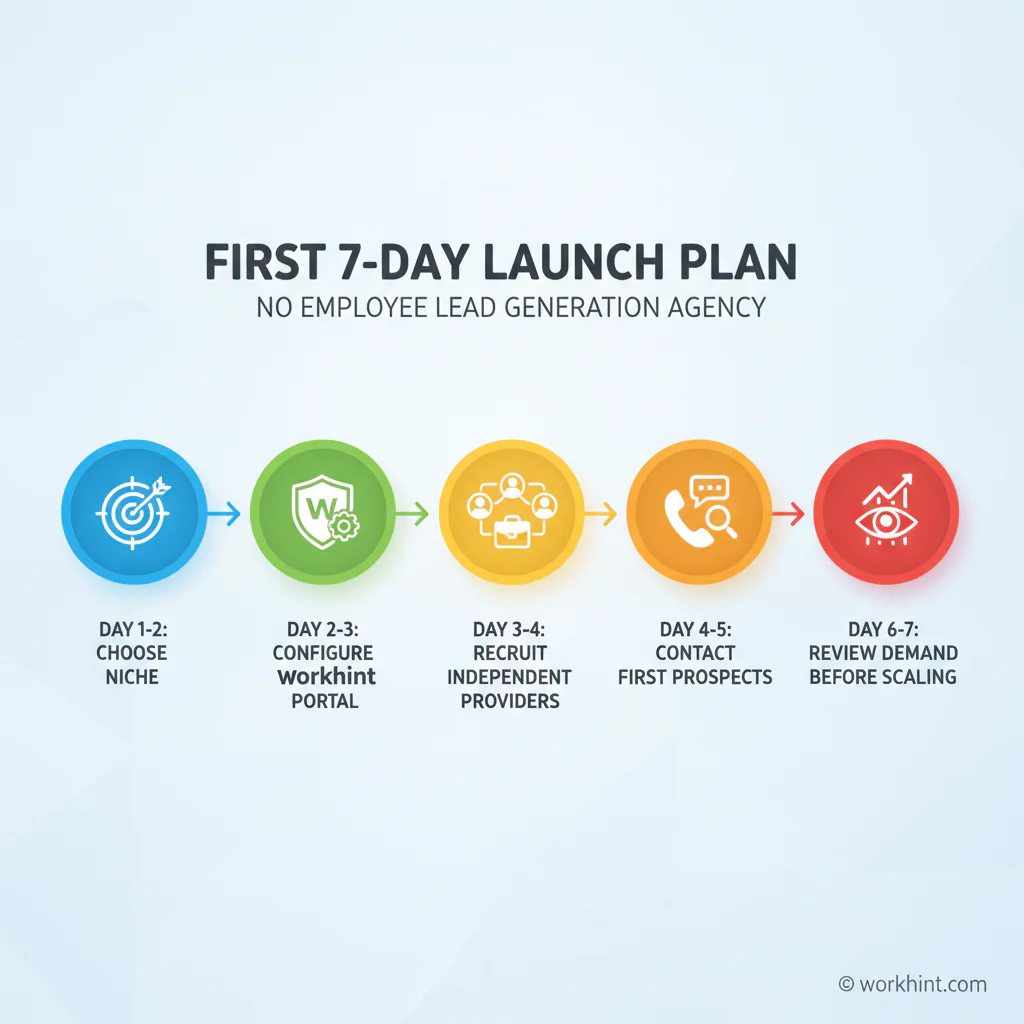
First 7-Day Launch Plan
- Day 1: Choose one niche, one buyer, and one measurable lead generation offer.
- Day 2: Set up the branded Workhint portal with client intake, campaign request forms, and a basic customer dashboard.
- Day 3: Define pricing, qualification criteria, approval steps, delivery format, invoicing, and provider payout rules.
- Day 4: Recruit three to five independent specialists for research, list building, copywriting, or appointment setting.
- Day 5: Contact the first 50 prospects with a niche-specific offer and a simple pilot package.
- Day 6: Route interested prospects through the platform, collect campaign details, and test the fulfillment workflow.
- Day 7: Review demand, provider readiness, pricing, and delivery quality before buying more tools or increasing spend.
By the end of the week, you should know whether the niche responds, whether providers can deliver the work, and whether your offer is priced high enough to leave margin.
Final Launch Checklist
- Choose a niche with urgent revenue pressure and clear buyer data.
- Create one paid pilot offer with a measurable deliverable.
- Register the business and prepare a simple service agreement.
- Configure the branded Workhint platform for intake, approvals, assignments, payments, and reporting.
- Recruit independent providers before selling more than you can fulfill.
- Create quality standards for lead qualification and replacement.
- Build a first prospect list and start founder-led outreach.
- Validate demand before hiring employees or buying expensive tools.
FAQ
How much does it cost to start a lead generation agency?
A lean launch can often start with a few hundred to a few thousand dollars for business setup, a simple website, basic data tools, outreach tools, and platform setup. The expensive part is not software; it is learning which niche will actually pay.
Can I start a lead generation agency with no employees?
Yes. Start with independent contractors for research, copywriting, list building, outreach operations, and appointment setting. Keep strategy, client relationships, quality control, and pricing under your control.
Do I need lead generation software before I get clients?
You need enough tools to deliver the first pilot professionally, but you do not need a large stack. Start with a branded operating platform, basic research tools, and a clear fulfillment process. Add specialized tools after demand is proven.
What niche is best for a new lead generation agency?
Look for businesses with high customer value, clear target buyers, repeatable outreach angles, and a strong reason to pay for qualified conversations. B2B services, home services, staffing, consulting, SaaS, and professional services can all work when the offer is narrow.
How should I charge for lead generation?
Start with a paid pilot, fixed list package, qualified lead package, appointment-setting model, or small monthly campaign. Avoid open-ended work until you know your fulfillment cost and conversion rate.
Is lead generation legal?
Lead generation is legal, but outreach, consent, data use, privacy, and email rules matter. Review applicable laws for your market and channels, document client approvals, and avoid deceptive practices.
How do I get my first lead generation client?
Pick one niche and contact businesses with a specific opportunity, such as a list of target accounts they are missing or a campaign angle for a buyer segment. Sell a small pilot first.
Conclusion
A lead generation agency is one of the more practical technology-enabled service businesses to start because the value is easy to understand: better prospects, better conversations, and more pipeline.
The low-risk path is to validate demand before building a traditional agency. Start with a niche, a specific offer, a branded platform, and a network of independent providers. Use Workhint to coordinate the business from client request to campaign delivery, payment, and provider payout. Once the model works, then invest in tools, people, and scale.
Leave a Reply