


A good onboarding checklist does more than welcome a hire; it prevents missing paperwork, access gaps, and manager confusion.
An employee onboarding checklist gives every new hire a clear path from signed offer to productive work. It also gives HR, operations, IT, finance, and the hiring manager one shared list of what must happen, who owns it, and when it is due.
This resource is designed for U.S.-based business teams that need a practical checklist they can adapt. It is not legal advice. Requirements vary by state, role, industry, union status, and employment model, so confirm compliance details with counsel or qualified HR support.
What is included
This checklist covers the parts of onboarding that most companies need to coordinate:
- Preboarding after the offer is accepted
- Employment forms, payroll setup, and new hire reporting
- IT access, equipment, security, and workspace setup
- Manager expectations, role goals, and first assignments
- Culture, policies, benefits, and required acknowledgments
- 30, 60, and 90-day follow-up
How to use this employee onboarding checklist
Start by assigning one owner for the overall onboarding workflow. That owner does not have to complete every task, but they should track status and remove blockers. Then copy the checklist into your HR system, work management tool, spreadsheet, or internal operating system.
For each task, add four fields: owner, due date, status, and evidence. Evidence might be a completed form, signed acknowledgment, activated account, delivered laptop, benefits confirmation, or manager note. Without evidence, onboarding becomes a set of assumptions.
Employee onboarding checklist template
Before the first day
- Confirm signed offer letter, start date, compensation, work location, employment type, and reporting manager.
- Send the welcome email with first-day schedule, arrival or login instructions, contact person, and required documents.
- Prepare employment eligibility paperwork. In the U.S., employers use Form I-9 to verify identity and employment authorization.
- Prepare payroll setup. Employees complete Form W-4 so the employer can withhold federal income tax correctly.
- Collect state tax forms, direct deposit details, emergency contact information, and benefits elections where applicable.
- Submit or schedule new hire reporting. The Administration for Children and Families states that federal law requires employers to report basic information on new and rehired employees within 20 days of hire to the state where they work.
- Create the employee profile in HR, payroll, benefits, timekeeping, learning, and communication systems.
- Order or prepare equipment, workspace, software licenses, security keys, phone numbers, badges, and role-specific tools.
- Set up calendar invites for orientation, manager 1:1s, team introductions, training sessions, and first-week check-ins.
- Share the employee handbook, confidentiality policy, security policy, expense policy, code of conduct, and any role-specific policy acknowledgments.
First day
- Welcome the new hire and confirm they can access email, chat, calendar, HR tools, and required work systems.
- Review the role, team structure, manager expectations, working norms, and first-week priorities.
- Complete any remaining required forms and acknowledgments.
- Walk through security basics, password manager setup, device handling, data access rules, and escalation channels.
- Introduce the new hire to immediate teammates, cross-functional partners, and support contacts.
- Assign a first practical task that helps the employee learn how work actually moves through the company.
First week
- Confirm all tools, permissions, equipment, and workspace needs are working.
- Review the team roadmap, current projects, customer or stakeholder context, and operating cadence.
- Assign required training for compliance, safety, privacy, security, harassment prevention, product knowledge, or job skills.
- Document the first 30-day goals and how progress will be measured.
- Schedule recurring manager check-ins and identify a peer buddy or operational guide.
- Review timekeeping and pay processes. The U.S. Department of Labor explains that FLSA-covered employers must maintain certain records for covered, nonexempt workers, including hours worked and wages earned.
First 30, 60, and 90 days
- At 30 days, review onboarding completion, early performance, support gaps, and unresolved access or process issues.
- At 60 days, check whether the employee understands the workflow, stakeholders, quality bar, and decision rights for the role.
- At 90 days, confirm performance expectations, longer-term goals, development needs, and whether onboarding should be closed or extended.
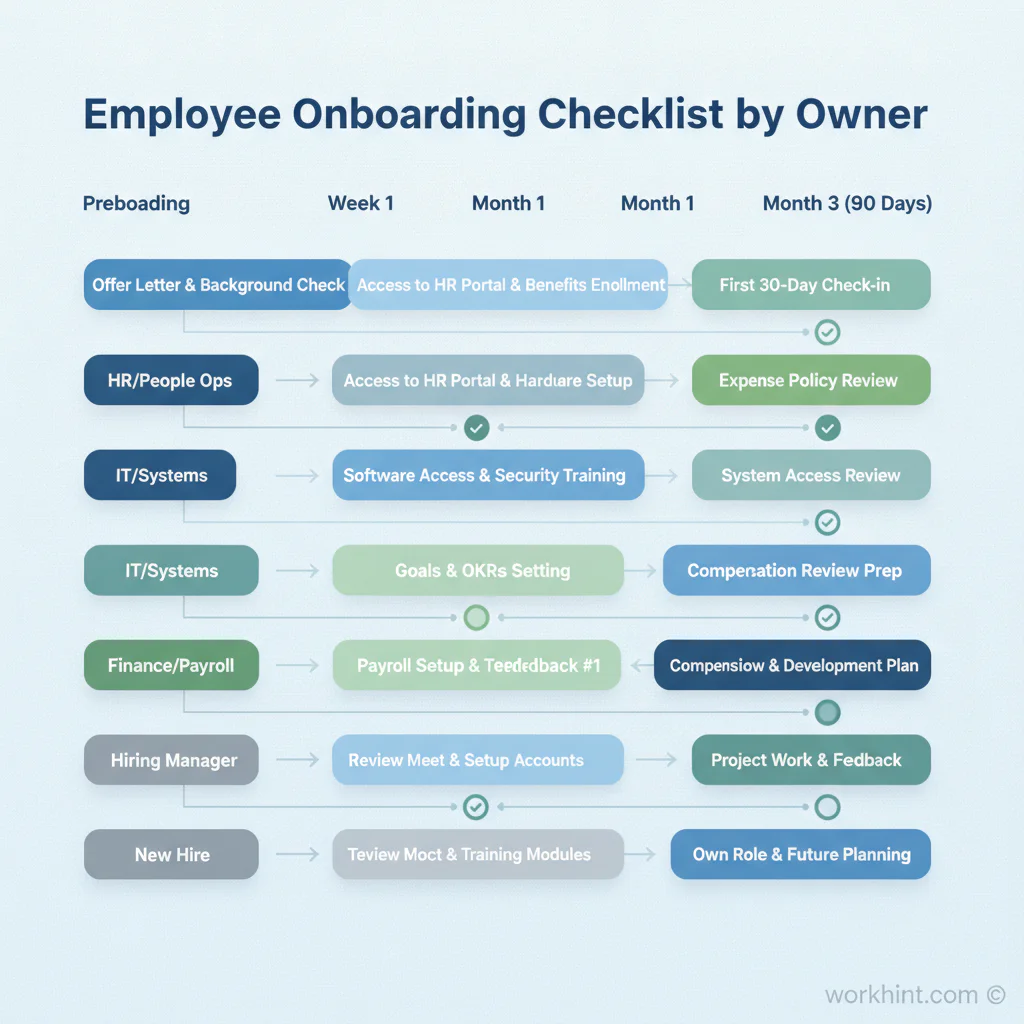
Employee onboarding checklist by owner
| Owner | Core tasks | Evidence to capture |
|---|---|---|
| HR | Offer, forms, handbook, benefits, policy acknowledgments, new hire reporting | Signed documents, completed forms, reporting confirmation, benefits enrollment status |
| IT | Device, email, accounts, permissions, security tools, access removal rules | Activated accounts, issued equipment, access list, security training completion |
| Finance or payroll | Payroll profile, tax forms, direct deposit, pay schedule, expense process | Payroll activation, direct deposit status, tax form completion |
| Hiring manager | Role goals, first assignments, team introductions, feedback cadence | 30-day goals, check-in notes, project assignment, training priorities |
| New hire | Forms, acknowledgments, training, tool setup, first deliverables | Completed training, signed policies, first-week task completion |
Example onboarding timeline
For a customer operations hire, preboarding might focus on employment forms, payroll, laptop delivery, CRM access, support tool access, and policy acknowledgments. Day one should cover team introductions, customer context, security expectations, and the first simple support review. By the end of week one, the employee should understand queue rules, escalation paths, quality standards, and who approves exceptions.
By day 30, the manager should know whether the hire can handle routine work with support. By day 60, the employee should manage common cases independently. By day 90, the company should know whether the role design, training, permissions, and performance expectations are working.
Common onboarding mistakes
- Starting onboarding on day one. The real work starts when the offer is accepted.
- Leaving IT access until the last minute. A new hire without the right permissions spends the first week waiting.
- Using one checklist for every role. Keep a company baseline, then add role-specific tasks.
- Collecting forms without tracking status. Each required item needs an owner, deadline, and evidence.
- Skipping the manager workflow. HR can run paperwork, but the manager owns role clarity and early performance.
- Stopping after orientation. Onboarding should continue through the first 30, 60, and 90 days.
Where Workhint fits
Workhint helps organizations turn a static onboarding checklist into a live work system. Instead of scattering tasks across spreadsheets, HR tools, chat messages, tickets, and calendar invites, a team can use Workhint to define the onboarding roles, required documents, approvals, access steps, reminders, manager check-ins, and reporting views around the employee journey.
For example, an operations team could create different onboarding paths for office employees, remote employees, field staff, contractors, or temporary workers. Each path can route tasks to HR, IT, finance, the manager, and the new hire while keeping the status visible. The checklist remains useful as a planning resource, but the workflow becomes something the business can actually run.
FAQ
What should be on an employee onboarding checklist?
An employee onboarding checklist should include offer confirmation, required employment forms, payroll setup, benefits, equipment, IT access, security, handbook acknowledgments, manager expectations, training, first assignments, and 30/60/90-day follow-up.
Who owns employee onboarding?
HR often owns the overall process, but onboarding is shared work. IT owns access and equipment, finance or payroll owns pay setup, the manager owns role clarity, and the new hire owns completing forms, training, and early tasks.
When should onboarding begin?
Onboarding should begin as soon as the offer is accepted. Preboarding reduces day-one delays because paperwork, access, equipment, and scheduling can be prepared before the employee starts.
Is this checklist enough for compliance?
No checklist can guarantee compliance for every company. Use this as an operating resource, then confirm federal, state, local, industry, and role-specific requirements with qualified HR, payroll, legal, or compliance support.
Conclusion
A strong employee onboarding checklist makes the first days easier, but its real value is operational. It gives every owner a clear responsibility, every task a deadline, and every required item a status. When onboarding is treated as a workflow instead of a welcome packet, new hires get productive faster and the business avoids preventable gaps.
Leave a Reply