


Third-party risk gets expensive when vendors are approved faster than the business can actually govern them.
A third-party risk management process is the workflow a company uses to evaluate, approve, monitor, and offboard outside organizations that affect the business. That includes software vendors, staffing agencies, contractors, logistics partners, consultants, payment providers, data processors, and any supplier with meaningful access or operational impact.
The goal is not to slow every vendor through the same heavy review. The goal is to understand the relationship before work starts, match review to the real risk, assign ownership, and keep it visible after contract signing. This is not legal, security, or regulatory advice, but it gives operators a practical structure to adapt with legal, procurement, finance, compliance, and IT.
What’s in this article?
- A practical third-party risk management process for business teams
- A risk-tiering checklist for vendors, contractors, agencies, and suppliers
- A workflow table showing owners, evidence, and decision points
- Common mistakes that make vendor risk harder to control
- Where Workhint fits when third-party work becomes operational
Why third-party risk management matters
Third parties create leverage. They also create dependencies. A payroll provider may touch sensitive worker data. A field service partner may represent the brand. A marketing agency may access unreleased plans. A software vendor may connect to production systems. A staffing firm may place people inside daily operations.
Regulated industries have formal expectations here. The OCC’s interagency guidance on third-party relationships describes a lifecycle that includes planning, due diligence, contract negotiation, ongoing monitoring, and termination. The FTC Safeguards Rule guidance tells covered businesses to select capable service providers, set security expectations in contracts, monitor their work, and reassess suitability. Outside regulated contexts, the same logic applies: know who you rely on, what they touch, who owns the relationship, and what happens when something changes.
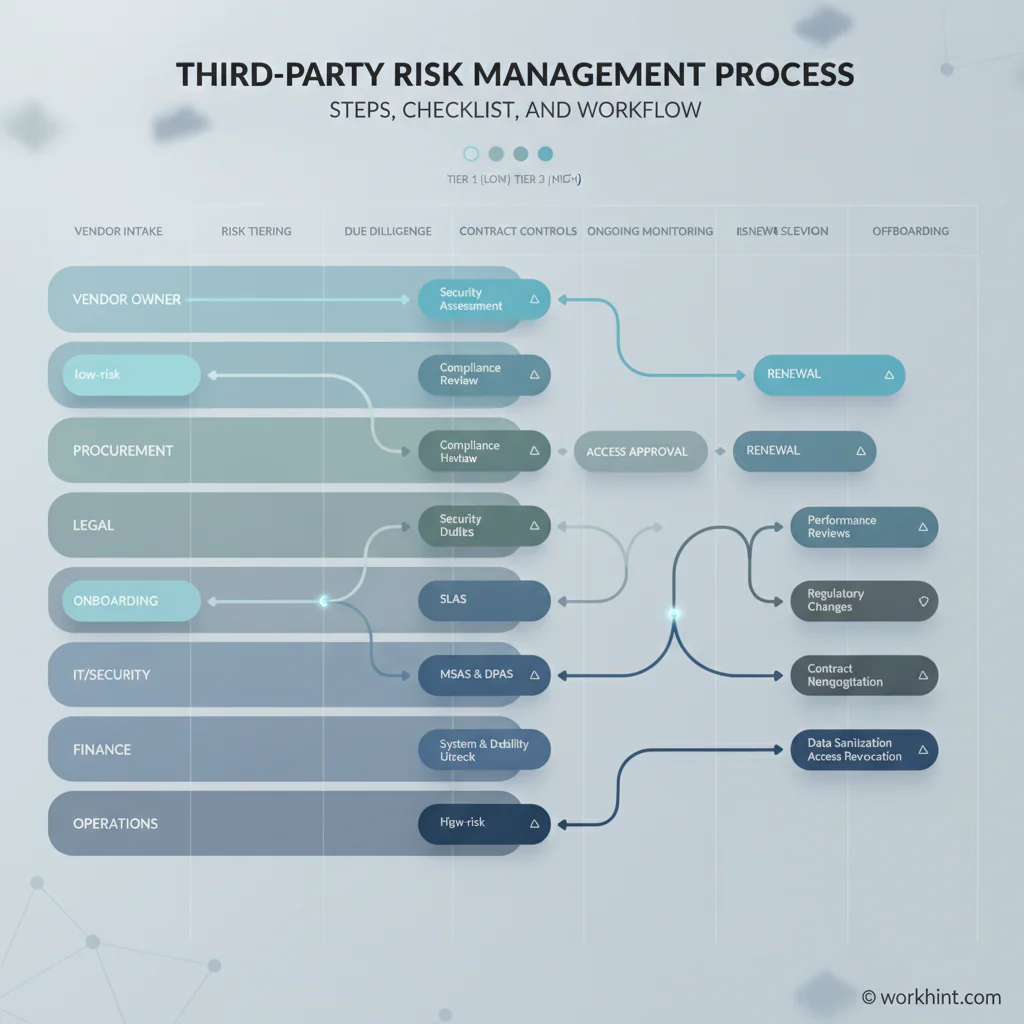
Third-party risk management process
A useful process starts before procurement and continues after launch. Treat it as a lifecycle, not a questionnaire.
- Start with intake. Capture the business need, vendor type, owner, scope, data involved, systems needed, locations, budget, payment model, and whether the relationship supports a critical operation.
- Assign a risk tier. Separate low-risk suppliers from vendors that handle sensitive data, enter facilities, affect customer delivery, process payments, provide labor, or support critical services.
- Run due diligence. Ask only for evidence that matches the tier: insurance, licenses, security documents, financial checks, compliance attestations, references, background requirements, or business continuity information.
- Document the decision. Record who reviewed the vendor, what evidence was accepted, what conditions apply, and whether approval is limited to a specific scope.
- Connect contract controls. Contracts should match the operational risk: service levels, data handling, confidentiality, audit rights, security requirements, insurance, subcontracting limits, incident notice, payment terms, and termination rights.
- Control onboarding and access. Do not let approval float separately from access. Permissions, facility access, documents, training, purchase orders, and payment setup should reference the approved scope.
- Monitor the relationship. Review performance, issues, incidents, document expirations, insurance renewals, security changes, and ownership changes on a cadence tied to risk tier.
- Handle incidents and changes. If the vendor changes scope, adds subcontractors, misses service levels, has a security event, or needs new access, route that as a review, not an informal favor.
- Review renewal or offboarding. Before renewal, confirm the relationship still makes sense. At termination, remove access, close payments, archive records, collect final deliverables, and document lessons learned.
Risk-tiering checklist
Risk tiering keeps the process practical. A catering vendor, a freelance designer, a cloud software provider, and a staffing agency should not all face the same review.
| Risk area | Questions to ask | Typical owner |
|---|---|---|
| Data | Will the third party access customer, worker, payment, health, financial, or confidential business data? | IT/security and legal |
| Operational dependency | Would a vendor failure affect customer delivery, payroll, field work, support, compliance, or revenue? | Business owner and operations |
| People and access | Will external workers need system, facility, badge, admin, or customer-facing access? | Operations, IT, and HR |
| Financial exposure | Is spend high, payment recurring, pricing variable, or tied to customer commitments? | Finance and procurement |
| Compliance | Does the relationship involve regulated work, licenses, tax forms, insurance, safety rules, privacy obligations, or cross-border activity? | Legal, compliance, and finance |
The NIST cybersecurity supply chain risk management program is a useful reference when the vendor touches technology, data, or digital operations. For critical services, the CISA External Dependencies Management Assessment is also a helpful reminder that third-party risk includes resilience, continuity, and dependency management, not just procurement paperwork.
Workflow owners and evidence
The biggest failure point is unclear ownership. Procurement may collect forms, legal may review contracts, IT may review access, finance may set up payment, and the business owner may manage the work. If those steps are disconnected, risk decisions disappear into email threads.
A practical workflow should define the decision record. For each third party, store the approved scope, risk tier, owners, required evidence, contract status, access status, payment status, renewal date, and offboarding trigger. That record becomes the source of truth when the vendor asks for more access, a manager expands scope, or finance approves an invoice.
Common mistakes
- Using one checklist for every vendor. This wastes time on low-risk suppliers and misses deeper review for high-risk providers.
- Approving the vendor but not the scope. A vendor approved for one project should not automatically be cleared for new data, systems, regions, or services.
- Separating risk from access. A vendor can pass review and still create risk if permissions are broad, permanent, or unmanaged.
- Forgetting ongoing monitoring. Insurance expires, service levels drift, systems change, subcontractors appear, and business owners leave.
- Skipping offboarding. Vendor risk does not end when work stops unless access, payments, documents, and obligations are closed.
Where Workhint fits
Workhint fits when third-party risk management needs to become a live workflow. A team can use Workhint to collect vendor intake, assign risk tiers, route approvals, track required documents, connect approved scope to assignments, control onboarding steps, monitor renewal dates, and keep payment readiness tied to approved work.
That matters because third-party risk is not owned by one department. It moves through people, documents, systems, access, work, approvals, invoices, and renewals. Workhint helps businesses turn that movement into a coordinated system instead of scattered forms, spreadsheets, reminders, and informal exceptions.
FAQ
What is a third-party risk management process?
It is the workflow a business uses to identify, assess, approve, monitor, and offboard outside organizations that support or affect the company. It usually covers vendor intake, risk tiering, due diligence, contract controls, access, monitoring, incidents, renewal, and termination.
Is third-party risk management the same as vendor management?
They overlap, but they are not identical. Vendor management often focuses on selection, contracts, performance, spend, and relationship ownership. Third-party risk management focuses on the risks created by the relationship, including security, compliance, operational dependency, financial exposure, privacy, access, and resilience.
Who should own third-party risk management?
Ownership is usually shared. The business owner defines the need and manages performance. Procurement manages sourcing and records. Legal reviews terms. IT or security reviews data and access. Finance manages payment and spend. Operations keeps the workflow moving.
How often should third-party risk be reviewed?
Review frequency should match the risk tier. Low-risk vendors may only need renewal review. High-risk or critical vendors may need annual or more frequent reviews, document refreshes, incident checks, access audits, and performance monitoring.
Conclusion
A strong third-party risk management process gives the business a practical way to use outside help without losing visibility or control. Start with intake, assign the right risk tier, collect relevant evidence, document approvals, connect contracts to access and payment, monitor the relationship, and close it cleanly when the work ends. The point is not bureaucracy. The point is making sure every third-party relationship has a clear owner, clear scope, clear evidence, and a clear path from approval to offboarding.
Leave a Reply