


Value stream mapping helps teams see where work really slows down before they automate or reorganize the process.
Value stream mapping is a practical way to study how work moves from request to outcome. Instead of looking at one task in isolation, the team maps the full flow of work, the handoffs, the waiting time, the decisions, and the information systems that support the process.
ASQ describes value stream mapping as a lean tool for documenting process steps, identifying waste, reducing cycle time, and planning improvement. For operations teams, the method is useful far beyond manufacturing. It can clarify customer onboarding, internal requests, vendor approvals, field service delivery, procurement, support escalation, contractor coordination, or any workflow where delays hide between teams.
What’s in this article?
- What value stream mapping is.
- When to use it instead of ordinary process mapping.
- How to create a current-state and future-state map.
- A practical operating model table for teams.
- How to turn the map into a scalable work system.
Why value stream mapping matters
Most workflow problems are not caused by one bad step. They come from the spaces between steps: unclear intake, missing information, duplicate review, waiting for approval, system re-entry, handoffs with no owner, or work sitting in a queue where no one measures aging.
A normal process map shows what happens. A value stream map shows how value moves, where it waits, what information controls the flow, and which parts of the process create waste. Lean Enterprise Institute explains that value-stream mapping includes both material and information flow and usually starts with a current-state map before creating a future-state map.
That distinction matters in office and service work. If a customer implementation takes 21 days, the work itself may only take six hours. The rest may be waiting for missing intake fields, finance approval, legal review, scheduling, account setup, or status updates. Value stream mapping gives the team a shared picture of that reality.
When to use value stream mapping
Use value stream mapping when the problem spans more than one role, tool, or team. It is strongest when work has a repeatable outcome but the path to that outcome is slow, inconsistent, or hard to measure.
- Customer onboarding takes too long and no one agrees why.
- Internal requests arrive through too many channels.
- Approvals stall because the rules are unclear.
- Operations teams re-enter the same data in multiple systems.
- Managers see output metrics but cannot see queue health.
- Automation projects keep failing because the process was never standardized first.
Do not use value stream mapping for a tiny single-person task. Use it when the full system matters: request, decision, work, review, delivery, evidence, and measurement.
How to create a value stream map
Start with one workflow and one outcome. “Improve operations” is too broad. “Reduce vendor approval lead time” or “make customer onboarding repeatable” is specific enough to map.
- Define the value stream. Name the trigger, customer or requester, outcome, start point, and end point.
- Walk the current state. Map what actually happens today, not what the SOP says should happen.
- Capture information flow. Show forms, messages, spreadsheets, systems, approvals, dashboards, and status updates that tell people what to do next.
- Add operating data. Record cycle time, wait time, rework, error rates, queue size, approval time, and percent complete and accurate where possible.
- Mark waste and friction. Look for duplicate entry, unclear ownership, over-approval, batching, missing context, unnecessary handoffs, and silent queues.
- Design the future state. Remove unnecessary steps, standardize inputs, simplify approvals, assign owners, and define what should be automated.
- Create the implementation plan. Turn the future-state map into owners, deadlines, workflow changes, system updates, metrics, and review cadence.
The EPA Lean in Government Starter Kit describes value stream mapping as a higher-level strategic method that maps a full process, creates a future-state design, and identifies improvements needed to reach that state. That is the right mindset: the map is not the deliverable. The operating change is.
Value stream mapping operating model
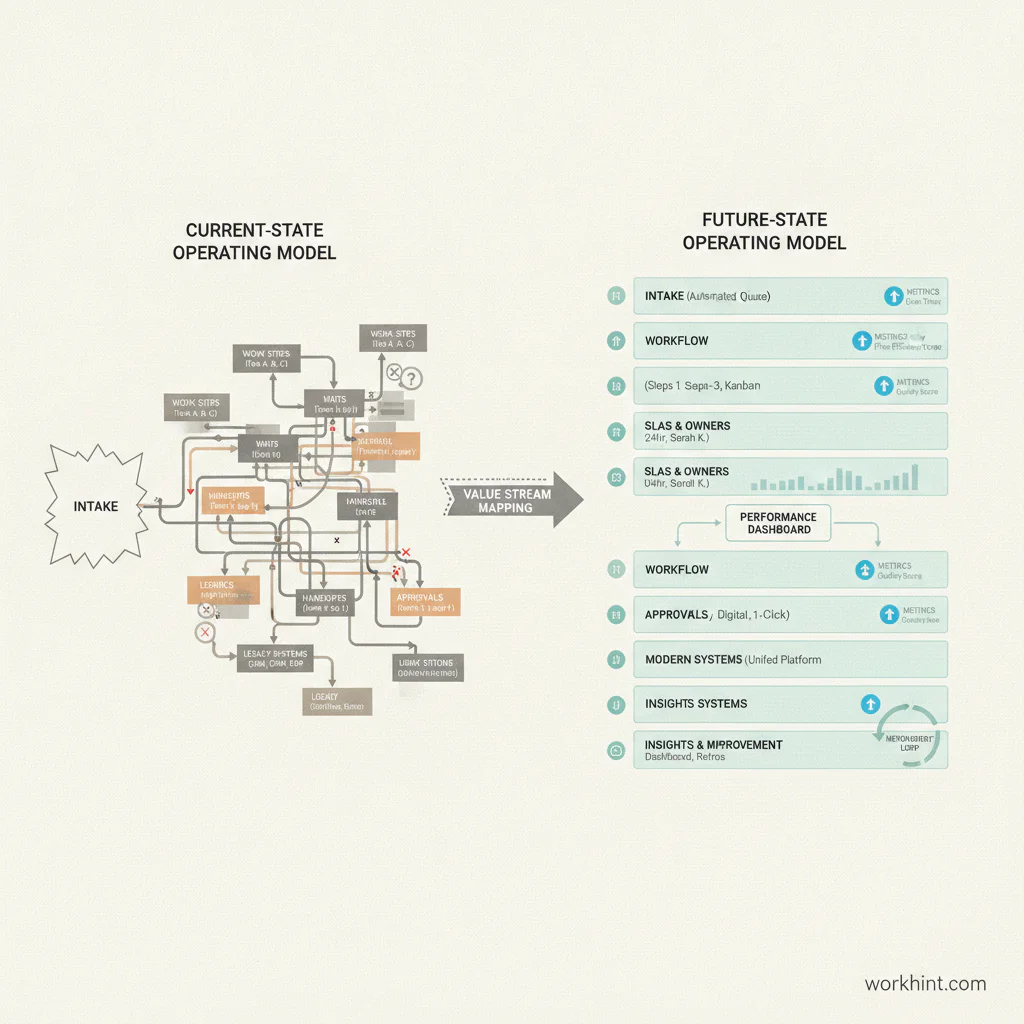
Use the table below to keep the mapping exercise practical. Each row should produce something the team can act on.
| Map element | What to capture | Operating decision |
|---|---|---|
| Trigger and outcome | What starts the work and what done means. | Which request types belong in this workflow? |
| Work steps | Activities, owners, handoffs, reviews, and delivery moments. | Which steps create value and which only add delay? |
| Information flow | Forms, systems, files, messages, status updates, and approvals. | Where should the source of truth live? |
| Time and queues | Cycle time, wait time, backlog, approval aging, and rework. | Which bottleneck should be fixed first? |
| Rules and exceptions | Decision thresholds, escalation paths, missing-data rules, and exception owners. | Which rules should be standardized or automated? |
| Future state | New flow, removed waste, owner changes, metrics, and system changes. | What must change in the operating system? |
Common mistakes
The first mistake is mapping the official process instead of the real one. If people currently use Slack, email, spreadsheets, and side conversations to move work forward, those belong on the map. Hidden work is where the improvement opportunity usually lives.
The second mistake is treating the exercise as a diagramming session. A good value stream map should lead to decisions: what to remove, what to standardize, what to automate, who owns the queue, and which metric will prove the workflow is improving.
The third mistake is automating too early. If the current process has unclear rules, weak ownership, or inconsistent inputs, automation can make the problem faster and harder to unwind. Standardize the future state first.
Where Workhint fits
Workhint fits after the team understands the current state and has designed the future state. The value stream map shows how work should move. Workhint can help turn that design into a live work system with intake, roles, permissions, assignments, approvals, documents, schedules, escalations, dashboards, reporting, and automation.
For example, a vendor approval value stream might become a Workhint system where requesters submit complete intake data, finance and legal approvals route by risk level, operations sees queue aging, vendors receive onboarding tasks, and leaders track cycle time and blocked requests. The map creates the operating logic. Workhint helps orchestrate that logic through daily execution.
FAQ
What is value stream mapping in business operations?
Value stream mapping is a method for seeing the full flow of work from request to outcome, including steps, owners, information flow, waiting time, rework, and improvement opportunities.
How is value stream mapping different from process mapping?
Process mapping usually documents the steps in a process. Value stream mapping looks at the wider flow of value, including information flow, queues, timing, waste, and the future-state operating design.
What metrics should a value stream map include?
Useful metrics include cycle time, wait time, lead time, queue size, approval aging, rework rate, error rate, throughput, SLA risk, and percent complete and accurate.
Who should participate in value stream mapping?
Include the people who do the work, approve the work, receive the output, manage the systems, and own the business result. Cross-functional participation prevents the map from reflecting only one team’s view.
What should happen after a value stream map is finished?
Create an implementation plan. Assign owners, update intake, clarify rules, remove unnecessary handoffs, automate stable steps, build dashboards, and review the workflow regularly.
Conclusion
Value stream mapping works because it shows the system behind the work. It helps teams stop guessing, see where time is lost, and design a better way for work to move from request to result. Start with one important workflow, map the current state honestly, design the future state carefully, and then turn the improvement plan into the operating system your team actually uses.
Leave a Reply