


A practical review form helps managers give specific feedback, document evidence, and turn performance conversations into clear next steps.
An employee performance review template gives managers a consistent structure for evaluating results, behavior, goals, and development needs. The value is a repeatable review process that helps employees understand what happened, what matters next, and how success will be measured.
Use this template as a manager-ready starting point. It is not legal advice, and HR teams should adapt it for local policies, employment laws, union obligations, and company-specific performance programs. The goal is to make reviews more specific, fair, and useful without turning them into a paperwork exercise.
What’s included
- A simple performance review structure managers can use for quarterly, semiannual, or annual reviews.
- A scoring table with evidence, ratings, examples, and follow-up actions.
- Questions for employees and managers to prepare before the meeting.
- A workflow for documenting goals, development plans, and ownership after the review.
- Common mistakes that make reviews vague, inconsistent, or hard to act on.
How to use this performance review template
Start by deciding what the review should accomplish. A compensation review, promotion review, probation review, and development conversation should not all use the same emphasis. The structure can stay consistent, but the weighting and discussion prompts should match the decision being made.
Before the meeting, ask the employee to complete a short self-assessment. The manager should gather examples, goal outcomes, customer feedback, project results, relevant reliability records, and prior commitments from earlier one-on-ones. The U.S. Office of Personnel Management notes that performance standards should be objective, measurable, realistic, and clearly recorded. That is a useful test for any review criteria.
During the meeting, separate three conversations: what was achieved, how the work was done, and what changes next. Afterward, document agreed goals, support needed, deadlines, and the owner for each follow-up action.
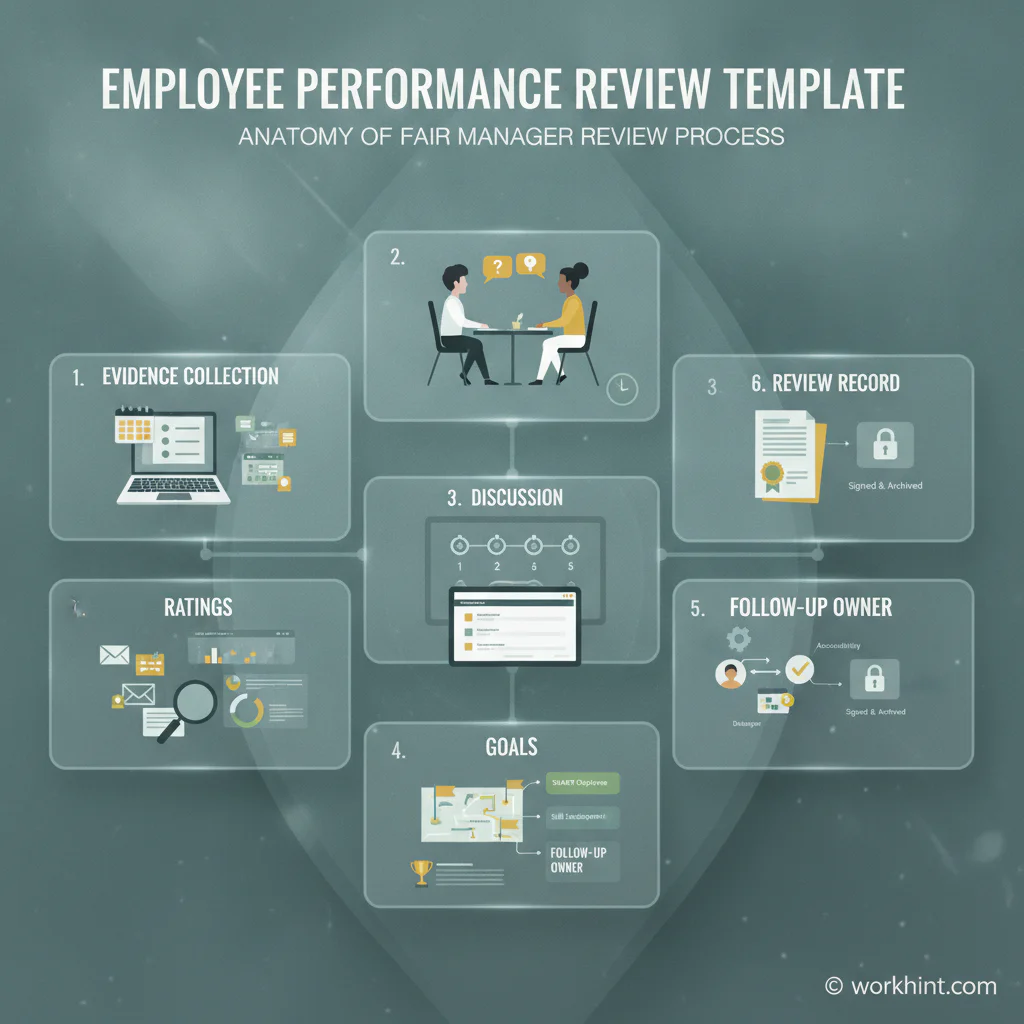
Employee performance review template
| Section | Manager prompt | Evidence to capture | Decision or follow-up |
|---|---|---|---|
| Role expectations | What outcomes was this role expected to deliver during the review period? | Job description, goals, service levels, project assignments, prior review notes. | Confirm whether expectations are still accurate or need to be updated. |
| Results delivered | Which goals were met, missed, exceeded, or changed? | Metrics, project completion, customer outcomes, revenue, quality, speed, volume. | Record rating, rationale, and any impact on priorities or compensation inputs. |
| Quality of work | Was the work accurate, complete, reliable, and aligned with standards? | Rework rates, defects, stakeholder feedback, audit notes, manager observations. | Define quality improvements, coaching, or stronger review steps. |
| Collaboration and behavior | How did the employee communicate, handle handoffs, and support team execution? | Peer feedback, meeting behavior, response times, conflict examples, handoff records. | Agree on behavior expectations and any communication changes. |
| Growth and development | What skills should the employee build next? | Skills gaps, career goals, manager assessment, upcoming business needs. | Assign training, mentoring, stretch work, or documented development actions. |
| Next-period goals | What should success look like by the next review? | Specific outcomes, dates, owners, dependencies, and review checkpoints. | Create measurable goals and schedule follow-up reviews. |
Suggested rating scale
A rating scale only works when each level is defined. If managers interpret ratings differently, the template will create false consistency. Keep the scale simple and require evidence for every rating.
- Exceeds expectations: Consistently delivers outcomes above role expectations, with strong evidence and positive business impact.
- Meets expectations: Reliably delivers the expected outcomes for the role and handles normal responsibilities with appropriate independence.
- Partially meets expectations: Delivers some expected outcomes but has recurring gaps in quality, timeliness, consistency, or behavior.
- Does not meet expectations: Misses important expectations and requires a documented improvement plan, support, and close follow-up.
The federal performance management regulations define performance standards in terms that can include quality, quantity, timeliness, and manner of performance. Those four dimensions are a useful way for business teams to make ratings more concrete.
Manager preparation questions
- What were the employee’s three most important contributions during the review period?
- Where did performance fall short of expectations, and what evidence supports that view?
- What changed during the review period that affected goals, workload, or priorities?
- What support did the employee ask for, and was it provided?
- What must be true by the next review for performance to be considered successful?
Employee self-assessment questions
- Which goals or projects best represent your impact this period?
- What obstacles affected your performance or delivery?
- Which skills did you strengthen, and which skills need more support?
- Where do you want clearer expectations from your manager?
- What goals should be prioritized for the next review period?
Example application
Assume a customer operations manager is reviewing a team lead. Instead of writing, “Great communication, needs improvement on follow-through,” the manager should document specific evidence: renewal handoff time improved from four days to two days, three escalation notes were missing required context, and two team members reported that weekly priorities were clearer after the lead introduced a Monday planning checklist.
The review then becomes actionable. The employee receives credit for improvement, understands the documentation gap, and leaves with a clear next goal: every escalation must include owner, customer impact, next action, and due date.
Common mistakes
- Using the same comments every cycle: Recycled feedback signals that the review is administrative, not meaningful.
- Rating personality instead of work: Focus on outcomes, behaviors, and evidence connected to the role.
- Ignoring goal changes: If priorities changed mid-cycle, document what changed and how expectations were reset.
- Skipping follow-up ownership: A development plan without owners and dates usually disappears after the meeting.
- Surprising the employee: Major concerns should be discussed before the formal review whenever possible.
Where Workhint fits
A performance review template becomes more useful when it is connected to the actual workflow around reviews. Workhint helps teams turn the template into a live review system with role-based forms, manager assignments, evidence collection, self-assessment steps, approval routing, reminders, and reporting.
For example, HR can define the template once, managers can complete reviews, employees can submit self-assessments, leaders can review calibration inputs, and follow-up goals can become assigned actions. Workhint is not a substitute for thoughtful management, but it can keep the process visible and consistent.
FAQ
What should be included in an employee performance review template?
Include role expectations, goals, results, quality of work, collaboration, development needs, manager comments, employee comments, rating definitions, and next-period goals. The template should also capture evidence and follow-up actions.
How often should managers use a performance review template?
Many companies use formal reviews annually or semiannually, with lighter quarterly check-ins. The best cadence depends on role complexity, team size, promotion cycles, and how quickly goals change.
Should employee self-assessment be part of the review?
Yes, in most business settings. Self-assessment helps employees prepare, highlights context the manager may have missed, and makes the conversation more balanced. It should not replace the manager’s evidence-based evaluation.
Can this template be used for remote or distributed teams?
Yes. Remote teams often benefit from a structured review form because managers cannot rely as much on informal observation. Use documented outcomes, project records, customer feedback, and written examples.
Is a performance review template legally required?
Requirements vary by location, employer type, contract, and policy. A template is generally a business process tool, not legal advice. For sensitive employment decisions, HR or legal counsel should review the process and documentation.
Conclusion
A good performance review template helps managers move from impressions to evidence. It gives employees clearer expectations, gives HR better records, and gives the business a more consistent way to connect performance, development, and goals.
Start with the sections above, adjust the criteria for your roles, and make follow-up actions part of the process. The review only matters if it changes what happens next.
Leave a Reply