


You can launch a locksmith brand first, then validate demand with licensed independent providers before buying a van or hiring staff.
If you want to start a mobile locksmith business, the biggest mistake is acting like you need to become a full traditional locksmith company on day one. The faster path is to launch a branded customer platform, define a narrow first offer, recruit qualified independent locksmiths, and prove demand before investing in vehicles, tools, inventory, or employees.
Locksmithing is a trust-heavy service. Customers need help during lockouts, moves, rekeys, lost-key situations, and security upgrades. That demand can be attractive, but the business also requires careful attention to licensing, insurance, training, background checks, and local rules. Treat compliance as part of the launch, not an afterthought.
What’s in this article?
- Why a mobile locksmith business works
- What you need before launch
- How to price mobile locksmith services
- How to get your first customers
- How Workhint helps launch the operating platform
- A first 7-day launch plan
- A final checklist and FAQ
Why a mobile locksmith business works
Mobile locksmithing works because customers often need fast, local, trusted help. A homeowner may need locks rekeyed after moving. A property manager may need recurring tenant turnover support. A small business may need lock repairs or access control coordination. A driver may need emergency lockout help.
The service also fits a provider-network model. Instead of hiring employees immediately, you can build a private network of licensed or qualified independent locksmiths, depending on your local rules. Your role is to create the brand, customer intake, pricing, dispatch process, service standards, payments, reviews, and repeat customer relationships.
Top-ranking guides commonly cover training, legal requirements, startup costs, equipment, service menus, marketing, and pricing. They often under-explain the operating system: how a customer request becomes a verified job, how the right provider is assigned, how quotes are approved, how payment is collected, and how provider payouts happen. That is the gap a platform-first launch can solve.
What you need to launch
Start with the leanest version that can deliver safe, legal, high-trust work. In some states or cities, locksmith businesses and individual locksmiths must be licensed. In others, requirements are lighter. Check your state licensing board, city rules, insurance requirements, and any background-check expectations before accepting jobs.
You do not need an office to validate demand. You may not need your own van at the beginning if independent providers already have tools and transportation. You do need a legitimate business entity, insurance, a branded customer platform, clear service categories, provider onboarding, quote approval rules, and a process for urgent requests.
| Launch item | Lean budget range | Why it matters |
|---|---|---|
| Business registration and local permits | $100 to $800 | Creates a legal operating base and helps with banking, taxes, and contracts. |
| Licensing or compliance checks | $0 to $1,500+ | Varies by state, county, and city. Do this before taking jobs. |
| General liability and bonding | $500 to $2,000+ | Protects the business and reassures customers in a high-trust service. |
| Branded Workhint platform setup | Lean monthly platform cost | Runs intake, scheduling, provider onboarding, quote approvals, payments, and payouts. |
| Website, local SEO, and Google Business Profile | $100 to $1,000 | Captures local demand and makes the brand look real. |
| Provider recruitment and screening | $100 to $750 | Builds the independent locksmith network before demand scales. |
| Basic marketing tests | $250 to $1,500 | Validates calls, forms, and booked jobs before larger investment. |
Delay large purchases until the numbers justify them. A dedicated van, advanced key machines, inventory, storefront lease, or employee payroll can come later. Your first milestone is not looking big. It is proving that customers will request service and qualified providers can fulfill it reliably.
How to price mobile locksmith services
Locksmith pricing depends on market, urgency, service type, licensing, provider rates, and parts. Keep pricing simple enough for customers to understand, but flexible enough for jobs that require inspection. Use transparent service-call fees, quote approvals, and clear emergency or after-hours rules.
| Service | Example customer price | Good early use case |
|---|---|---|
| Residential lockout | $85 to $175+ | Fast local response with verified provider availability. |
| Rekey service | $20 to $45 per cylinder plus service fee | New homeowners, landlords, tenant turnover, and property managers. |
| Lock repair or replacement | $125 to $350+ | Quote-approved work where parts and labor vary. |
| Small business lock service | $150 to $500+ | Office moves, access issues, and recurring maintenance relationships. |
| Property manager package | Monthly or per-turnover pricing | Recurring work with predictable dispatch and documentation. |
For a provider-network model, price must cover the provider payout, payment processing, support time, marketing cost, insurance, platform cost, refunds, and profit. If a locksmith keeps 65% to 75% of labor revenue, your margin must come from enough job volume, service fees, recurring accounts, or higher-value commercial work.
How to get first customers
Start where urgent or repeat demand already exists. Property managers, real estate agents, apartment operators, small offices, coworking spaces, storage facilities, and local homeowners are better early targets than broad brand advertising.
Create one simple offer first: residential rekeys after a move, property turnover lock service, or emergency lockout response in one launch area. A narrow offer is easier to explain, price, staff with providers, and fulfill. It also makes local SEO and outreach sharper.
Use local search, Google Business Profile, neighborhood groups, property manager outreach, real estate partnerships, and direct email to local businesses. Track every inquiry. If customers ask for services you do not support yet, log the demand instead of overextending the operation.
How Workhint helps launch it
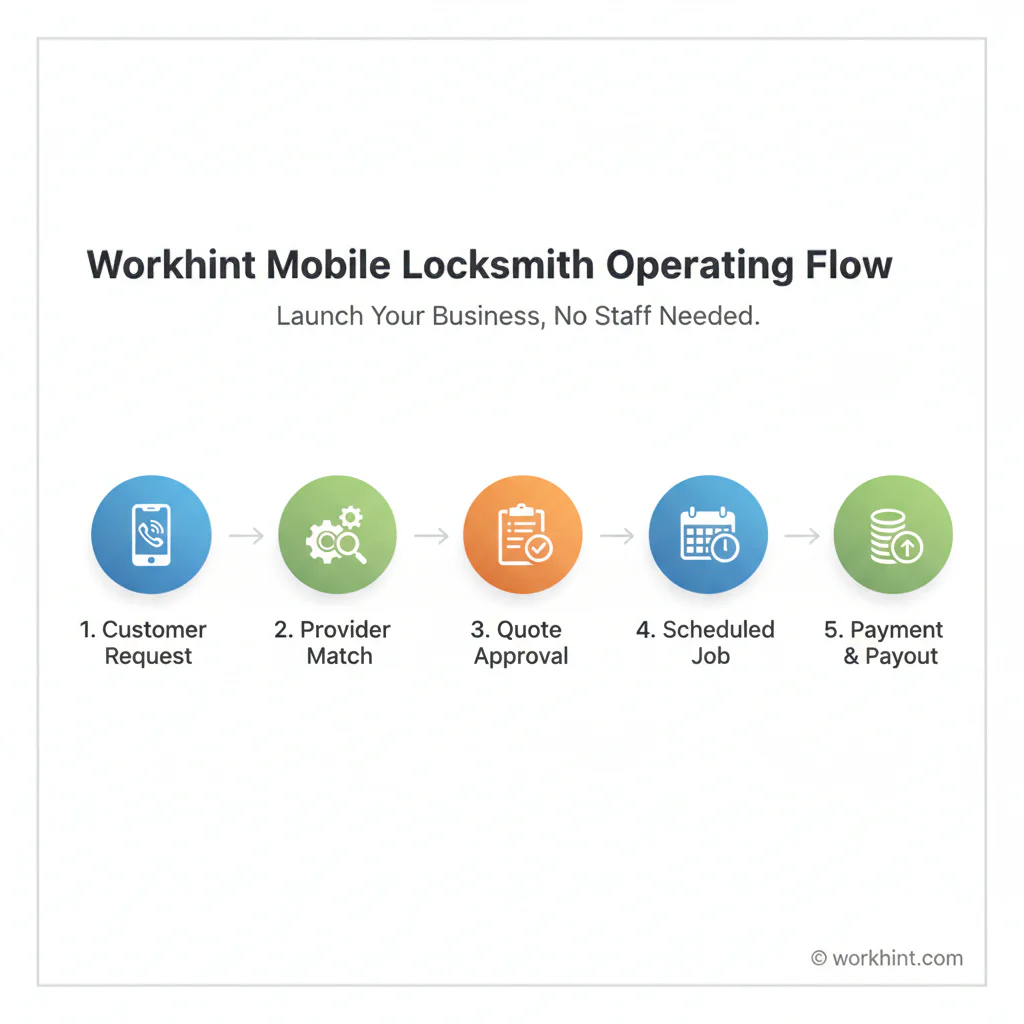
Workhint helps you launch the mobile locksmith business as a branded operating platform before you build custom software or hire staff. The customer sees your brand, your service request flow, your quote approval process, and your payment experience. Behind the scenes, Workhint coordinates the providers and operational steps.
A customer can request a rekey, lockout, repair, or property turnover service through a branded portal. Workhint captures the location, urgency, property type, photos, notes, preferred time, and required approvals. The system can route the job to available independent locksmiths based on service area, qualifications, licensing status, schedule, and job type.
For quote-based work, Workhint can collect provider notes, send the customer an approval request, trigger scheduling, collect payment, and keep the job moving. After completion, it can store job photos or forms, request a review, generate an invoice, and calculate the contractor payout. That gives you the operating foundation of a locksmith platform while you focus on trust, local demand, and provider quality.
First 7-day launch plan
- Day 1: Choose one launch market, one customer segment, and one first offer, such as move-in rekeys for homeowners or tenant-turnover lock service for property managers.
- Day 2: Confirm state and local locksmith licensing requirements, insurance needs, business registration steps, and provider qualification rules.
- Day 3: Set up the branded Workhint platform basics: customer intake, service categories, quote approvals, scheduling, payment collection, and provider payout flow.
- Day 4: Recruit the first qualified independent locksmiths or local service partners. Verify credentials, service area, response time, pricing expectations, and availability.
- Day 5: Create a simple landing page, Google Business Profile, and outreach list of property managers, real estate agents, apartment operators, and local businesses.
- Day 6: Contact prospects, offer a simple launch package, and route any real requests through the platform instead of handling them manually.
- Day 7: Review demand, provider readiness, margins, response time, customer questions, and compliance gaps before spending more.
The expected outcome is not a mature locksmith company in one week. It is a tested operating model: customers can request help, providers can accept work, jobs can be scheduled, quotes can be approved, and payments can move through one system.
Final launch checklist
- Choose the launch city, service area, and first locksmith offer.
- Verify licensing, insurance, bonding, background-check, and local compliance requirements.
- Register the business and create a separate business bank account.
- Build the branded Workhint customer portal and intake flow.
- Create provider onboarding, credential checks, availability rules, and service standards.
- Set pricing, quote approval rules, emergency fees, payment collection, and contractor payout logic.
- Recruit the first independent locksmiths or qualified service partners.
- Launch local SEO, direct outreach, and referral partnerships.
- Validate demand before buying a van, stocking inventory, leasing space, or hiring employees.
FAQ
How much does it cost to start a mobile locksmith business?
A lean platform-first launch may start with business registration, licensing research, insurance, provider onboarding, a branded customer platform, and local marketing tests. Costs rise quickly if you buy a van, machines, inventory, or specialized tools before demand is proven.
Do I need a locksmith license?
It depends on your state, county, and city. Some jurisdictions require locksmith business licenses, individual locksmith licenses, background checks, insurance, or other registrations. Verify local rules before accepting customer jobs or recruiting providers.
Can I start without being a locksmith myself?
You may be able to operate the business platform and recruit qualified independent locksmiths, but local law matters. Some places require an owner, manager, or responsible person to hold a locksmith license. Get legal and licensing guidance before launching.
Do I need a van right away?
Not necessarily. If you launch as a branded platform with independent providers who already have transportation and tools, you can validate demand before buying a vehicle. A van becomes more useful when job volume, service mix, and economics justify owned assets.
What locksmith services should I offer first?
Start with a narrow, repeatable offer such as residential rekeys, move-in lock changes, property manager turnover support, or simple lockout response. Avoid complex automotive, safe, or access-control work until you have the right providers and compliance coverage.
How do I get the first locksmith customers?
Focus on repeat demand sources: property managers, real estate agents, apartment communities, small businesses, coworking spaces, and local search. A narrow local offer is easier to sell than a broad list of every locksmith service.
How does a provider-network locksmith business make money?
The business earns margin between the customer price and provider payout, plus possible service fees, recurring account packages, emergency fees, or commercial maintenance relationships. The model works best when dispatch, quoting, payment, and provider payouts are tightly controlled.
Conclusion
A mobile locksmith business can be launched more carefully and with less upfront risk when you start with the operating platform instead of the expensive assets. Validate the market first. Build the brand, intake flow, provider network, pricing, scheduling, approvals, payments, and payout process. Then invest in vehicles, tools, inventory, and staff only when demand proves the business deserves it.
Leave a Reply