


The right model depends less on headcount and more on who should own the outcome.
Staff augmentation vs managed services is a practical operating decision, not just a procurement label. Both models bring outside capability into the business, but they create very different responsibilities for your team. Staff augmentation adds people under your direction. Managed services hands a defined function or outcome to a provider that is expected to run it against agreed expectations.
The choice matters because the wrong model creates hidden work. A company may hire augmented staff when it really needs a provider to own delivery. Or it may buy a managed service when the internal team still wants to direct every task. Either mismatch leads to unclear accountability, delayed approvals, access issues, and invoice disputes.
What’s in this article?
- How staff augmentation and managed services differ in day-to-day operations.
- A decision workflow for choosing the right model.
- A comparison table for control, accountability, cost, risk, and management load.
- Common mistakes teams make when using external workforce models.
- Where Workhint fits when the model needs to become a repeatable workflow.
Why the decision matters
Companies use external workers, vendors, agencies, and service providers because internal capacity is limited and work changes faster than org charts. The Bureau of Labor Statistics tracks several alternative work arrangements, including independent contractors, temporary help agency workers, on-call workers, and workers provided by contract firms. That variety also means one operating model will not fit every need.
Staff augmentation works best when the company already knows what needs to be done and has managers who can direct the work. Managed services works best when the company wants an outside provider to own a function, process, service level, or deliverable. The difference is not whether the provider is external. The difference is where ownership sits after the contract starts.
Staff augmentation vs managed services explained
Staff augmentation adds external people to your team for a defined period, skill gap, workload spike, or project need. Your business usually controls priorities, schedules, tools, reviews, and day-to-day direction. It can be faster than hiring employees, but it still requires active internal management.
Managed services gives an external provider responsibility for a defined function or operating outcome. The provider may supply people, tools, reporting, service levels, and management. Your team should define the required outcome, governance cadence, security requirements, escalation path, and acceptance criteria, but the provider should own execution inside the agreed scope.
Classification and control still matter. The IRS says businesses should consider evidence of behavioral control, financial control, and the type of relationship when determining worker status. The U.S. Department of Labor also focuses on the real economic relationship under the FLSA. This is not legal advice, but it is a reason to design the operating model carefully instead of treating labels as protection.
Decision table for business teams
| Question | Choose staff augmentation when | Choose managed services when |
|---|---|---|
| Who should direct the work? | Your internal managers need daily control over priorities and execution. | The provider should manage execution and report outcomes. |
| What is the work type? | Specialized capacity, backlog support, project help, or temporary skill gaps. | Repeatable operations, ongoing support, defined service levels, or owned functions. |
| How clear is the outcome? | You know the tasks but need more skilled hands. | You can define results, quality standards, and escalation rules. |
| How much management capacity exists? | You have owners who can plan, assign, review, and unblock work. | You lack internal capacity to manage the function day to day. |
| How should cost be controlled? | You want flexible capacity tied to hours, roles, or time periods. | You want costs tied to scope, service levels, outcomes, or a recurring service. |
| What risk controls are needed? | Access, classification, supervision, and offboarding need close internal oversight. | Vendor risk, service continuity, data access, and provider accountability need governance. |
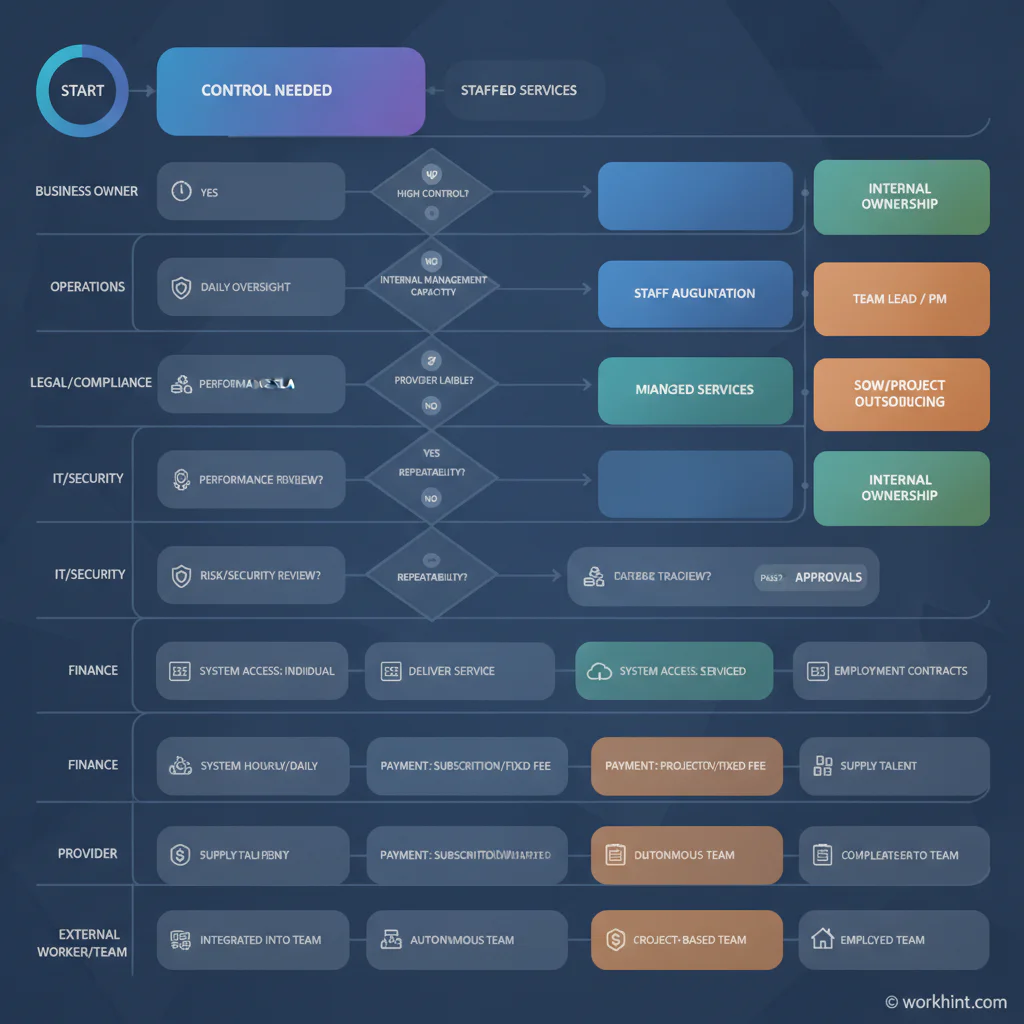
Staff augmentation vs managed services decision workflow
Use this workflow before approving the model:
- Define the business outcome. Write the result in plain language. If the desired result is capacity, staff augmentation may fit. If the desired result is a running function, managed services may fit.
- Map internal ownership. Name the business owner, daily manager, finance approver, legal or procurement reviewer, and IT or security owner.
- Assess management load. If your team must plan every task, review every decision, and fix every blocker, do not pretend the provider owns the outcome.
- Review access and risk. External workers and providers may need systems, customer data, operational context, or payment records. NIST’s cyber supply-chain risk management guidance is a useful reminder that third-party relationships need risk controls, not just contracts.
- Choose the commercial model. Decide whether the work should be priced by time, role, milestone, scope, service level, or recurring managed service.
- Set the governance cadence. Agree on reporting, escalation, change requests, acceptance criteria, and renewal or closeout decisions before work begins.
Common mistakes to avoid
The first mistake is buying staff augmentation when the internal team has no time to manage the people. External capacity does not remove planning, prioritization, review, or communication. If nobody owns those internally, the work can stall even when the provider sends capable people.
The second mistake is buying managed services while still directing the provider like internal staff. If the business wants every task done its way, the scope should reflect that. Otherwise, managed services can become expensive staff augmentation with unclear authority.
The third mistake is skipping handoff design. A good model needs intake rules, access setup, documents, approvals, payment terms, escalation paths, and offboarding. Without those mechanics, the work falls back into spreadsheets and ad hoc follow-ups.
Where Workhint fits
Workhint helps teams turn the decision into an operating workflow. For staff augmentation, Workhint can structure role requests, approvals, onboarding records, access steps, assignments, status reporting, timesheets or milestone reviews, and payment readiness. For managed services, it can define service intake, provider responsibilities, SLA checkpoints, issue escalation, approvals, invoice review, renewal decisions, and reporting.
The point is not to make Workhint the center of the decision. The point is to prevent the decision from living only in a contract. Once the model is chosen, the business still needs a system that shows who owns each step, what evidence is required, what is approved, what is blocked, and what needs to happen before payment or renewal.
FAQ
Is staff augmentation the same as outsourcing?
No. Staff augmentation usually adds external people under internal direction. Outsourcing usually gives a provider responsibility for a defined scope or outcome. Managed services is a more structured version of outsourcing when the provider runs an ongoing function or service.
Is managed services always better for long-term work?
Not always. Managed services works well when the outcome is stable and the provider can own execution. Long-term staff augmentation may still fit when internal leaders need direct control, but review management load and classification risk.
Can a team use both models?
Yes. A company might use managed services for help desk support and staff augmentation for a product migration. The key is to document which model applies to each workstream so ownership, approvals, access, and payment rules are not confused.
What should be decided before signing?
Decide who owns outcomes, who manages daily work, what systems the provider can access, how changes are approved, how performance is measured, how invoices are reviewed, and what happens at renewal or offboarding.
Conclusion
The best choice between staff augmentation and managed services comes down to ownership. Choose staff augmentation when you need skilled capacity and can manage the work internally. Choose managed services when you need a provider to run a defined function or outcome. In either case, the contract is only the start. Success comes from a clear workflow for onboarding, access, assignments, approvals, reporting, payments, and review.
Leave a Reply