


A pet waste business can start lean when the platform, routes, providers, and payments are built before heavy spending.
If you want to know how to start a pet waste business, the appeal is simple: dog owners need the job done repeatedly, the equipment is inexpensive, and customers often prefer a recurring service over doing it themselves.
The old way is to buy gear, print flyers, clean every yard yourself, and hope demand appears. A better way is to validate first. Build a branded customer platform, recruit independent local providers, test recurring routes, and only invest more when customers are booking.
This guide explains how to launch with no staff, using a provider network and Workhint as the operating foundation.
What’s in this article?
- Why a pet waste business works
- What you need to launch
- How to price pet waste removal
- How to get first customers
- How Workhint helps launch it
- A 7-day launch plan
- Checklist and FAQ
Why This Business Works
Pet waste removal is a small job with recurring demand. Customers pay because they want a clean yard, less smell, fewer flies, safer outdoor space for kids, and one less chore on their weekly list.
The business also has a useful operating pattern. Jobs are local, repeatable, route-based, and easy to standardize. That makes it possible to start with a small provider network instead of hiring employees on day one.
Apartment communities, homeowner associations, dog daycares, property managers, and busy homeowners can all become recurring customers. The strongest version is a branded service platform that turns small recurring jobs into a predictable route operation.
What You Need To Launch
You do not need an office, fleet, or full-time team to validate demand. You need a clear service area, simple offer, basic tools, insurance, request intake, and a fulfillment process.
Start with one city or a few nearby neighborhoods. Recruit independent providers who already have reliable transportation and are comfortable doing outdoor service work. Give them clear standards for photos, gates, safety, disposal, customer notes, and visit completion.
| Launch item | Lean starting range | Why it matters |
|---|---|---|
| Business registration and local permits | $50-$300 | Creates a basic legal operating structure |
| General liability insurance | $300-$900/year | Protects against property and service claims |
| Branded platform and domain | $100-$500 | Lets customers request service and manage accounts |
| Scoopers, buckets, bags, gloves, sanitizer | $75-$250 | Covers the first provider kit or backup kit |
| Provider onboarding materials | $0-$150 | Creates repeatable service standards |
| Local launch marketing | $150-$750 | Tests demand in a defined service area |
Check local waste disposal rules before launching. Some cities, apartment communities, or commercial properties have specific disposal expectations. Make clear whether waste is bagged in the customer’s outdoor trash bin or removed under local rules.
How To Price It
Most pet waste businesses price around frequency, yard size, number of dogs, and first-cleanup condition. Recurring weekly service is usually the core offer because it creates predictable routes and predictable revenue.
| Offer | Example price | Best use |
|---|---|---|
| Initial cleanup | $40-$90 | Messy yards, new customers, one-time resets |
| Weekly residential service | $15-$25 per visit | One to two dogs in a normal yard |
| Twice-weekly service | $25-$45 per week | Multiple dogs or high-use yards |
| Commercial or community pickup | $75-$250+ per visit | Apartments, HOAs, dog parks, property managers |
| Add-ons | $5-$25 | Deodorizing, photo reports, extra waste volume |
A simple revenue target helps. If 100 customers pay $20 per weekly visit, gross weekly revenue is $2,000 before provider payouts, software, insurance, marketing, and supplies. The work becomes attractive when routes are tight, providers are reliable, and billing is automatic.
How To Get First Customers
Your first goal is not to look big. It is to prove that local dog owners and property managers will book through your platform.
Start with neighborhoods where houses have yards and high dog ownership. Use door hangers, local groups, dog parks, vets, groomers, pet stores, apartment managers, and property managers. Offer an initial cleanup plus weekly service so customers have an easy first step.
For commercial customers, lead with convenience and cleanliness. Apartment managers and HOAs do not want complaints, odors, or messy common areas. A recurring service with visit photos and clear reporting can be easier to buy than a one-off cleanup.
How Workhint Helps Launch It
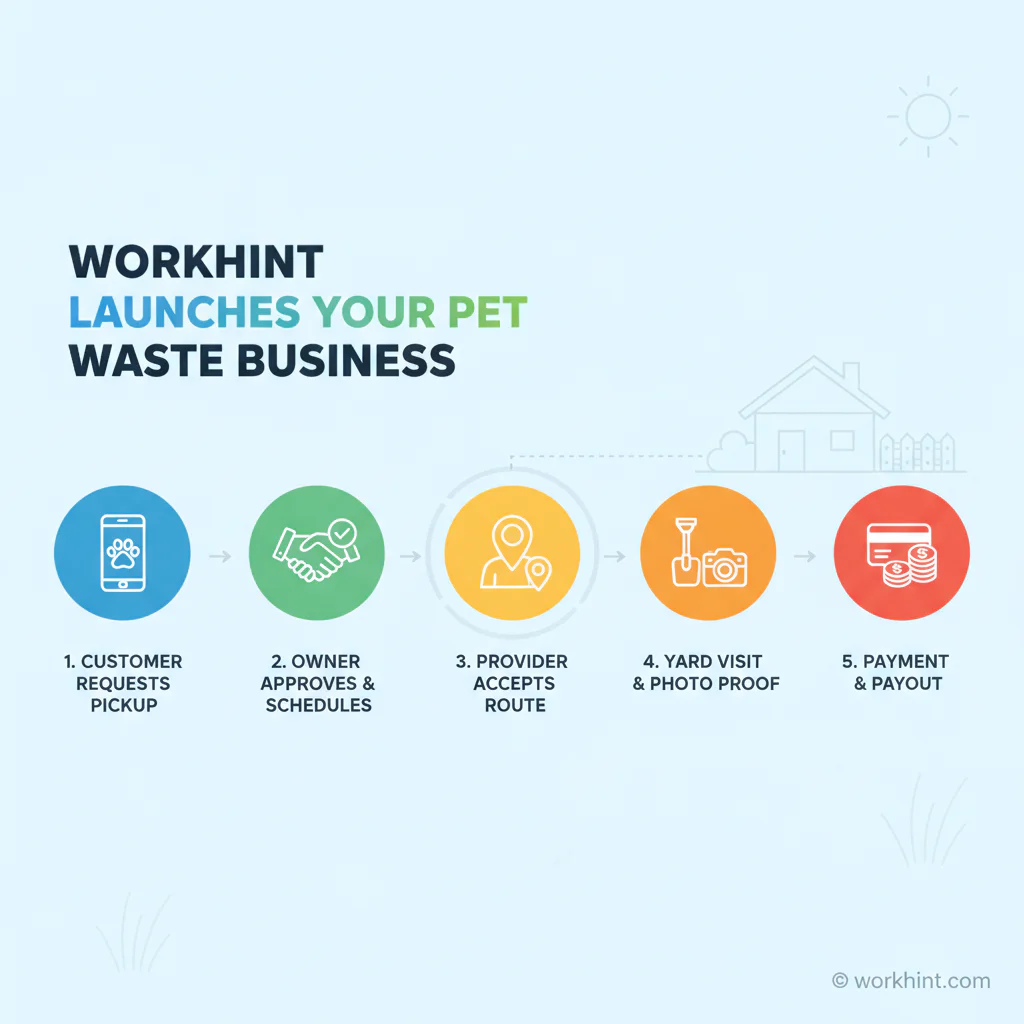
Workhint helps you launch as a branded service platform before spending heavily on staff, vehicles, or custom software.
A customer can visit your branded portal, choose recurring weekly pickup, enter the number of dogs, describe yard access, upload gate notes, approve the quote, and pay online. The request flows into your operations dashboard, where you match the job to an independent provider in the right service area.
Providers receive onboarding, route instructions, service checklists, mobile job tasks, photo requirements, and completion forms inside the system. Customers can see scheduled visits, update instructions, review completed service notes, and manage payment. You can track routes, provider payouts, recurring revenue, customer issues, and city-by-city growth from one place.
That matters because the bottleneck is not the scooper. The bottleneck is coordination. Workhint gives the business a real operating foundation from the first customer request through scheduling, service completion, payment, and provider payout.
First 7-Day Launch Plan
Day 1: Pick one launch area, define the first offer, and decide whether you will start with residential weekly service, commercial pickup, or both.
Day 2: Set up the branded Workhint platform basics: customer intake, service options, neighborhood coverage, and customer dashboard.
Day 3: Configure pricing, quote approval, scheduling, payment collection, provider payout rules, and visit completion forms.
Day 4: Recruit two to five independent local providers. Give them service standards, safety notes, photo requirements, and route expectations.
Day 5: Contact first demand sources: pet stores, groomers, dog walkers, apartment managers, HOAs, and neighborhood groups.
Day 6: Route every inquiry through the platform. Track objections, pricing questions, service-area gaps, and provider availability.
Day 7: Review demand before spending more. If people are booking, tighten routes and recruit more providers. If not, adjust the offer, price, or neighborhood.
Final Launch Checklist
- Choose one launch market and service radius.
- Register the business and check local disposal rules.
- Buy only essential tools and supplies for validation.
- Set up liability insurance before taking paid jobs.
- Create weekly, twice-weekly, initial cleanup, and commercial packages.
- Configure the branded Workhint customer portal and operations dashboard.
- Recruit independent providers with clear service standards.
- Create intake, quote approval, scheduling, payment, completion, and payout flows.
- Launch local outreach before buying expensive equipment or vehicles.
- Track repeat bookings, route density, provider reliability, and customer feedback.
FAQ
How much does it cost to start a pet waste business?
A lean launch can often start with a few hundred to a few thousand dollars, depending on registration, insurance, branding, platform setup, supplies, and marketing. Avoid buying vehicles or hiring staff until demand is proven.
Do I need a license for pet waste removal?
Requirements vary by city and state. Most founders should check business registration, local permits, insurance, and disposal rules before accepting paid work.
Can I start a pet waste business with no employees?
Yes. You can start with independent local providers if you set clear standards for onboarding, scheduling, yard access, waste handling, customer communication, and completion proof.
How do pet waste removal businesses get customers?
Common channels include local SEO, door hangers, neighborhood groups, dog walkers, groomers, vets, pet stores, apartment managers, HOAs, and referrals from existing customers.
Is pet waste removal profitable?
It can be profitable when recurring customers are grouped into efficient routes. Route density, payment automation, provider reliability, and low customer churn matter more than one-time cleanups.
What equipment do I need at the beginning?
Start with scooping tools, bags, gloves, sanitizer, closed containers, simple branded clothing, and reliable transportation. Add specialized equipment only after job volume justifies it.
Should I charge weekly or per visit?
Weekly recurring pricing is usually easier for customers and better for route planning. Initial cleanups and commercial jobs can be priced separately because they vary more.
Conclusion
A pet waste business is worth considering because it combines low startup costs, recurring local demand, and simple service delivery. The modern version is not just one person with a rake. It is a branded local service platform with customers, providers, routes, payments, and standards coordinated from the start.
Use the first week to validate demand, prove pricing, and learn which neighborhoods respond. Once customers are booking and providers can deliver reliably, you can expand routes, add commercial accounts, and grow the business without taking on heavy upfront risk.
Leave a Reply