


You can validate party rental demand before buying tents, chairs, linens, storage space, or a delivery truck.
Learning how to start a party rental business does not begin with a garage full of inventory. The leaner path is to sell a clear offer, coordinate suppliers, and prove customers will book before you commit capital.
This model works because party rentals are coordination-heavy. Customers need items delivered, set up, tracked, and picked up. The founder does not need to own every item on day one. The founder needs a dependable operating system, a provider network, clear pricing, and a way to turn requests into fulfilled events.
What’s in this article?
- Why party rentals work as a low-overhead startup
- What you need before taking the first booking
- How to price rentals without owning every asset
- How to find first customers and supplier partners
- How Workhint helps launch the platform and operations
Why This Party Rental Business Works
Party rentals sit at the intersection of local events, convenience, and repeatable operations. Families, companies, venues, planners, schools, churches, and groups need reliable event setup support.
Search demand is strong because new operators want to understand startup costs, permits, insurance, inventory, delivery, and pricing. Many guides focus on buying equipment first. A faster path is to start as a branded rental coordination platform, build relationships with existing inventory owners, and add owned inventory only after demand is proven.
The business is attractive because customers buy convenience and one point of contact. Providers join because you can send them bookings they may not have captured alone. Your first offer can be narrow: backyard parties, corporate events, kids birthdays, or wedding add-ons.
What You Need To Launch
You need enough structure to sell and fulfill professionally, not enough equipment to look like the biggest rental company in town. Start with a branded customer platform, simple catalog, intake questions, supplier agreements, quote approval, scheduling, payment collection, and provider payout rules.
Check local requirements before booking. Many rental businesses need registration, sales tax setup, general liability insurance, and local permits. Tents, inflatables, food equipment, generators, and public events can involve extra rules.
| Launch item | Lean starting approach | Typical early budget |
|---|---|---|
| Brand and website | Create a focused local brand and request flow | $100-$500 |
| Workhint platform setup | Build intake, quote, scheduling, payment, and provider workflows | Platform subscription |
| Insurance and registration | Register the business and price general liability coverage | $500-$2,500 |
| Supplier network | Partner with local rental owners, decorators, venues, and setup crews | $0-$300 |
| Marketing | Local SEO page, referral outreach, community groups, planner partnerships | $200-$1,000 |
| Owned inventory | Buy only the first proven bundle after booked demand appears | $0-$2,000 initially |
Avoid scattered inventory. Choose one package you can fulfill through partners, such as a 30-person backyard party setup or a small corporate gathering bundle. If customers do not request it, learn that before buying it.
How To Price It
Party rental pricing should include item cost, delivery or coordination, setup labor, deposits, taxes, and margin. If you coordinate provider-owned inventory, your job is to build a profitable spread between customer price and provider cost.
| Offer | Customer price | Provider or supply cost | Gross margin target |
|---|---|---|---|
| Small backyard table and chair package | $250-$450 | $150-$275 | 30%-45% |
| Kids party bounce house coordination | $225-$400 | $150-$275 | 25%-40% |
| Corporate meeting setup package | $600-$1,200 | $375-$800 | 25%-40% |
| Wedding decor add-on package | $900-$2,500 | $550-$1,600 | 30%-45% |
Do not compete only on price. Compete on fast quotes, clean communication, reliable setup windows, transparent terms, and one place for approval, payment, and booking status.
How To Get First Customers
Your first customers should come from narrow local demand sources. Build one landing page for your first package and make the request flow simple. Then contact event planners, venues, schools, churches, neighborhood associations, and office managers.
Ask what they regularly need but dislike coordinating. That research can shape your first rental bundle: reliable chair delivery, graduation seating, overflow decor, or simple birthday setup without five vendor calls.
Use the first ten conversations to validate demand. Track every request by category, budget, event date, location, delivery needs, and whether your provider network could fulfill it.
How Workhint Helps Launch It
Workhint can act as the branded operating foundation for the party rental business before you invest in custom software, warehouse space, or inventory.
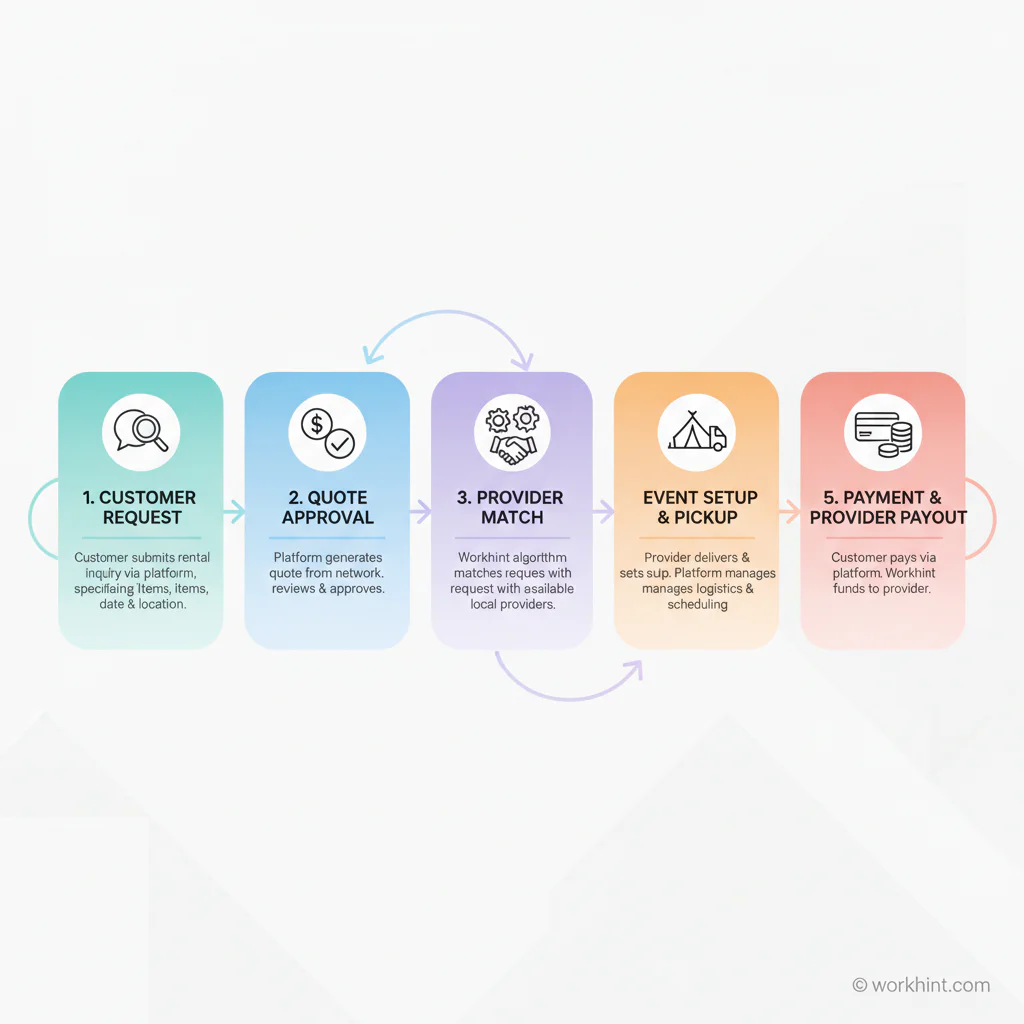
A customer can request a backyard party, corporate event, or wedding add-on through your branded portal. Workhint can collect the event date, location, guest count, item needs, delivery window, setup requirements, venue rules, photos, and budget. The request can route to your internal dashboard for supplier confirmation.
From there, Workhint can help generate the quote, send it for approval, collect payment, schedule delivery and pickup, assign provider tasks, track completion, and manage contractor payouts. The customer sees a professional branded experience. Providers see the work they need to complete. You see requests, calendars, quotes, payments, status, and performance in one operating system.
That changes the launch sequence. Instead of buying inventory first, launch the platform, recruit providers, sell a narrow package, route real bookings through the system, and buy inventory only when the data supports it.
First 7-Day Launch Plan
- Day 1: Choose one launch market, one customer type, and one rental package. Avoid trying to serve every event category.
- Day 2: Set up the branded Workhint customer portal, request form, and internal operations dashboard.
- Day 3: Define quote rules, scheduling windows, payment collection, deposits, cancellation terms, and provider payout logic.
- Day 4: Recruit five to ten local suppliers, decorators, setup crews, or small rental owners who can fulfill your first package.
- Day 5: Contact planners, venues, schools, community groups, office managers, and local Facebook groups with the specific package.
- Day 6: Route every inquiry through the platform, issue quotes quickly, and confirm which provider can fulfill each request.
- Day 7: Review demand, margins, fulfillment reliability, provider responsiveness, and whether owned inventory is worth buying.
Final Launch Checklist
- Choose the business name, service area, and first rental niche.
- Register the business and review sales tax, permit, and insurance requirements.
- Create one clear package instead of a broad unfocused catalog.
- Configure the branded customer request, quote, payment, scheduling, and provider payout flow in Workhint.
- Recruit reliable independent providers or supplier partners before selling aggressively.
- Create terms for deposits, damage, cancellation, delivery, setup, pickup, and weather.
- Launch one local landing page and outreach list.
- Book early requests before buying expensive inventory.
- Use the first jobs to decide which items deserve owned investment.
FAQ
How much does it cost to start a party rental business?
A traditional inventory-heavy launch can cost thousands, especially with tents, storage, and delivery vehicles. A platform-first launch can start leaner with partners, local marketing, insurance, and one narrow package.
Can I start a party rental business with no inventory?
Yes, if you operate as a branded coordination platform and partner with local suppliers or independent providers. You still need clear agreements, insurance checks, customer terms, scheduling, payment, and quality control.
Do party rental businesses need licenses?
Requirements vary by location and rental type. Expect to review business registration, sales tax collection, insurance, and any local rules for tents, inflatables, public events, or food-related equipment.
What are the best party rental items to start with?
The best first items are the ones customers already request in your market and providers can fulfill reliably. Tables, chairs, linens, small decor, bounce houses, and simple event packages are common starting points, but demand should decide.
How do party rental businesses make money?
They earn margin on rental packages, delivery, setup, add-ons, damage waivers, rush requests, and recurring local relationships.
Should I hire employees right away?
Usually not. Start with independent providers, supplier partners, and setup crews. Hire only when booking volume, quality control, and margins justify dedicated staff.
How do I get my first party rental customers?
Start with local event planners, venues, schools, churches, community groups, office managers, neighborhood groups, and SEO pages for your first package. Ask about real needs before expanding inventory.
Conclusion
A party rental business can launch without pretending to own everything from day one. The smarter path is to validate demand, build a branded customer experience, coordinate reliable providers, and use first bookings to decide where capital should go.
Workhint makes that path practical by giving the business an operating foundation from the start: requests, quotes, scheduling, provider coordination, payments, payouts, and reporting in one branded platform. That lets you focus on demand and supplier quality before taking on traditional rental costs.
Leave a Reply