


Vendor offboarding is where contract closure, security cleanup, final payment, and business continuity have to meet.
A vendor offboarding checklist helps a business end a vendor relationship without leaving behind access, unresolved invoices, handover gaps, data obligations, or audit gaps. Vendors may have logins, files, customer data, API credentials, service responsibilities, equipment, invoices, and institutional knowledge that teams depend on.
Vendor offboarding is not just sending a termination notice. It is a coordinated workflow across procurement, legal, IT, security, finance, business owners, and the vendor. This is practical operations guidance, not legal advice.
Why vendor offboarding matters
Vendors can become embedded in daily operations. A marketing agency may control ad accounts. A software vendor may hold customer exports. A logistics partner may manage delivery exceptions. A consultant may have access to shared drives, dashboards, code repositories, or finance systems. Without structured closeout, the company can lose continuity or leave sensitive access open.
Security teams already treat supplier relationships as part of a broader risk program. CISA’s vendor supply-chain risk template asks whether organizations have documented offboarding processes, including knowledge transfer, removal of access to documents and applications, recovery of assets, and documentation of the process. NIST SP 800-161 Rev. 1 also frames cyber supply-chain risk management as a lifecycle issue across products, services, suppliers, and business processes.
The operating lesson is simple: plan the vendor exit before the exit happens. Know who owns notice, what access exists, what data the vendor has, which services require transition, what invoices remain, and what evidence must be retained.
Vendor offboarding checklist
Use this checklist when a vendor, supplier, agency, implementation partner, or outsourced service provider is ending an engagement. Adjust the depth based on risk, data sensitivity, dependency, and contract complexity.
- Confirm the termination trigger. Identify whether the relationship is ending because of expiration, non-renewal, breach, replacement, budget change, or project completion.
- Review the contract before notice. Check notice periods, termination rights, cure periods, transition support, confidentiality, data return or deletion, final invoice rules, and renewals.
- Name the internal owner. Assign one person to coordinate procurement, legal, IT, finance, business operations, and vendor communication. Without an owner, offboarding becomes a set of disconnected tasks.
- Create a transition plan. List the services, workflows, systems, reports, assets, and customer-facing responsibilities that must continue after the vendor exits.
- Capture knowledge before access changes. Collect SOPs, configuration notes, open work, login inventory, project files, account ownership records, reporting definitions, and unresolved issues.
- Inventory vendor access. Include SSO, VPN, shared drives, project tools, CRM, finance systems, cloud platforms, ad accounts, code repositories, physical badges, API keys, webhooks, and shared credentials.
- Schedule access removal. Remove access at the right time for continuity and security. Critical systems may need a staged transition, but lingering access should require written approval and an expiration date.
- Resolve data return and deletion. Confirm what company data the vendor holds, what must be returned or deleted, what evidence is required, and who verifies completion.
- Settle final financial obligations. Match final invoices to approved work, credits, deposits, service credits, penalties, purchase orders, and payment records.
- Close operational loops. Update vendor records, internal directories, support contacts, escalation paths, procurement systems, renewal trackers, and stakeholder communications.
- Retain the evidence. Store notice records, approval decisions, access removal confirmations, data deletion evidence, final invoice approvals, handover materials, and any exception notes.
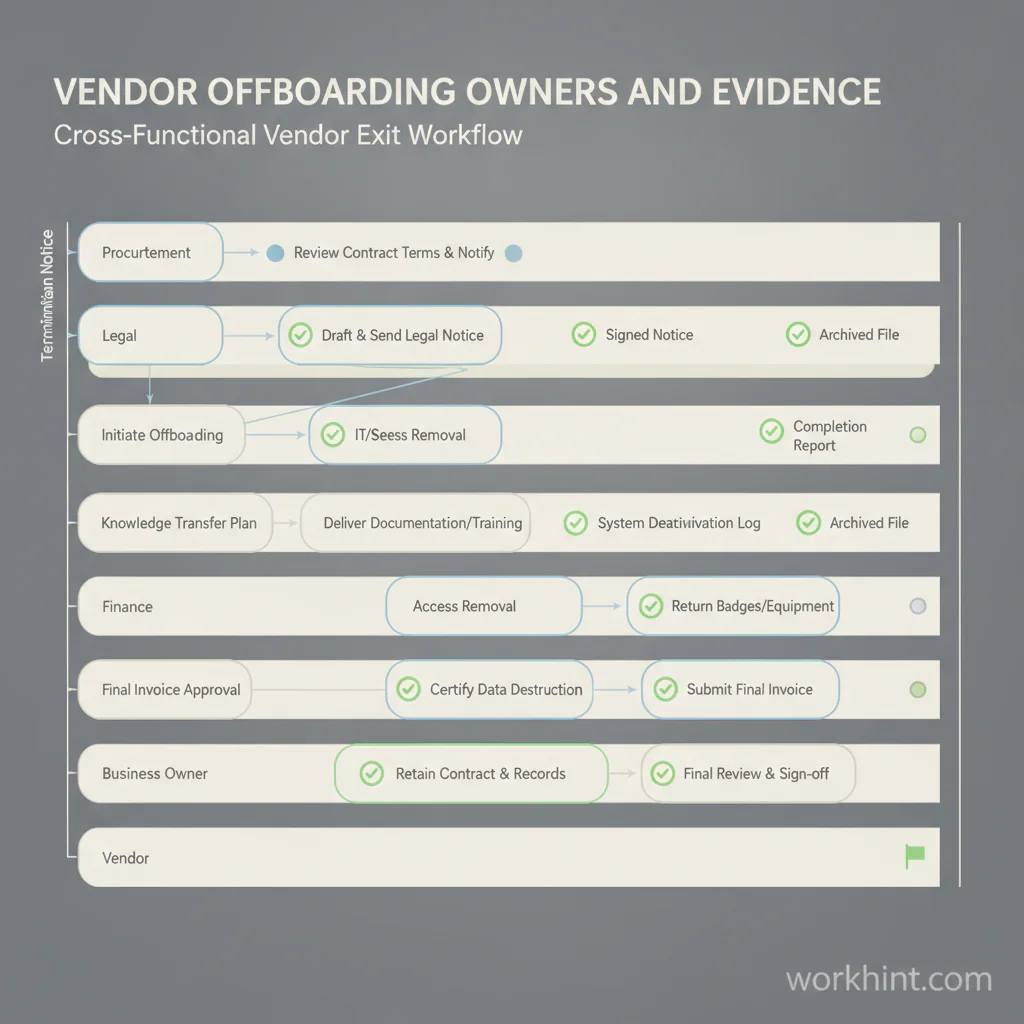
Vendor offboarding owners and evidence
| Offboarding area | Primary owner | Evidence to keep | Risk if missed |
|---|---|---|---|
| Termination notice | Procurement or legal | Notice, delivery confirmation, contract clause, effective date | Dispute over timing or rights |
| Knowledge transfer | Business owner | SOPs, open issue list, transition plan, handover notes | Service interruption or lost context |
| Access removal | IT or security | Account disablement logs, key rotation, integration removal | Unauthorized access after exit |
| Data return or deletion | Security, privacy, or legal | Data inventory, deletion confirmation, return record | Privacy, confidentiality, or audit exposure |
| Final invoices | Finance | Approved invoice, PO closure, credits, payment status | Overpayment, late payment, or unresolved dispute |
| Vendor record closure | Procurement operations | Status update, renewal cancellation, exception notes | Accidental renewal or future confusion |
How to run the offboarding workflow
Start with risk tiering. A low-risk vendor that never touched systems or sensitive data may only need contract closure, final payment, and record updates. A high-risk vendor with customer data, production access, regulated information, or customer-facing responsibilities needs legal, security, and continuity review.
Next, separate the exit into three dates: notice date, operational transition date, and final access removal date. Notice may happen before service ends. Transition may begin immediately. Access removal may happen after handover or at contract end. Document the reason for each date and avoid indefinite exceptions.
Then run offboarding through a shared checklist. Each owner should update one record with status, evidence, blockers, and approvals. If a task cannot be completed, record the exception and the owner accepting the risk, especially for access, data, final invoices, and transition support.
Finally, close the vendor record only when the company can answer four questions: did the contract end properly, can the business continue operating, is access removed, and can finance explain the final payment status?
Common vendor offboarding mistakes
The first mistake is treating vendor offboarding as a procurement-only task. Procurement may own the vendor record, but IT, finance, legal, privacy, security, and business teams usually own the risk. Bring them into the workflow early.
The second mistake is removing access before knowledge transfer is complete. That can break operations when the vendor manages configuration, accounts, reports, integrations, customer workflows, or specialized systems. Capture the handover first, then revoke access on a planned timeline.
The third mistake is accepting verbal closure. A manager saying “we are done with them” is not enough. Store the notice, invoice decision, access evidence, data confirmation, and any unresolved issues in a place future teams can find.
The fourth mistake is forgetting renewals and integrations. A vendor may be offboarded operationally but still have an auto-renewing contract, active API token, recurring billing profile, shared folder, or support contact in internal documentation.
Where Workhint fits
Workhint fits when vendor offboarding needs to become a repeatable operating workflow instead of scattered emails, tickets, spreadsheets, and reminders. A business can use Workhint to create a vendor exit intake form, assign owners by risk tier, route legal and finance approvals, track access-removal tasks, collect data deletion evidence, manage transition steps, and keep final payment status visible.
That is useful because vendor exits cross teams. Workhint helps the company connect the people, permissions, documents, tasks, approvals, reminders, and reporting around the exit. The goal is enough visibility that nothing sensitive, expensive, or operationally critical is left behind.
FAQ
What is vendor offboarding?
Vendor offboarding is the process of formally ending a vendor relationship while closing contract obligations, transitioning work, removing access, resolving data responsibilities, settling final invoices, and retaining proof that the process was completed.
Who should own vendor offboarding?
Procurement often coordinates vendor offboarding, but one business owner should be accountable for the outcome. Legal, IT, security, finance, privacy, and operational teams should own their specific tasks and evidence.
When should vendor access be removed?
Vendor access should be removed when it is no longer needed for transition or support. For sensitive systems, set a planned removal date, require written approval for exceptions, and keep evidence that accounts, credentials, keys, badges, and integrations were removed.
What should be included in vendor offboarding evidence?
Keep termination notices, delivery confirmation, contract review notes, handover materials, access-removal logs, data return or deletion confirmations, final invoice approvals, PO closure, stakeholder communications, and exception records.
Conclusion
A strong vendor offboarding checklist protects the business after the relationship ends. It gives procurement, IT, finance, legal, security, and business owners a shared way to close contracts, preserve continuity, remove access, resolve data obligations, and prove what happened. The best time to design that workflow is before the vendor exit becomes urgent.
Leave a Reply