


MSAs and SOWs work best when legal terms, project scope, approvals, and payment rules stay connected after signature.
MSA vs SOW is a common contract question because many vendor and contractor relationships need both documents. The master service agreement sets the relationship rules. The statement of work turns one piece of work into a concrete project with deliverables, timelines, owners, and payment triggers.
The mistake is treating the difference as only a legal detail. For business teams, the MSA and SOW decide how work gets approved, what counts as complete, who can request changes, and when invoices can be paid.
What’s in this article?
- The practical difference between an MSA and an SOW.
- When vendor and contractor teams should use one document or both.
- A decision table for what belongs in the MSA versus the SOW.
- A workflow for approvals, delivery, change control, and payment.
- Where Workhint fits when external work needs a live operating system.
Why MSA vs SOW matters
A master service agreement is usually designed to create the broad commercial and legal framework for an ongoing relationship. It may cover confidentiality, intellectual property, liability, payment mechanics, termination, data protection, insurance, and general responsibilities.
A statement of work is narrower. It defines a specific project, engagement, service package, milestone, or deliverable set. Contract management guidance from Icertis describes the MSA as the overall terms and the SOW as the detailed agreement for a specific project or service. That distinction matters because teams often reuse the same vendor for many different work requests.
If every project requires renegotiating the full relationship, work slows down. If every project runs under a vague agreement with no project-level SOW, the business loses control of scope, budget, timeline, and acceptance criteria.
A simple way to understand the difference
Think of the MSA as the rules of the relationship and the SOW as the work order. The MSA answers, “How do we work together in general?” The SOW answers, “What exactly are we doing this time?”
That is why an MSA can stay active across multiple SOWs. A software consultant might use separate SOWs for implementation, training, and support. A creative agency might use separate SOWs for a brand refresh, paid media campaign, and website project.
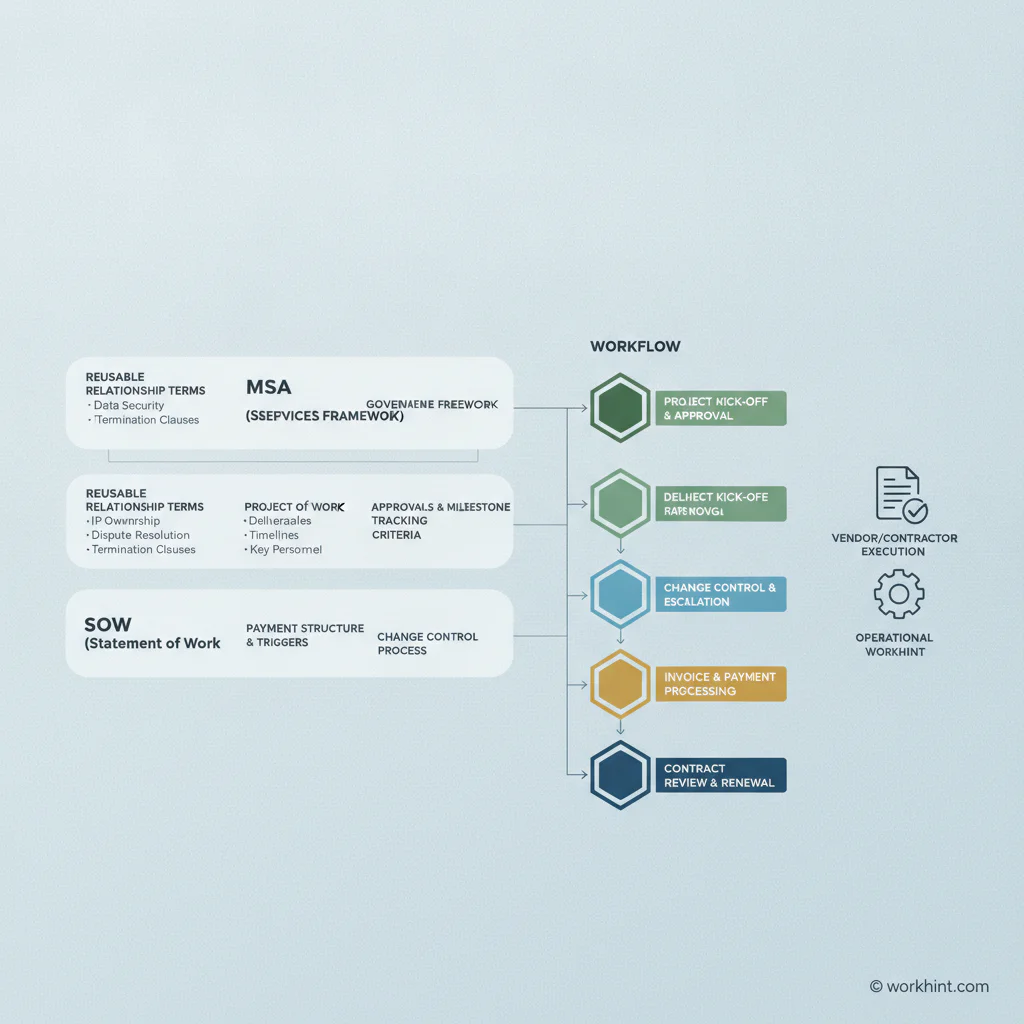
A practical MSA vs SOW decision table
| Decision area | Usually belongs in the MSA | Usually belongs in the SOW |
|---|---|---|
| Relationship terms | Confidentiality, IP ownership, liability, insurance, termination, dispute process. | Named project, service period, point of contact, project-specific assumptions. |
| Scope | General service categories the vendor or contractor may provide. | Exact deliverables, acceptance criteria, exclusions, dependencies, and timeline. |
| Pricing | Rate cards, standard payment terms, taxes, expense policy, invoicing method. | Project fee, milestone payments, approved budget, reimbursable expenses, billing cadence. |
| Approvals | Who can sign SOWs, approve changes, and terminate work. | Which business owner accepts deliverables and approves invoices for this project. |
| Change control | General rule that changes require written approval. | The actual change request, revised scope, new price, and updated delivery date. |
| Closeout | Record retention, confidentiality survival, final payment mechanics. | Final deliverables, handoff materials, access removal, final invoice approval. |
When to use an MSA, an SOW, or both
Use an MSA when the relationship may repeat, expand, or involve sensitive information. It gives legal, finance, procurement, and operations one reusable baseline.
Use an SOW when work needs project-level control. A good SOW should explain the outcome, deliverables, milestones, timeline, dependencies, review process, acceptance criteria, and payment trigger. Juro’s explanation of MSA vs SOW makes the same distinction: the MSA governs the broader relationship, while the SOW carries project-specific responsibilities and timelines.
Use both when the business expects multiple engagements under one relationship. This avoids renegotiating broad terms while keeping every project specific enough to manage.
The operating workflow after signature
The contract stack only works if the company operationalizes it. A signed MSA and SOW should trigger a workflow that starts before work begins and ends after closeout.
- Approve the business need. Confirm why external support is needed, the budget owner, and the expected outcome.
- Check the MSA. Confirm that the relationship terms are current, signed, and appropriate for the type of work.
- Create or approve the SOW. Define deliverables, timeline, rates, payment triggers, acceptance criteria, and exclusions.
- Set access and onboarding rules. Give the vendor or contractor only the systems, files, and context needed for the work.
- Track delivery evidence. Capture milestones, approvals, issues, and handoffs in one place instead of scattered messages.
- Route changes formally. Do not let extra work, new deadlines, or price changes happen through informal messages alone.
- Connect acceptance to payment. Invoice approval should reference the SOW, accepted deliverables, approved expenses, and payment terms.
- Close the engagement. Collect final files, remove access, settle invoices, preserve records, and decide whether another SOW is needed.
For service contracts, public procurement guidance often emphasizes performance outcomes and measurable standards. FAR Subpart 37.6 is specific to federal acquisition, but the operating lesson travels well: external work is easier to manage when expected results and assessment methods are clear before work starts.
Common mistakes to avoid
The first mistake is using an MSA as if it were the project plan. Broad legal terms do not tell a designer, consultant, agency, or contractor what to deliver by Friday.
The second mistake is letting each team invent its own SOW process. One department may require milestone acceptance, another may approve work through email, and another may skip change orders entirely.
The third mistake is burying operational ownership inside legal language. The workflow still needs to identify who reviews changes, checks budget, updates the timeline, and tells finance what changed.
Where Workhint fits
Workhint fits when MSA and SOW management needs to become a live workflow rather than a folder of signed files. A business can use Workhint to structure vendor or contractor intake, route MSA and SOW approvals, assign legal, finance, procurement, IT, and business owners, collect documents, manage access, track milestones, capture deliverable acceptance, route change requests, connect invoices to approved work, and keep closeout records visible.
That does not replace legal review. It makes the approved contract model operational, so the business can see approved relationships, active SOWs, payment-ready work, and missing approvals.
FAQ
What is the main difference between an MSA and an SOW?
An MSA sets the general relationship terms between two parties. An SOW defines the specific work, deliverables, timeline, responsibilities, and payment details for a particular project or engagement.
Can you have an SOW without an MSA?
Yes, but it depends on the risk and relationship. A small one-time project may use a standalone agreement or SOW with enough legal terms included. Repeat or higher-risk work usually benefits from an MSA plus separate SOWs.
Does the MSA override the SOW?
It depends on the order-of-precedence clause in the contract. Teams should ask legal counsel to define which document controls if the MSA and SOW conflict, especially for pricing, scope, IP, liability, or termination terms.
Who should approve an SOW?
Approval usually involves the business owner, finance or procurement, and legal when needed. IT, security, HR, or compliance may also review if the vendor or contractor needs system access, sensitive data, regulated work, or worker classification review.
How should SOW changes be handled?
Use a written change request that states the revised scope, timeline, cost, dependencies, and approver. Informal messages may help discuss the change, but the final approval should be recorded before the vendor or contractor performs the extra work.
Conclusion
The practical answer to MSA vs SOW is simple: use the MSA to govern the relationship and the SOW to govern the work. The stronger model connects both documents to intake, approvals, access, milestones, changes, invoices, and closeout. That is how businesses keep vendor and contractor work flexible without letting scope, payment, and accountability drift.
Leave a Reply