


You do not need a quick-lube shop to test demand for oil changes. You need bookings, technicians, compliance, and repeat customers.
A mobile oil change business is attractive because customers already need the service, but many would rather avoid driving to a shop, waiting in line, or coordinating maintenance across multiple vehicles. The opportunity is convenience.
This guide explains how to start a mobile oil change business with no staff using a platform-first model: customers request service, approved providers accept jobs, work is documented, payment is collected, and providers are paid.
What’s in this article?
- Why mobile oil changes can work as a local service business
- What you need before taking the first booking
- How to price services and get first customers
- How Workhint can become the operating platform
- A 7-day launch plan, checklist, and FAQ
Why this business works
Oil changes are recurring, predictable, and time-sensitive. Individual customers need them every few months, while small fleets need them repeatedly across vans, trucks, and employee vehicles. That creates a natural repeat-service model.
The strongest first market is usually not random consumers. It is local businesses with multiple vehicles: contractors, delivery companies, cleaning companies, property managers, rideshare drivers, landscapers, and small logistics operators. They value uptime more than a small discount.
Recent startup guides often put full mobile oil change launch costs in the low five figures. A platform-first model lets you validate demand with qualified providers before buying branded vehicles and inventory.
What you need to launch
The first version should be narrow: one launch market, one or two oil change packages, defined service areas, and clear provider standards. Do not try to become a full mobile mechanic company on day one.
You still need business formation, insurance, safe used-oil handling, and local compliance checks. Rules vary, so confirm requirements with local regulators, an insurance broker, and a certified used-oil hauler before taking paid jobs.
| Launch item | Lean approach | Estimated range |
|---|---|---|
| Business setup | LLC or local registration, EIN, basic bookkeeping | $200 to $800 |
| Insurance | General liability, commercial auto review, garagekeepers coverage if applicable | $1,000 to $4,000+ |
| Platform and booking flow | Branded customer portal, intake, scheduling, payment, provider payout | $0 to $1,500 to start |
| Provider onboarding | Background checks, requirements, service checklist, disposal rules | $100 to $700 |
| Initial supplies | Only what is needed for first jobs if providers do not supply materials | $300 to $2,000 |
| Marketing | Local landing page, outreach list, flyers for fleet-heavy areas | $200 to $1,000 |
| Owned vehicle and equipment | Delay until demand is proven or use provider-owned equipment first | $0 now, $10,000+ later |
How to price it
Pricing must cover oil, filters, travel time, labor, disposal, payment fees, insurance, customer support, and provider payout. A mobile oil change is not just the oil change. It is convenience delivered at the customer’s location.
Start with simple packages. Keep add-ons limited until the operation is stable. Fleet pricing can be lower per vehicle when several vehicles are serviced in the same location because travel time is spread across more jobs.
| Offer | Example price | Best fit |
|---|---|---|
| Standard mobile oil change | $89 to $129 | Individual drivers and simple vehicles |
| Full synthetic service | $119 to $179 | Newer cars, SUVs, and higher-mileage customers |
| Fleet visit | $75 to $125 per vehicle | Three or more vehicles at one location |
| Inspection add-on | $20 to $50 | Tire pressure, fluids, lights, and basic checklist |
| After-hours convenience fee | $25 to $75 | Evening, weekend, or urgent service windows |
How to get first customers
Start where the pain is obvious. A plumbing company with eight vans loses money when drivers wait at a shop. A property manager may need several vehicles serviced without disrupting the day. A rideshare driver values weekend availability.
Build a list of 100 local targets with vehicles. Call or email the owner, operations manager, or office manager with a simple offer: on-site oil changes for multiple vehicles, scheduled around their workday, with digital service records and one invoice.
How Workhint helps launch it
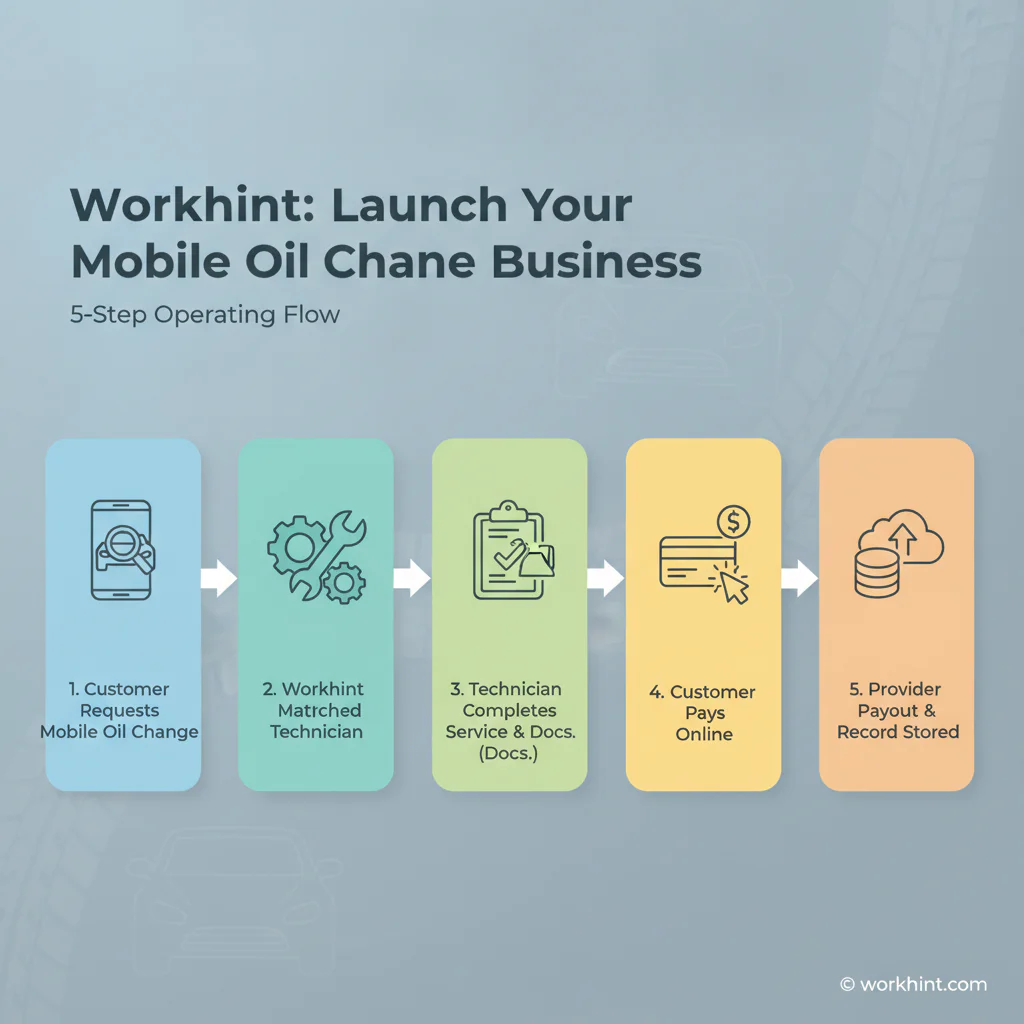
Workhint can become the branded operating platform for a mobile oil change business before the founder buys a van or hires technicians. The founder can launch a customer portal under the business name where customers request service, enter vehicle details, choose a package, select a time window, and approve pricing.
Behind that portal, Workhint can route requests to approved independent technicians by location, availability, qualifications, and service type. Providers receive job details, follow a mobile checklist, upload completion notes, document disposal steps, and close the job.
Customers receive updates, approve add-ons, pay online, and keep service records. The founder manages onboarding, schedules, quotes, invoices, reviews, reporting, and contractor payouts from one system.
First 7-day launch plan
- Day 1: Choose one market, one customer type, and two service packages. Avoid full mobile mechanic work at launch.
- Day 2: Set up the branded Workhint platform basics: request form, customer portal, service area, and admin dashboard.
- Day 3: Build the quote, scheduling, payment, completion checklist, disposal, and payout flow.
- Day 4: Recruit the first qualified independent providers and verify insurance, tools, experience, and compliance requirements.
- Day 5: Contact fleet-heavy businesses, office parks, apartment communities, and local operators with multiple vehicles.
- Day 6: Route interested customers through the platform, test booking windows, and confirm provider availability.
- Day 7: Review demand, margins, job quality, and compliance gaps before buying vehicles.
Final launch checklist
- Choose the launch city and target customer segment
- Create two simple oil change packages
- Confirm local business, insurance, tax, and used-oil requirements
- Set up a certified used-oil disposal process
- Build the branded customer request and payment flow
- Create provider onboarding, service checklist, and payout rules
- Recruit qualified independent mobile technicians
- Contact the first 100 fleet or repeat-service prospects
- Complete first jobs through the platform and review margins before buying vehicles
FAQ
How much does it cost to start a mobile oil change business?
A traditional launch with a van, equipment, inventory, insurance, and branding can reach the low five figures. A platform-first launch can cost less upfront when providers already have equipment.
Do I need a license to start a mobile oil change business?
You usually need standard business registration and may need local permits, sales tax setup, environmental compliance, and used-oil handling approvals. Requirements vary by location, so verify before taking paid jobs.
Can I start without employees?
Yes, if you structure the business as a branded platform with independent qualified providers. Use written agreements, clear standards, proper insurance guidance, and local labor compliance review.
What should I charge for mobile oil changes?
Many lean operators test packages around $89 to $179 depending on oil type, vehicle, travel, and convenience. Fleet visits may use lower per-vehicle pricing when multiple vehicles are serviced at one location.
Who are the best first customers?
Small fleets are often better than one-off consumer jobs. Contractors, delivery teams, rideshare drivers, property managers, and local service companies have recurring maintenance needs and clearer convenience value.
What expenses should I avoid at first?
Avoid multiple vehicles, deep inventory, a shop lease, fleet wraps, or employees before demand is proven. Invest first in compliance, provider quality, scheduling, payments, and customer acquisition.
Conclusion
A mobile oil change business can start as a lean service platform, not a capital-heavy auto shop. Validate demand, recruit qualified providers, build a reliable operating process, and let booking volume guide larger investments.
Workhint helps make that possible by giving the business a branded customer platform, provider network, scheduling workflow, payment flow, service documentation, and reporting system from the start.
Leave a Reply