


Use this checklist to find outdated, unclear, or ignored SOPs before they turn into operational risk.
A standard operating procedure audit checklist helps a business test whether its SOPs are accurate, usable, current, and actually followed. The audit asks whether the documented procedure still matches the way work happens, whether employees can perform the task, and whether the business has evidence that the procedure is being used.
This resource is written for operations leaders, HR teams, compliance managers, quality owners, and department heads that need repeatable work to stay consistent. It is not a substitute for industry-specific regulatory review. If your SOPs support regulated work, use it alongside the standards that apply to your business.
What is included
- A practical SOP audit checklist you can copy into a document, spreadsheet, or workflow system.
- A scoring model for identifying which procedures need revision first.
- An evidence table for assigning owners and follow-up actions.
- A simple example showing how to audit one business SOP.
- Common mistakes that make SOP audits performative instead of useful.
How to use this standard operating procedure audit checklist
Start with one SOP or one operating area. Pick a process that is repeated often, creates customer impact, involves risk, or depends on handoffs. Good candidates include customer onboarding, vendor approval, invoice review, access requests, incident response, employee onboarding, field service, or quality checks.
Review the SOP in three ways: read the document, observe the process, and interview the people who perform or approve the work. The Brown University SOP template reinforces a useful baseline: an SOP should describe process steps, not bury the user in unrelated background. The audit should test that same discipline.
For formal quality programs, align your audit process with the standard your organization follows. ASQ describes quality audits as systematic, independent reviews that determine whether activities and results comply with planned arrangements. That framing matters even for non-regulated teams: an SOP audit should compare intended process, actual process, and evidence of completion.
Standard Operating Procedure Audit Checklist Template
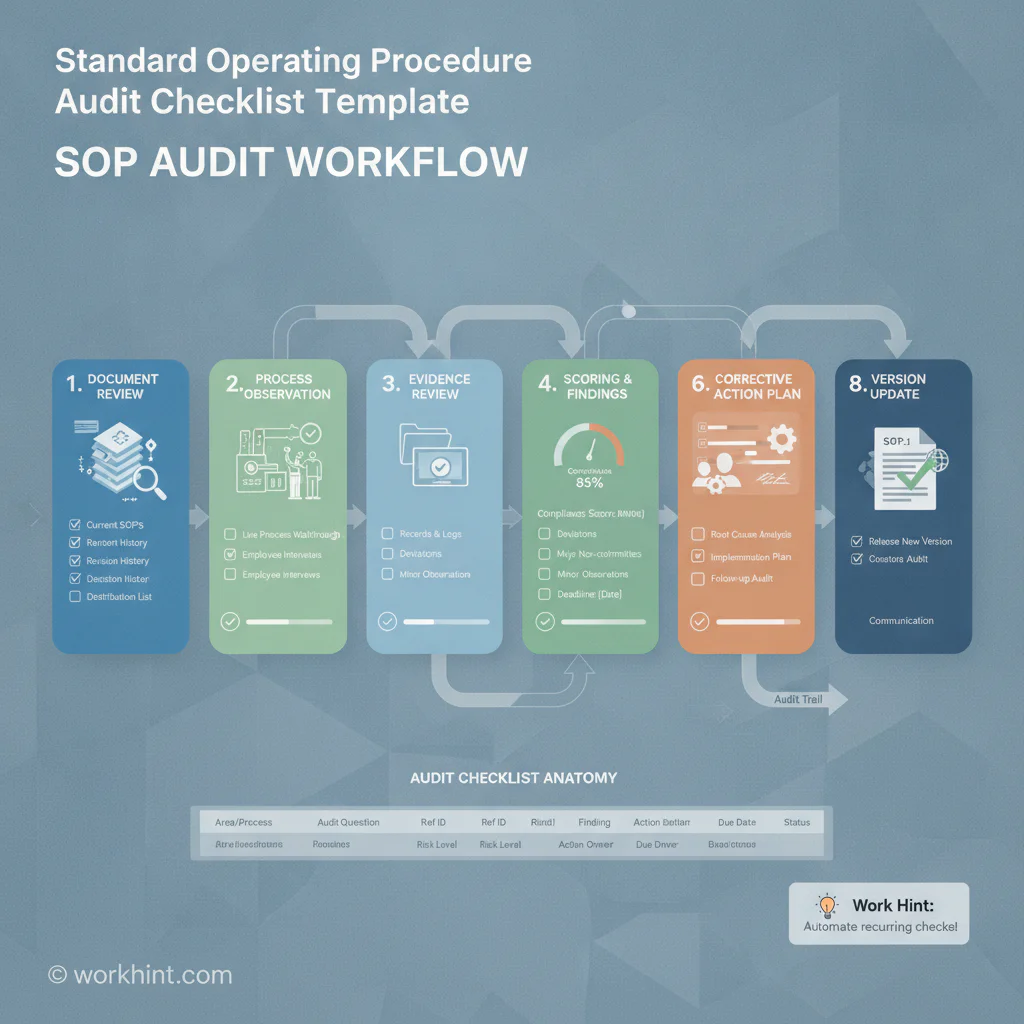
Copy the checklist below and customize the scoring scale for your business. A simple score works well: 0 means missing or unusable, 1 means partially adequate, and 2 means complete and usable.
| Audit area | Question to answer | Evidence to review | Score |
|---|---|---|---|
| Purpose | Does the SOP clearly explain what process it controls and why it matters? | Purpose statement, business outcome, risk or quality reason | 0 / 1 / 2 |
| Scope | Does it define where the procedure starts, ends, and does not apply? | Scope notes, exclusions, process boundaries | 0 / 1 / 2 |
| Roles | Are owners, performers, approvers, and escalation contacts named by role? | Role table, approval map, escalation path | 0 / 1 / 2 |
| Inputs | Are required requests, forms, files, permissions, or data defined before work starts? | Intake form, required fields, source systems | 0 / 1 / 2 |
| Procedure steps | Can someone follow the steps in sequence without guessing? | Step list, screenshots, system names, handoff points | 0 / 1 / 2 |
| Decision rules | Does the SOP explain what to do when a condition changes? | Decision criteria, exception rules, approval thresholds | 0 / 1 / 2 |
| Controls | Are required reviews, approvals, safety checks, or quality gates clear? | Approval records, QA checklist, control evidence | 0 / 1 / 2 |
| Records | Does the SOP say what evidence must be retained and where? | Logs, completed forms, files, audit trail, retention location | 0 / 1 / 2 |
| Version control | Is the owner, review date, change history, and current version visible? | Revision history, approval date, next review date | 0 / 1 / 2 |
| Actual use | Do employees follow the SOP in real work, or have informal shortcuts replaced it? | Observation, interviews, system records, exception examples | 0 / 1 / 2 |
How to score and prioritize SOP fixes
After scoring each area, separate cosmetic edits from operating risks. Missing approval criteria, unclear ownership, outdated system instructions, absent evidence, or employees bypassing the procedure can create real exposure. The ISO 9001 quality management standard is built around documented information, process control, and continual improvement. Even without certification, the principle is useful: documentation should help the organization run and improve the process.
Use this priority model:
- High priority: the SOP is missing, outdated, not followed, or lacks required controls for risky work.
- Medium priority: the SOP works, but roles, steps, evidence, or exceptions are unclear.
- Low priority: the SOP is usable, but needs formatting, examples, links, or minor updates.
Assign one accountable owner for every fix. If an audit produces findings without owners and deadlines, it becomes a documentation exercise instead of an improvement process.
Example SOP audit record
| Finding | Risk | Owner | Fix | Due date |
|---|---|---|---|---|
| Approval thresholds are not defined for expenses above $5,000. | Managers may approve spend without finance review. | Finance lead | Add threshold table and executive approval rule. | August 5 |
| The SOP refers to an old accounts payable inbox. | Invoices may be sent to the wrong queue. | AP manager | Replace inbox, update screenshots, notify teams. | July 29 |
| Exceptions are handled in chat but not logged. | Audit trail is incomplete when payment questions arise. | Operations manager | Create exception field and require resolution notes. | August 2 |
Common mistakes
The first mistake is reviewing the document without watching the work. A polished SOP can still be wrong if the process has changed. The second mistake is treating all gaps equally. Prioritize gaps that affect approvals, quality, customer commitments, compliance, safety, access, money, or handoffs.
The third mistake is making the SOP owner the only reviewer. The people who perform the process usually know where the written steps are unclear. The fourth mistake is skipping the final control: after revision, confirm that the updated version is communicated, accessible, and connected to the tools where work happens. HHS project communication templates are a reminder that changes need defined audiences, channels, and timing, not just an updated file.
Where Workhint fits
Workhint helps teams turn an SOP audit checklist into a live improvement workflow. A team can capture each finding, assign an owner, set a due date, route approval for procedures, collect evidence, notify affected roles, and keep open gaps visible until closed. That matters when SOPs involve HR, finance, operations, IT, vendors, contractors, field teams, or customer-facing work. For teams turning repeatable resources into operating processes, workflow automation software can connect intake, routing, approvals, handoffs, reminders, and status tracking.
The checklist remains useful on its own. Workhint becomes relevant when SOP audits need to move beyond a spreadsheet into tracked ownership, approvals, reminders, version review, exception handling, and reporting.
FAQ
What is an SOP audit checklist?
An SOP audit checklist is a structured set of questions used to evaluate whether a standard operating procedure is accurate, complete, current, controlled, and followed in real work.
How often should SOPs be audited?
Review critical SOPs at least annually, and sooner when the process, owner, tool, regulation, customer requirement, or risk profile changes. High-risk procedures may need quarterly or event-triggered reviews.
Who should audit standard operating procedures?
The audit should usually involve the process owner, someone who performs the work, and an independent reviewer from operations, quality, HR, compliance, finance, or another relevant function. The right mix depends on the risk of the process.
What should be checked during an SOP audit?
Check purpose, scope, owners, inputs, steps, decision rules, approvals, records, version control, accessibility, training, and evidence that the SOP is being followed. Also look for informal workarounds.
What happens after an SOP audit?
Document findings, prioritize risks, assign owners, update the SOP, approve changes, communicate the new version, archive the old version, and verify that the revised process is being used.
Conclusion
A standard operating procedure audit checklist is valuable because it tests whether documented work still matches real work. Use it to find unclear steps, missing controls, outdated instructions, weak evidence, and procedures people no longer follow. The best audit does not end with a score. It ends with assigned fixes, updated procedures, and a process the business can trust.
Leave a Reply